
Slowly submerging in Tooradin
The coastal village of Tooradin is located on the shores of Westernport Bay, Victoria, Australia.
Since I live fairly close to Tooradin I often pick up a hot pie and a cappuccino from the wonderful bakery here and drive down to the jetty area for a relaxing break.
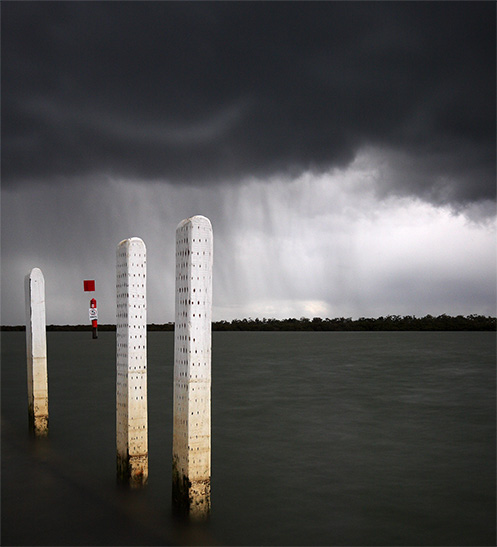
Tooradin has two jetties right next to each other. One jetty is of a floating pontoon design which rides on the surface of the water, rising and falling as the tides change. The other jetty is the usual kind consisting of a raised platform fixed to sturdy wooden pillars.
An interesting thing about the fixed platform jetty is that the platform gradually disappears below the surface of the water as the tide rises. This provides the photographer with some interesting possibilities.
Below – the rising tide starts to envelope the platform.

Standing on this jetty makes one feel like a captain going down with his ship.
Below – “Channel” which is available to purchase as a print here.
The platform is just a few centimeters below the surface.

After taking a few long exposures at the jetty mother nature decided to give me a nudge. The thick black storm clouds opened up and sent down a barrage of hail to chase me back to the car.
Below – Run from the Hail
The Jetties of Portsea and Sorrento
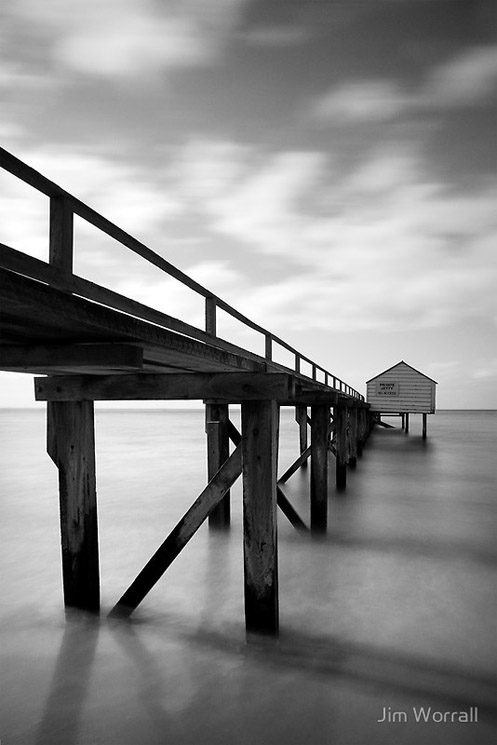
Portsea and Sorrento are coastal villages located at the tip of the Mornington Peninsula, south east of Melbourne. They both share a wild and woolly ocean beach to the south and the much calmer waters of Port Phillip Bay to the north. As a photography enthusiast I enjoy the contrast between the ocean and bay sides of the peninsula.
In winter and early spring you can stand on the ocean beach and not see another soul, a prospect I find very attractive. The only problem is that the wild and woolly conditions that keep the crowds away also make photography difficult. A photographer here has to contend with the difficulties of high winds and sea spray, not impossible I know but very annoying when combined with the low temperatures of winter.
For this reason I’ve found myself gravitating towards the calmer bayside beaches on my last couple of trips down that way.
Below – “34 Steps” which is available to purchase as a print here.

I’ve recently been trying to consciously simplify my images by attempting to exclude as many distracting elements as possible. Whilst shooting on the bayside beaches this has been fairly easy to achieve by using long exposures to reduce the detail in the water and sky. Another benefit of the long exposures is that birds and boats can move through the frame without even appearing in the finished exposure. I used a combination of an ND400 and an ND8 filter giving me about 12 stops of darkness to make the exposures up to 30 seconds long for these images.
Below – “The Danger of Diving”, Portsea beach, which is available to purchase as a print here.

Portsea and Sorrento bayside beaches feature a wonderful collection of public and private jetties.
Below – “Outbound”, Sorrento beach, which is available to purchase as a print here.
Despite being technically over exposed I like the drama this high key image presents.
I like the way the sea and the sky are almost one. A personal favorite.

Below – “Nature versus Nurture”, Portsea beach, which is available to purchase as a print here.

Below – “Boomerang”, Portsea beach, which is available to purchase as a print here.

Below – “Civilization meets the Sea”, Portsea beach, is available to purchase as a print here.

Below – “The Trappings of Wealth”, Sorrento beach, is available to purchase as a print here.
Visiting the Silky Lady – Hopetoun Falls
The Hopetoun Falls is a popular tourist attraction located in the Otway Ranges in Victoria, Australia.
Pictured below – A View to the Falls – Just a short distance from the car park, visitors are treated to a tempting glimpse of the falls from above through a gap in the lush forest greenery.

A short picturesque walk down a path through the forest gives access to the base of the falls. Upon arrival at the base it’s very easy to imagine that you’d somehow been transported into a fairytale. It’s a dream location for photographers and indeed it’s difficult to take a bad shot here.
Below – The Silky Lady

Below – Peeking at the Silky Lady

Below – In the Land of Fairytales

The Beauty of Polly McQuinn’s Weir, Strathbogie.
The picturesque Polly McQuinn’s Weir is well sign posted and located a few kilometers south-west of Strathbogie, Victoria, Australia.
The weir features a spillway where water streams over a concrete wall and onto large exposed granite boulders.
The water then continues snaking around more boulders before flowing under a road bridge then traversing a gently sloped granite plateau before reaching a deep pool surrounded by native vegetation.
There are many opportunities here for the keen photographer.
Below – A long exposure of water cascading over the spillway wall and onto granite boulders beneath.
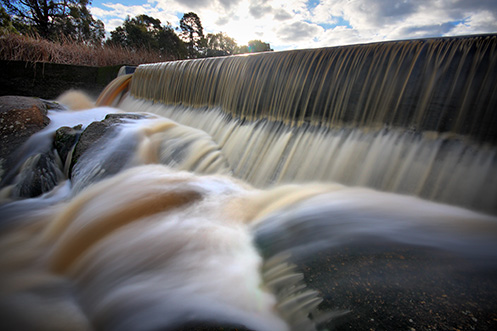
Below – Looking back towards the spillway wall, water flows rapidly over and around granite boulders on it’s way downstream.

Below – In the days preceding my visit to the weir the area had received heavy rainfall.
I suspect this caused lot of the brown silt present in the water. This caused an interesting effect in the water with the deeper sections of the flow taking on a brownish tinge and the shallow sections appearing bluish during long exposure shots.

Below – The view from the bottom of the spillway looking downstream.
The silted water runs rapidly under the road bridge.
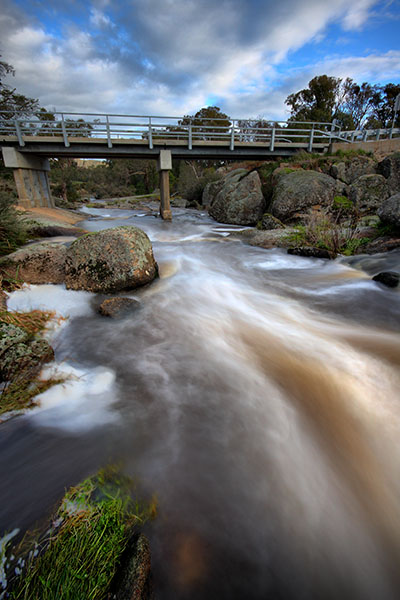
Below – “Polly’s Overflow” – Looking upstream from the pool, the water traverses a gentle granite plateau then strikes some foreground boulders whipping the water into a frenzy before it finally enters the tranquility of the pool. This image is available to buy as a print at my Zazzle and RedBubble sites.
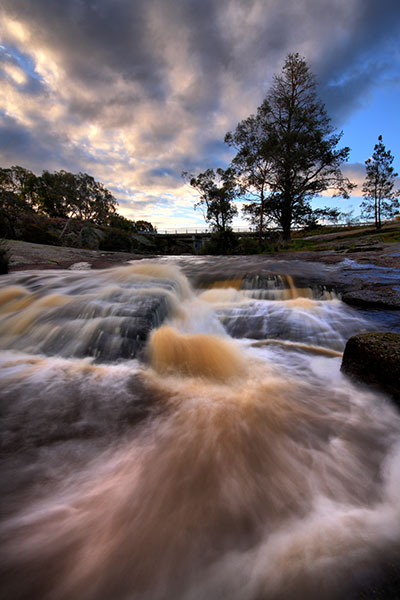
Below – “In Search of Polly”
Apparently the weir was named after a young woman called Polly McQuinn who drowned here more than 100 years ago. Legend has it that the ghost of Polly can sometimes be heard calling for help from passer by.
Unfortunately I didn’t hear Polly on the day I was here.
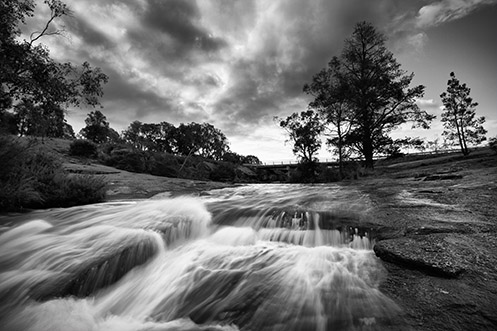
West – along the coast
Following is a short series of seascape images taken on a recent trip along the Victorian/South Australian coastline.
Below – The Great Ocean Road – just south of Lorne, Victoria, Australia.
Notice the skid marks on the road at the bend, …this road is a popular tourist route attracting visitors from all over the world.
Some of these visitors unfortunately forget that we drive on the left side of the road in Australia. This causes all sorts of drama.
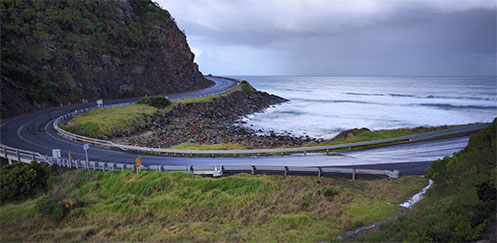
Below – Along the Edge – A view of the incoming storm from the lookout at Glenaire, Victoria, Australia.

Below – Bay of Martyrs – A long exposure image from down on the beach at the Bay of Martyrs, on the Great Ocean Road, Victoria, Australia. I was attracted by the unusual shapes that the ocean had managed to create with the foreground rocks here.

Below – Storm at Port Campbell Pier – a long exposure image made during a stormy morning at Port Campbell pier. This pier really has quite a hard life being continually hammered by waves from the open ocean.
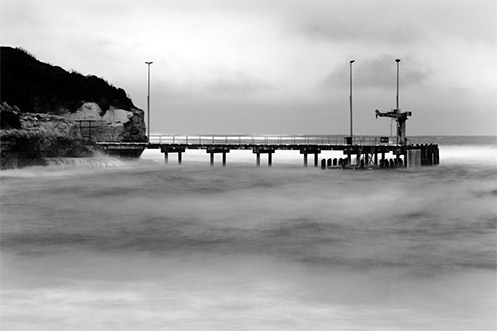
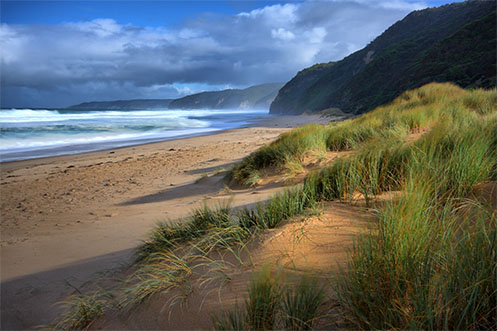
Below – Johanna’s Morn – The morning sun starts to warm the sands of Johanna beach, Victoria, Australia.
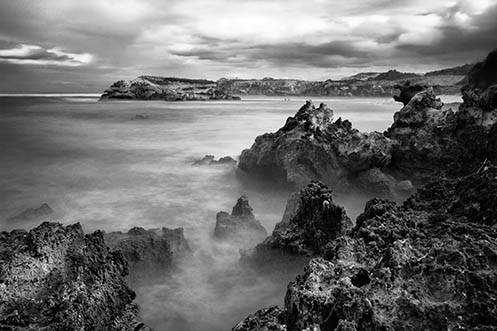
Below – Her Deceptive Charm – A long exposure image from Cape Northumberland in South Australia.
The waves were really ripping into the rocks here, …….although the image looks deceptively calm due to the long exposure time.
Below – At Ocean’s Edge – On the beach at Cape Northumberland, South Australia.

Abandoned, dilapidated, derelict, decayed and once loved.
Following is a collection of farmhouse images taken on a trip through western Victoria and South Australia.
Initially I intended to take a lot of seascape images on this trip but the rain and sheer cliffs along the Great Ocean Road often conspired against me.
As the journey progressed I found myself becoming more interested in the landscape including the many vacant derelict buildings scattered along the way.
Below – “Shambles” – A deserted farmhouse at Byaduk North, Victoria, Australia.
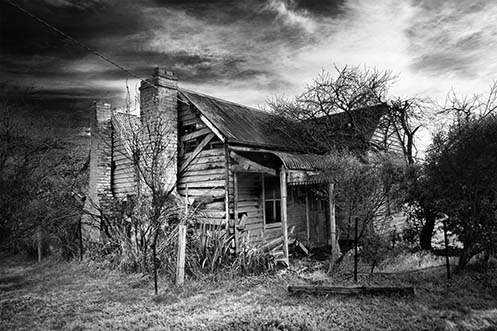
Below – “Out the Back” Byaduk North, Victoria, Australia.

Below – “The Love Shack” – Found along the road north of Port Fairy, Victoria, Australia.
There is also a colour version of the Love Shack here.
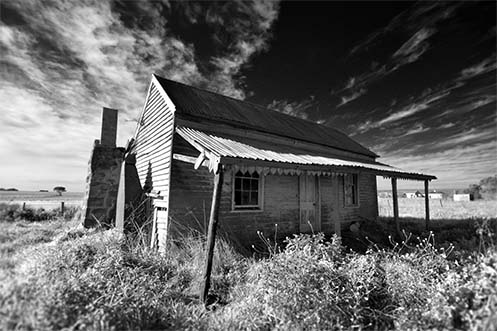
Below – “Spiders n’ Snakes” – an abandoned house along the roadside in Puralka, Victoria, Australia.

Below – “Cottage in the Vineyard” Padthaway Heritage Cottage (Front) near Bordertown, South Australia.

Below – “Backdoor to the Vineyard” Padthaway Heritage Cottage (Rear) overlooking the vineyard, near Bordertown, South Australia.
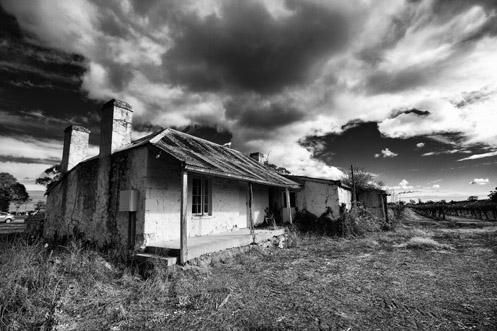
Strolling at Seaford beach with the LX3
This morning I dropped my car off for a service.
With the knowledge that I’d have a couple of hours to kill I took along the Panasonic LX3 to see what I could find. After a leisurely breakfast at the local cafe I strolled down to the beach at Seaford and gave the LX3 a bit of a run in “Dynamic B&W” mode.
This little camera never fails to amaze me. Of course the image quality is not as good as a DSLR but to me the quality is certainly quite acceptable. I just love the LX3 for portability when I don’t want to lug around the DSLR and lenses.
Below – K-Nine. (paw prints in the sand)
Note that the background is blurred because the shot was taken at f2.0.

Below – Observer. (bench at the end of the pier)
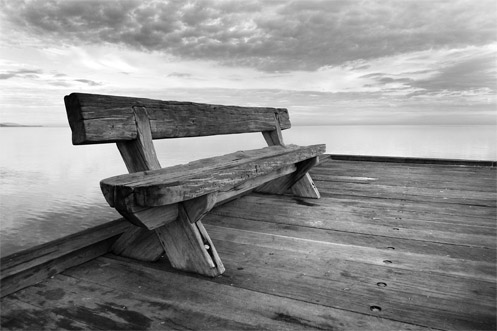
Below – Gull.
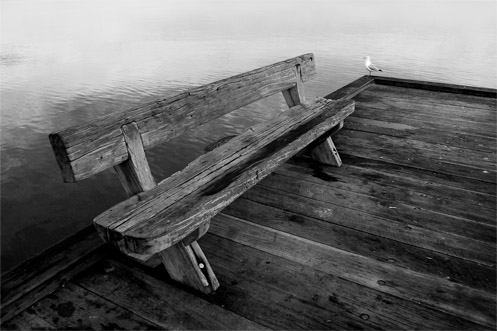
Below – Last Man Over.

The House of Pills – Bacchus Marsh
One of the tourist attractions at Bacchus Marsh is the old Chicory Kiln.
The kiln was constructed in 1885 and was used to roast chicory roots which were then ground and used as a coffee additive.
The front face of the kiln features a defaced advertisement for “Dr.Morse’s Indian Root Pills”, a product which was claimed by the manufacturer to contain ingredients which would “cleanse the blood”.
Cleansing the blood was apparently thought to be a good thing at the time as “impurity of the blood” was considered to be the cause of all disease. (Wiki)
Below – House of Pills

Below – Perspective 81 the elevated door on the chicory kiln.

Down amongst the Mangroves, Westernport Bay.
You certainly have to admire the hardiness of the Mangrove tree.
It thrives in poor quality soil in tidal areas, and twice a day has it’s roots submerged in salty sea water. Under storm conditions the Mangrove is battered by both wind and waves yet it still manages to hold firmly.
The Mangrove tree is also an interesting subject from a photographer’s perspective. At high tide with the roots submerged it’s fairly easy to photographically isolate the subject from it’s surroundings by using a long exposure time to smooth any waves around it’s base and blur any clouds in the sky.
Below – TimeKeeper
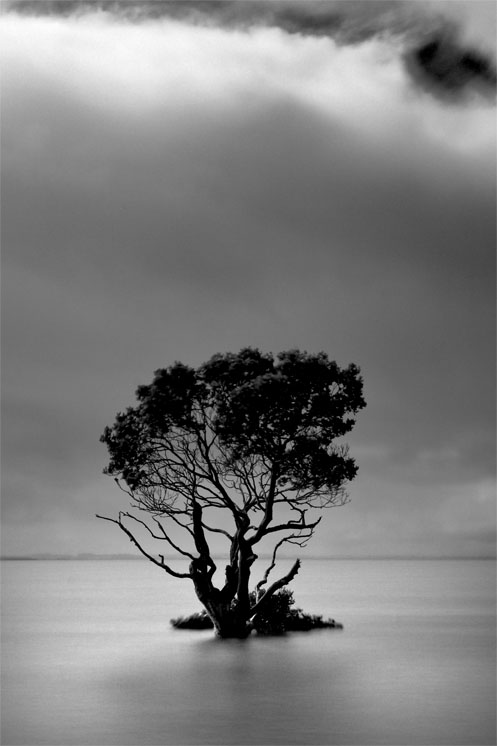
Below – The Risen

Below – Approaching the Forest

At low tide the Mangrove tree has it’s roots exposed creating potentially a new subject of interest for the photographer. The long roots are often intertwined with each other giving the impression of writhing serpents (perhaps that’s just my imagination running wild).
Below – The Serpent Tree
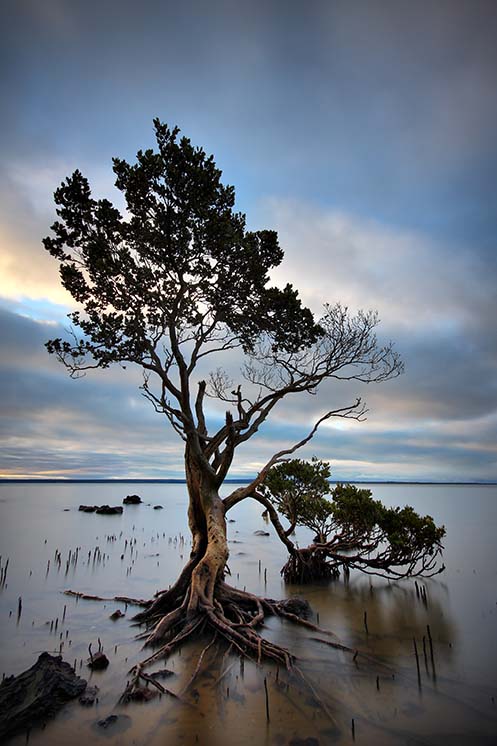
Below – Wild n’ Woolly a long exposure with the roots exposed and the leaves thrashing around in the wind.
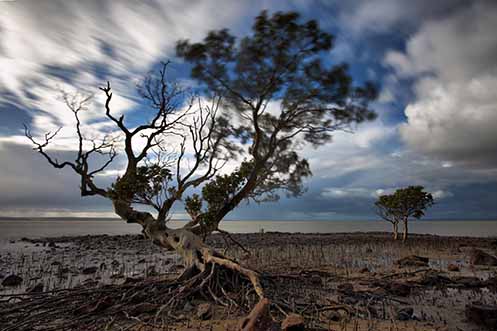
Below – On Borrowed Time the same tree as above but at high tide.

Trestle Bridge Encounters.
Whilst on a recent photography tour of eastern Victoria I encountered a couple of old wooden trestle railway bridges, …….and who can resist a good bridge!

The Stony Creek trestle bridge (pictured above) is located at Nowa Nowa in Victoria’s south east.
Apparently this is the largest standing bridge of it’s kind in Victoria, measuring 247 meters long and standing 20 meters high. The bridge was made in 1916 and remained in service for over 60 years until it was damaged by bushfire in 1980.
– – – – – – – – – – – – – – – – – – – – – – – – – – – –
The two images below were taken at the trestle bridge in Mt Lawson state park, in Victoria’s north east.
The high timber bridge which was built around 1915 spans Boggy Creek and formed part of the now disused Wodonga – Cudgewa railway line.
The view from above –

The view from below –

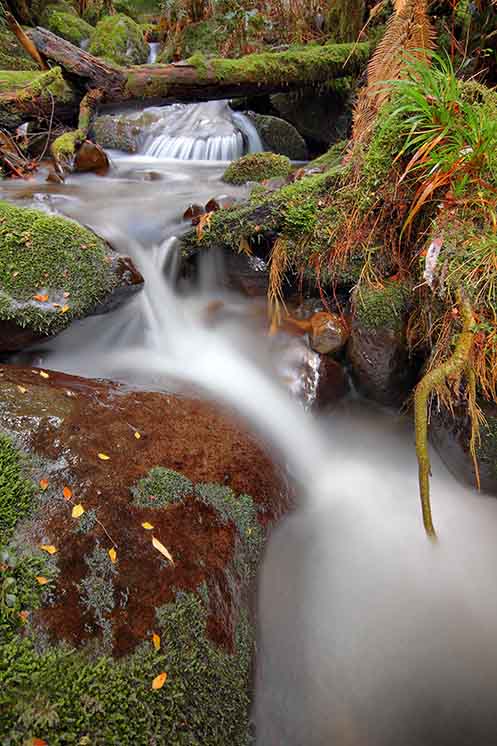
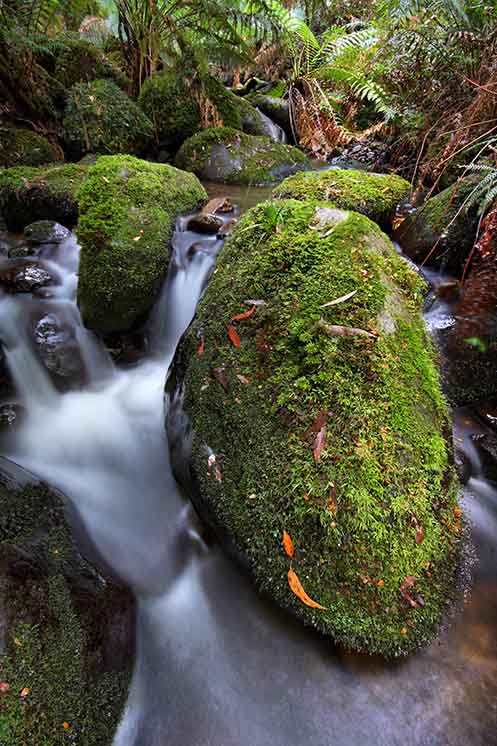
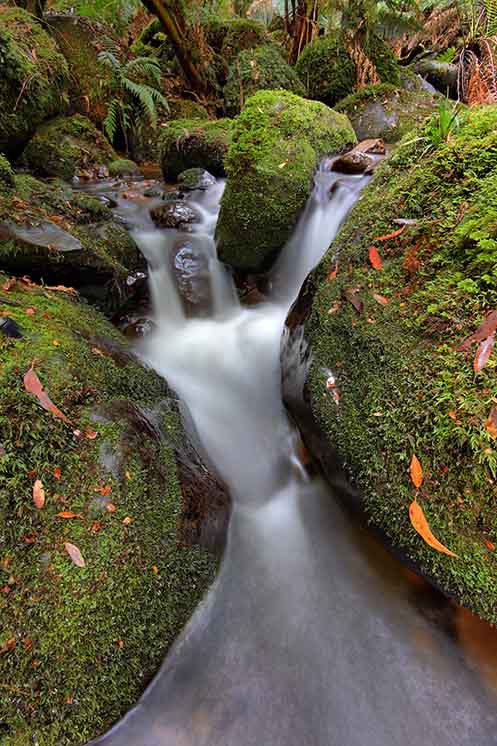
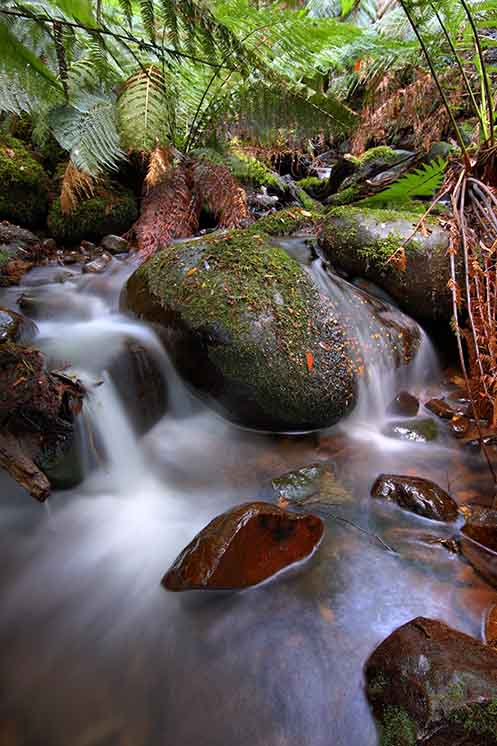
Exploring Cement Creek
It seems to me that Cement Creek was dealt an injustice when it was first named.
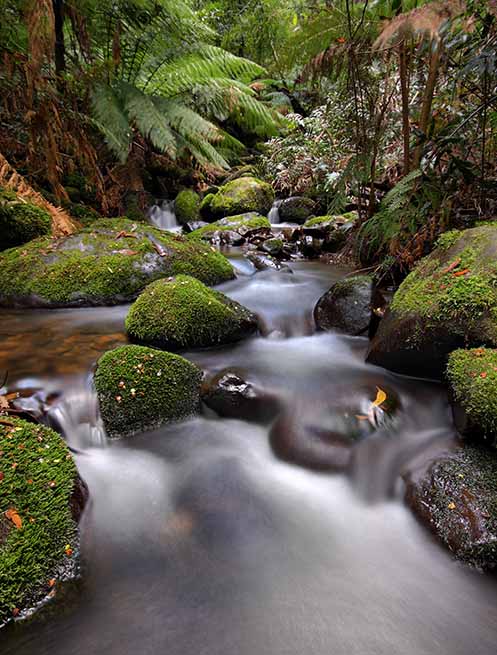
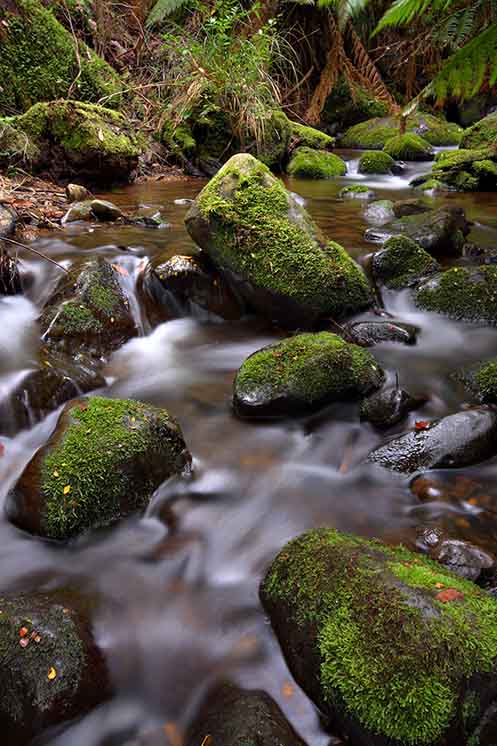
Despite it’s odd name, it really is quite an attractive location and a fine example of lush Victorian forest.
Cement Creek in located at the foot of Mount Donna Buang, near the intersection of Donna Buang Rd and Acheron Way.
On this excursion we gained access to the creek by walking along raised platforms which got us most of the way, then we jumped the handrail into the forest to get to the flowing water. At this location you need to be prepared to get muddy and wet, so it’s advisable to keep a change of clothes in the boot of your car.
The main hazard here is the slippery moss covered rocks. A minor hazard is the hungry leeches.
Incorporating HDR tonemapping techniques with long exposures
The following images were experiments using HDR tone mapping techniques combined with the effects of long exposure times.
Each image was constructed from at least 3 separate exposures using in-camera auto exposure bracketing. In my case, being a Canon shooter, I used 3 exposures of -2,0 and +2 simply for convenience. I believe Nikon shooters have a bit more flexibility in this area.
The images were all taken during daylight hours so it was necessary to use some heavy ND filtering in order to increase the exposure times and achieve a nice misty look to the water. In my case I used an ND400 and an ND8 filter stacked together to achieve this.
With the camera set to aperture priority mode I adjusted the aperture and filter combination (sometimes removing the ND8) to achieve an exposure of 8 seconds. When the shutter button is depressed the camera would then give me 3 exposures at 8 seconds, 2 seconds and 30 seconds (which is close enough to 0,-2 and +2). My particular camera doesn’t let me expose for longer than 30 seconds unless I go to bulb mode and use a remote timer, so out of laziness I tend to limit many of my exposures to 30 seconds. 🙂
The exposures were then combined and tonemapped using HDR software and tweaked in Photoshop to achieve the end result.
Despite all of this sounding a bit technical it’s really quite simple and I encourage you to try it. The results are often very rewarding.
BELOW – Jurassic Afternoon – Sunlight and waves break through a slit in the prehistoric Pinnacles rock formation on Phillip Island.

BELOW – The Mist of St.Pauls – A long exposure at St. Pauls beach, Sorrento, Victoria, Australia.

BELOW – Prehistoria – An image from The Pinnacles, at Phillip Island, Victoria, Australia.

BELOW – Swimming with Dinosaurs – Down amongst the prehistoric Pinnacles rock formations at Phillip Island, Victoria, Australia.

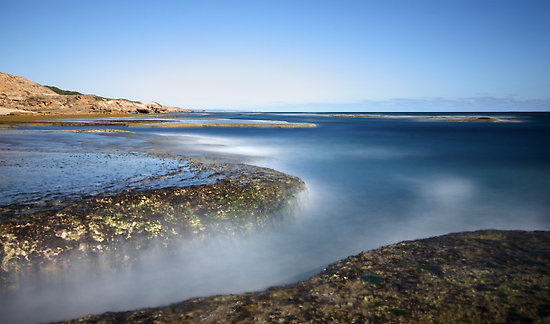
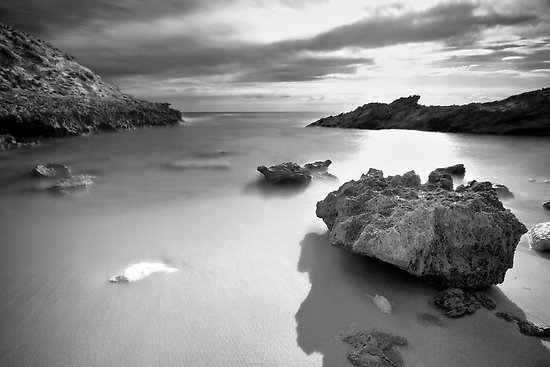
Daytime experiments with the ND400 filter.
The following long exposures were taken during daylight hours using an ND400 and ND8 filter stacked together on the front of my Sigma 10-20mm lens. The combination of these two filters attenuates so much light that peering into the viewfinder reveals an inky blackness even during bright daylight conditions.
It’s therefore necessary to compose the image BEFORE screwing the filters onto the lens. It’s also necessary to adjust the focus manually since the auto-focus system has no chance of working under such conditions.
*** (Update October 2012) The introduction of “live view” to many DSLR cameras means that is’s no longer necessary to compose and pre-focus with the dark filters off the lens. I shoot all the time now using live view to peer through the combined darkness of an ND400 and ND8. The filters now stay on the lens which means there is a lot less fiddling around. If you’re looking for a guide to show you how to use an ND400 have a look at my recent blog post here.***
I found that if I set the ISO as low as possible, and set the aperture very small (i.e. a high number), then it was possible to obtain a shutter duration of about 3 minutes. Such long exposures during daytime create some interesting images. I’m looking forward to experimenting more with the ND400.


The trip to Point Lonsdale
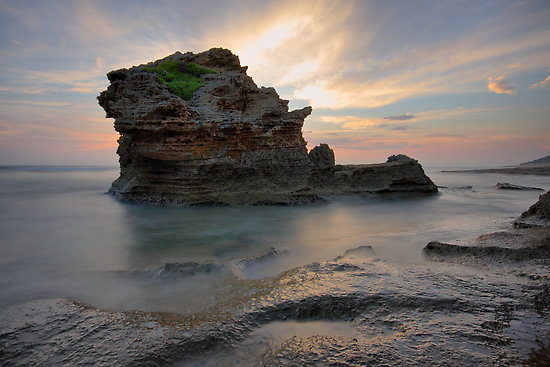
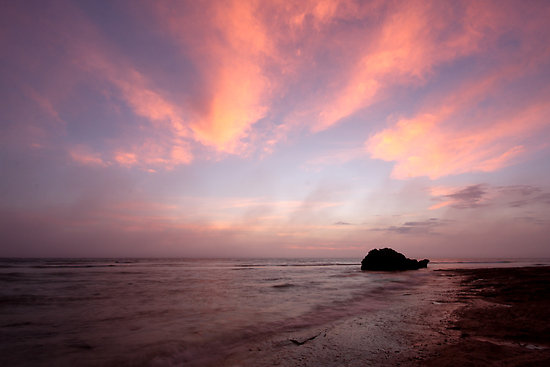
The following are a series of images taken at Point Lonsdale at high tide.
Initially we went there in the middle of the day to try out some “black glass” ND400 filters. The idea was to shoot some daytime long exposures of the low tide water interacting with the exposed rock shelves. Unfortunately I felt a bit disappointed by the results, not because of the ND400 filter but because I had trouble finding satisfying compositions.
Upon returning to Point Lonsdale at sunset the tide was high and there was a bit more foreground interest and some colour in the sky. I managed to find these images a bit more satisfying.

Addicted to the Ocean
A snapshot of a fellow RedBubble photographer catching “last light” at Blairgowrie beach.

An Evening at Spray Point, Blairgowrie.
The following images were taken on an evening excursion to Spray Point / Montforts beach, Blairgowrie.
I’m never really sure where one beach ends and the other begins. 🙂
Tidal Trickle (below) was taken just prior to the sun dropping below the horizon giving some nice pinks in the sky.

Friends and Fatalities (below) is a long exposure shot taken just after the sun had dropped below the horizon.
The extended exposure time makes the moving water take on a misty appearance and blurs the clouds whilst the foreground rocks remain in focus.

The Unpredicted (below) is a long exposure shot showing water flowing off the rock plateaus after sunset.
Despite the deceptively calm appearance of the image this is really a potentially treacherous area with unexpectedly large waves occasionally sweeping across the plateaus.

Swanning around Westernport Bay
Here are some more images taken at various places around Westernport Bay, Victoria, Australia.
It’s always a lot of fun shooting around here at low tide. The beaches feature a fine grain sticky mud that slowly tries to draw you beneath the surface. With each step that you take you risk losing your footwear. 🙂
Taking long exposures is certainly interesting as the tripod gradually sinks into the silt.
This is just the sort of place where you should take emergency pants in case you unexpectedly sit down in the mud.
The following image was taken at Crib Point beach.
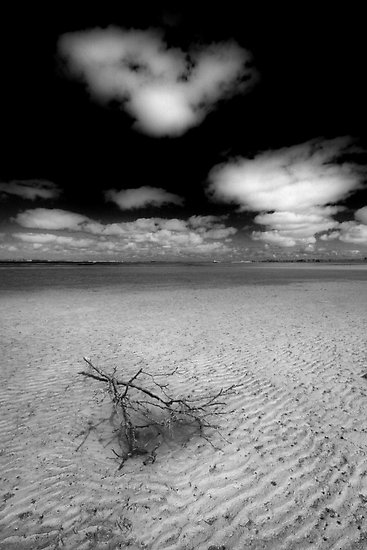
This image Barnacle Build was shot at Balnarring beach.
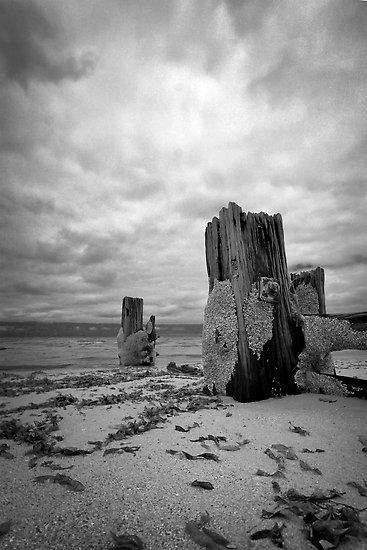
The following image The Threat of Punishment was taken at Grantville beach. All of the ground in this shot is mud.

A Black and White Journey to Grantville Beach
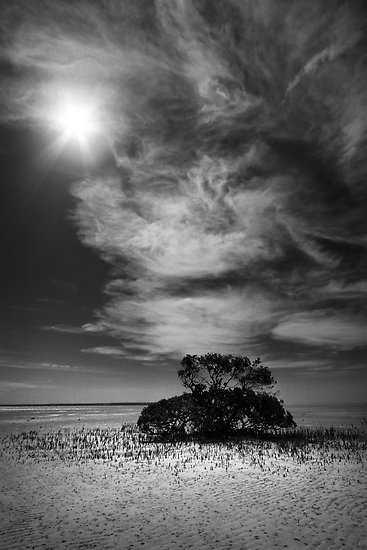
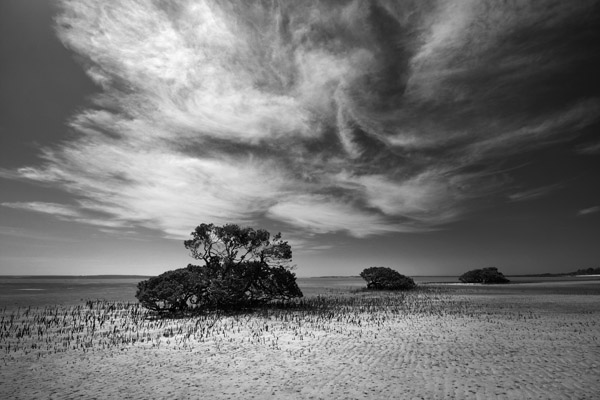
The following two images were taken at Grantville which is located on the eastern side of Westernport Bay, Victoria, Australia.
Low tide at the Grantville beach exposes a huge expanse of fine silty mud dotted with clusters of mangrove trees. On the day I was there the sky was filled with bright swirling clouds so I incorporated them into the photos as an added point of interest. Originally I envisioned capturing the scenes with a featureless blue sky but nature has a way of changing plans. 🙂
I’m been told by several people that the first photo below contains a face in the clouds, and ever since it’s been pointed out to me I see it every time I view the image.
There’s a word for this, ….and the word is pareidolia.
Out on the rock shelves
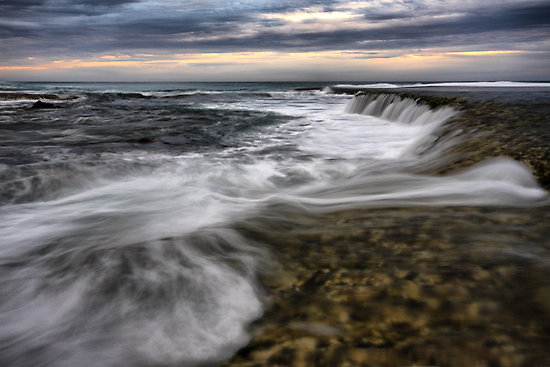
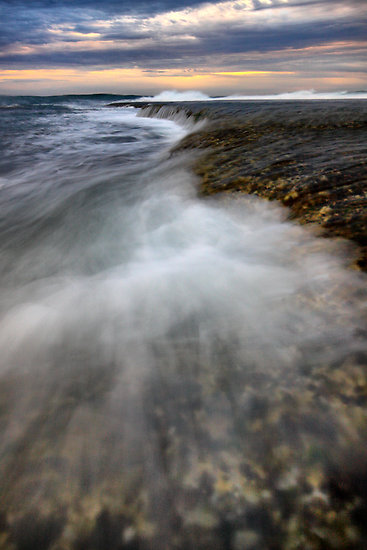
The following three images were taken on an excursion to the rock shelves of Montforts beach, in Blairgowrie.
It’s an interesting place to be during the transition from high to low tide, as the water on the expansive rocky plateaus cascades over the sides on it’s return to the ocean.
Whilst here it’s important to be aware of which way the tide is going and also keep an eye out for occasional large rogue waves that sweep across the shelves. Prepare to get wetter than you expected here.

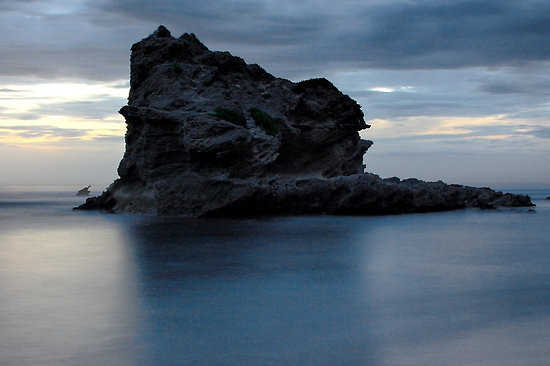
The image below was taken at the neighboring Sorrento beach.
It’s a long exposure taken after sunset giving the oceans surface a deceptively calm and smooth appearance.
Light and Time at my Ocean Beach
A selection of images taken from two excursions to Sorrento beach.
Return to Primal is a long exposure taken after sunset. The true motion of the waves disguised by the slow shutter speed.

High Tide Sphinx is a slow(ish) exposure taken at high tide as the sun was setting behind the Sphinx rock formation at Sorrento beach, Australia.
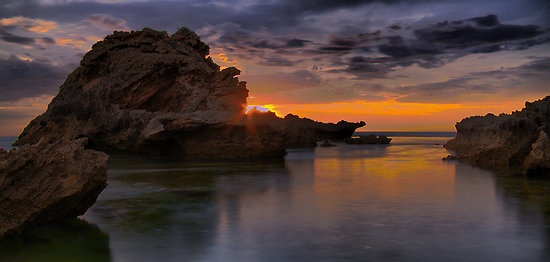
Life in the Good Pond is a slow(ish) exposure taken at sunset. A polarizing filter was used to take the reflection off the surface of the rock pool allowing the scene below the surface to become visible. The blurring on the water was caused by the wind rippling the surface.

I Peek Around the Corner is another image from Sorrento where a polarizing filter was used to remove the unwanted reflection of the sky from the surface of the water enabling us to see the wonder below. In the distance on the horizon the Sphinx rock formation is visible.

Around the Sorrento Sphinx
These images were taken while visiting the Sphinx rock formation at Sorrento beach.
It was quite a windy day causing a lot of ripples on the surface of the rock pools so I used a long exposure (several seconds) to smooth them out and make the ripples disappear.


December Hues – a Sorrento sunset
An image taken just after the sun had dropped below the horizon.
I had an ND8 and polarizing filter stacked on the front of the lens to to extend the shutter time and blur the waves giving a soft appearance to the water.
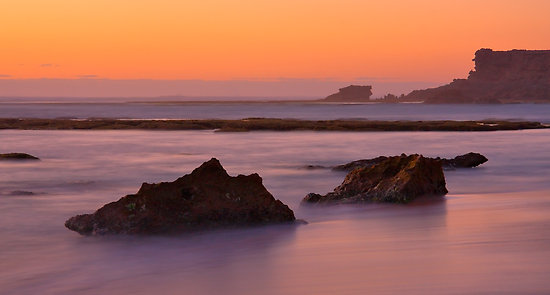
South Gippsland hills
Images taken from a recent excursion to South Gippsland.
The Symphony of Harvest
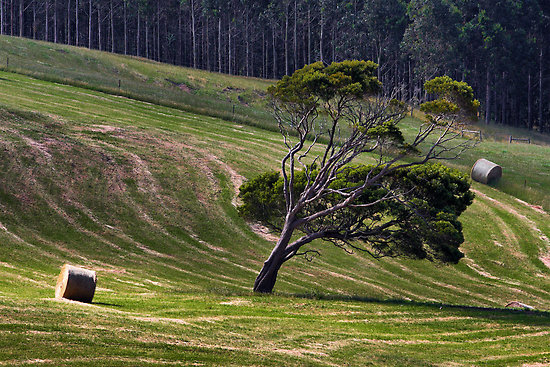
An image taken near Mt Best.
Distinctive trails on the ground show the path of harvesters on the grass. The foreground tree is shaped into submission by the prevailing winds.
The hay bale in the foreground is highlighted by the sun shining through scattered cloud.
I Looked Up High

Image taken near Dollar, Victoria, Australia.
Agnes – the rolling hills
This image was taken near Agnes, in Victoria’s Gippsland region.
In the cooler wetter months the hills are a lush green colour then they start to brown off over summer.
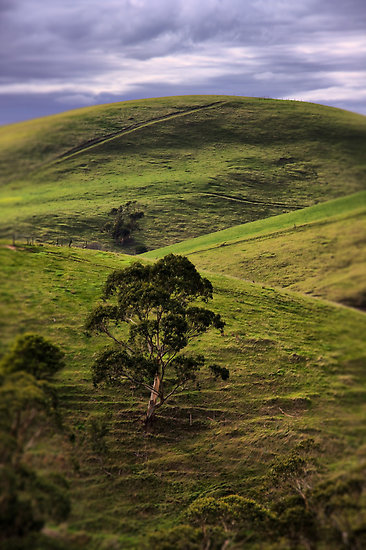
Dusk at Sorrento ocean beach – some long exposures
A series of long exposures taken at Sorrento beach, Australia.


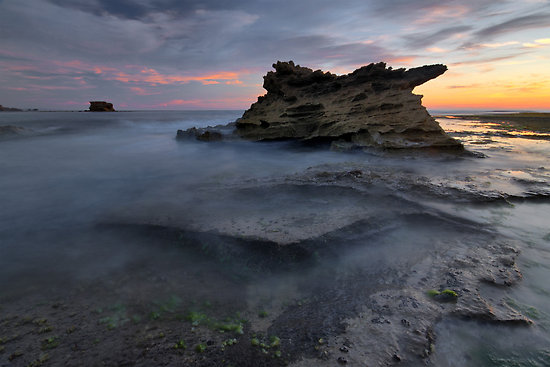

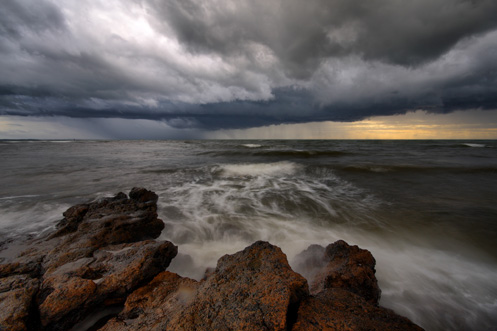
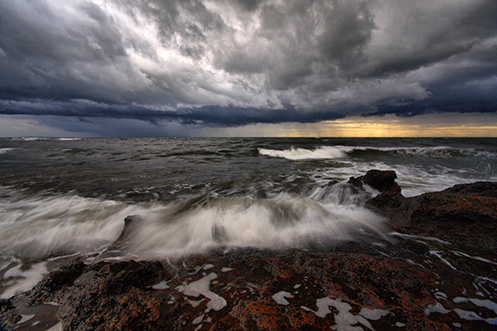
A storm rolls over Port Phillip Bay
Following are 3 images taken yesterday at Ricketts Point, Beaumaris, as a storm rolled across the bay.
The apparent power and turbulence of the clouds in the sky is mirrored by the motion and ferocity of the water. It was an invigorating place to be.

Images from Koonya beach
These images were taken on a recent dusk excursion to Koonya beach on the Mornington Peninsula in Victoria, Australia.
Dusk is my favorite time of day for shooting, ……it’s certainly MUCH more user friendly than that other time of day, …….what do they call it, ….”dawn” or something like that. 🙂


Droughts and Floods
An image taken at the very scenic Lake Glenmaggie area in Victoria, Australia.
The water level rises and falls dramatically according to the prevailing conditions.

The Path to Bushrangers Bay
Some more images taken on an excursion to Bushrangers Bay in Victoria, Australia.

Below – An image taken along the path to Bushrangers Bay.
Rolling hills, farmland and grazing cattle. Very relaxing stuff indeed.

Long exposures on the Mornington Peninsula
A series of long exposures taken at Sorrento and Blairgowrie beaches on the Mornington Peninsula, Australia.
These images were taken using the Sigma 10-20mm and Canon 17-85 mm lenses with ND8 and polarizing filters stacked on the front in order to slow the shutter speed.
Note – when stacking two filters on the 10-20mm lens the rim of the outermost filter becomes visible in the corners of the images necessitating a little cropping in post processing.
All of these images are available to purchase in various forms and sizes by clicking on their titles.
Blaze – taken at Sorrento beach.
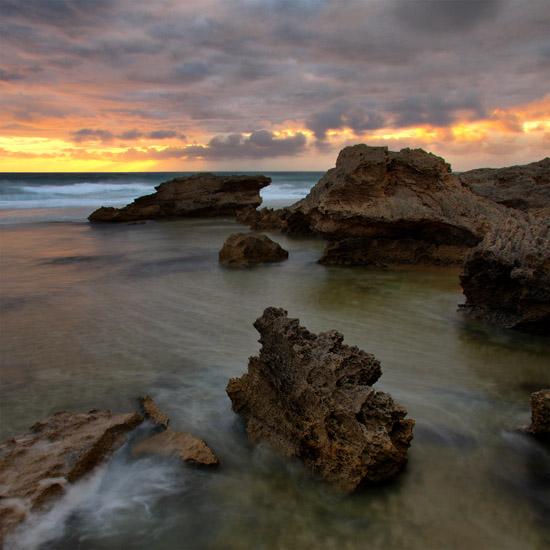
The Glow of Last Light – taken at Sorrento beach.

The Pastel Kiss of Night – taken at Blairgowrie beach.
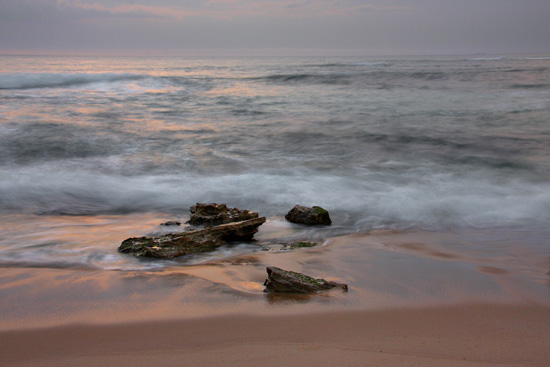
Welcome the Night – taken at Blairgowrie beach.

Koonya Isle – taken at Blairgowrie beach.

Through Angler’s Eyes – taken at Blairgowrie beach.


 Photography by Jim Worrall