
ND400 Long Exposures at Safety Beach (Bracketing and tonemapping long exposures)
Following is a series of bracketed and tone-mapped long exposure images from Safety Beach, Victoria, Australia.
All were shot in the late afternoon using ND400 and ND8 filters combined to achieve the desired long exposure times.
Below – “Safety Beach Jetty”

Here’s how I do my bracketed images – Many of my waterscapes are long exposure tonemapped images generated from 3 exposures at 0,-2 and +2 EV. In order to achieve these 3 exposures I set my camera to aperture priority mode, enable auto bracketing and set the ISO as low as it will go. I then tinker with the aperture value, iso value and either add or remove ND filters in order to force the camera to achieve a shutter speed of 8 seconds for the first exposure (0 EV). Now when the shutter button is activated the camera gives me 3 exposures at 8 seconds, 2 seconds and 30 seconds (which corresponds to approximately 0,-2 and +2 EV)
When these 3 exposures are blended together (tonemapped) in an HDR program the resulting image contains the misty silky effects from the 8 and 30 second exposures and also contains some details from the slower 2 second exposure. When shooting REALLY fast moving water I usually aim for a faster initial exposure time of say 4 seconds. The camera then gives me 3 bracketed exposures at 4 seconds, 1 second and 16 seconds (0,-2 and +2 EV)
The aim is to catch some detail in the fastest exposure but also benefit from the misty effect of the longer exposures.
UPDATE – Oct 2012 – If you’re looking for an introductory guide on how to use the ND400 have a look at my other blog post here.
Below – “Seep” a stormwater drain at Safety Beach.
Yes, a drain can look beautiful. 🙂
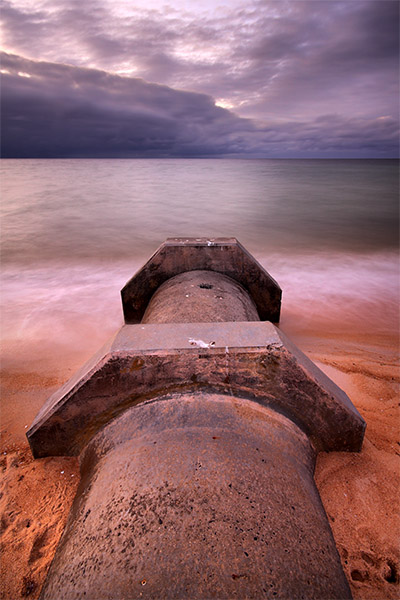
Below – “Jettison” another stormwater drain at Safety Beach.

The Window of Opportunity – Grantville Beach.
Amongst the photographic gems that Grantville beach makes available to photographers is a set of 3 rows of short pylons.
No doubt these pylons are the remains of an old jetty but they differentiate themselves from other such sites in a couple of interesting ways. Firstly, it’s unusual to see 3 rows of pylons like this. Most old jetties leave behind only two rows of pylons.
Secondly the pylons are extremely short here, with most of them extending from the muddy base by only a few short inches.
The short stature of these pylons provides photographers with an interesting challenge. At high tide the pylons are invisible as they’re completely submerged by water, and at low tide they’re an awful looking series of posts sitting in mud.
The challenge for the photographer is to arrive at the site during a narrow window of opportunity whilst the tidal transition ideally has all of the pylons surrounded by water around their bases and yet not enough water to make them shorten or disappear below the surface.
Below – “Runway to the Afterlife”
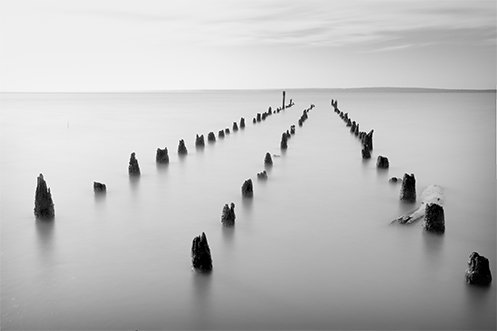
On my first visit to the site I was extremely lucky and caught the tide at just the right height. I wasn’t aware of how elusive these pylons could be until subsequent visits, hoping to catch the pylons in a different light, I haven’t been fortunate enough to arrive at the right time. 😦
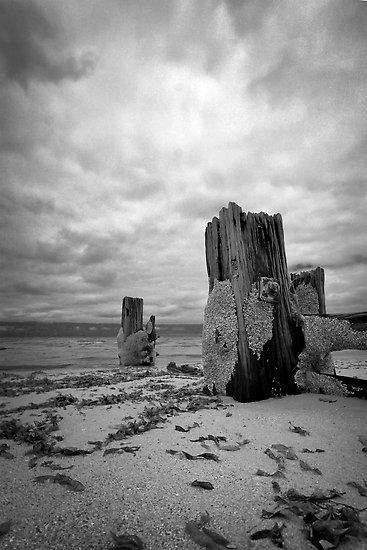
Below – “Mortality” an image taken near the pylons on a different evening. The dark brooding sky sets the mood of the image. In the foreground lays a dead jellyfish, stranded by the outgoing tide.
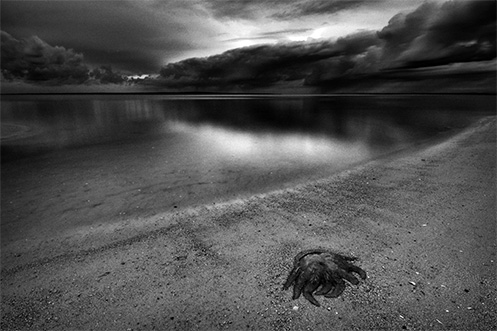
Below – “Deep Creek Reflections“, also near the pylons Deep Creek enters the Westernport Bay.
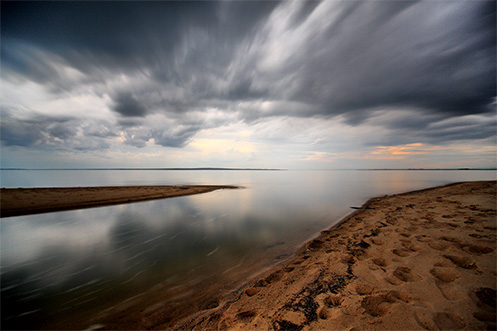
Trolling around under bridges and piers
On excursions where I’m near a bridge or pier, my inner troll has a tendency to take control and drag me under.
Sometimes the results are quite pleasing. Strangely enough I often find the underside to be more photographically pleasing than the top side.
Below – “Gateway” the underside of the San Remo bridge.
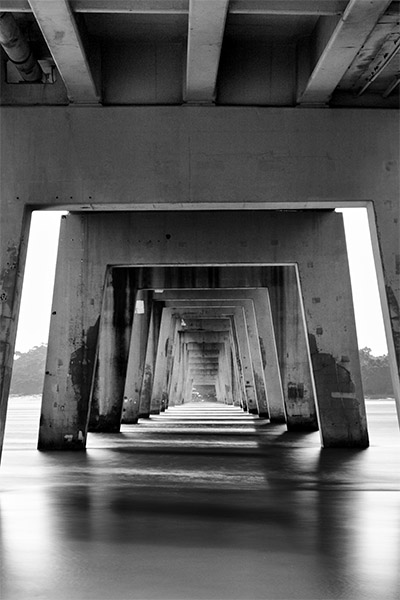
Below – “San Remo Bridge” the gateway to Phillip Island, Victoria, Australia.

Below – “Dromana Downunder” the underside of Dromana pier. No trolls under here!

Contrasts – Views from Jam Jerrup
Contrasting views from the beach at Jam Jerrup, Victoria, Australia.
It’s interesting to see how different a location can appear under different light and tidal conditions. This is exactly the reason why I like to return to the same places many times.
Below – “Aspirations” is a minimalistic long exposure image taken at high tide.

Below – “Blunderbuss” is a wider view of the same area taken at low tide with some more drama taking place in the clouds.
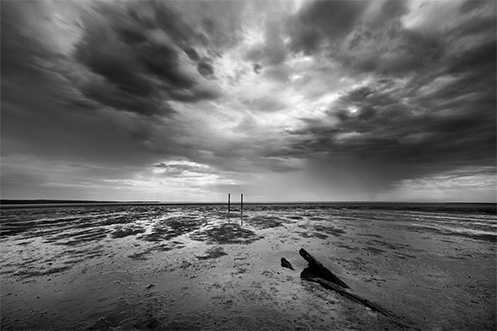
Below – “Exploring the Meme” is the boat ramp and single post at Jam Jerrup.
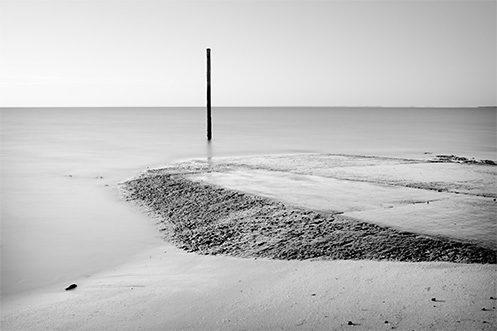
A Photo Exploration of Grantville beach.
I visited Grantville the day after Victoria had been hammered by unusually high rainfall.
Apparently the extreme rainfall was a side effect of cyclone Yasi’s passage across Queensland and into central Australia.
With the worst of the rain over, the day provided some beautiful photographic conditions with the sun filtered through an interesting arrangement of constantly changing storm clouds.
I love the beach down this way. Each time I visit here I discover something new.
Before I discovered photography I would never have guessed that I would find storm water drains interesting. 🙂
Below – “Purge” a storm water drain running into Westernport Bay.

For those who are interested in the technical details, the drain images are constructed using HDR tone mapping techniques. The long exposures were achieved using a combination of ND400 and ND8 filters on the end of the lens to smooth the waves on the water.
Below – “Running from the Idols” – another drain dumping water into Westernport Bay.
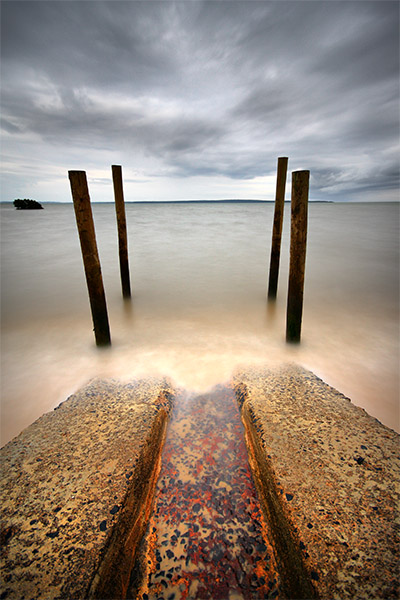
Below – A long exposure self portrait, standing at the end of the Grantville jetty.

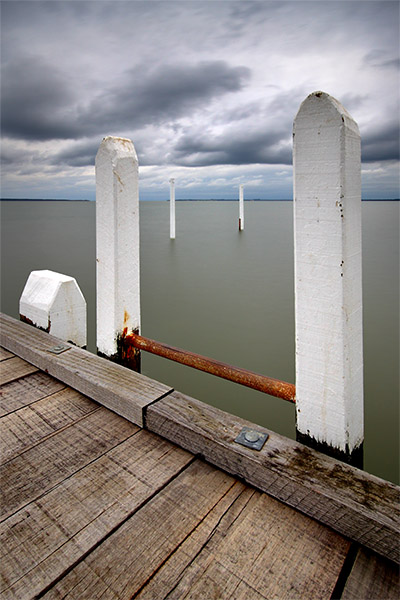
Below – “Grantville Jetty” – a view from the jetty looking out towards the boat ramp marker posts.
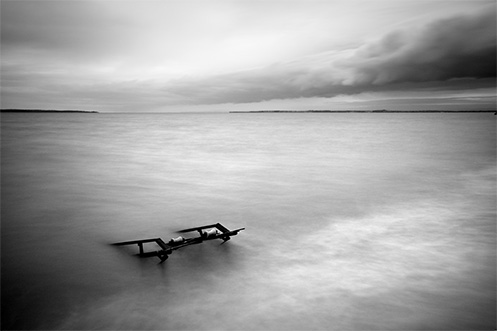
Below – “After the Rains” – a long exposure image from Grantville beach as rain clouds exit. An old boat trailer sits semi-submerged in the foreground.
Exploring Beachport, South Australia.
I visited the town of Beachport just prior to the summer “silly season”. This provided me the with the opportunity to explore the area without the usual crowds of holiday makers cluttering up the splendid beaches.
The town sits on the end of a small cape with one side facing towards the open ocean and the other side facing more towards the mainland providing a relatively safe harbour area and calmer beaches.
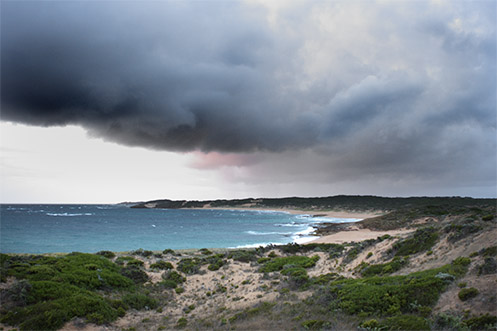
Below – Thar She Blows – a storm approaches Beachport from the ocean.
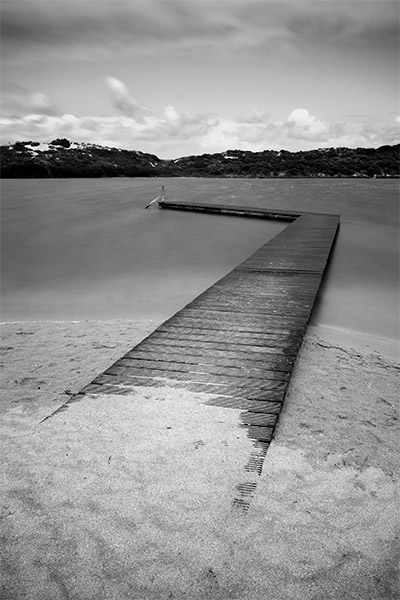
Below – Beachport Pier – located on the calmer east side of the cape, is apparently the second longest pier in Australia. You need a cut lunch and a sherpa to trek from one end of the pier to the other. 🙂

Below – The Pool of Siloam at Beachport contains water which is claimed to be seven times saltier than seawater which makes floating really easy. The pool is fed by underground springs.
Below – Back on the rougher ocean side Post Office Rock at Beachport provides some nice wave action.
I lost a pair of runners and socks here to an unexpected wave.
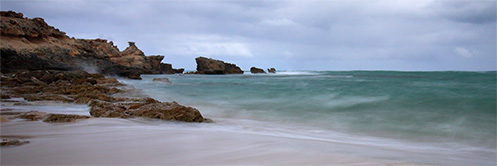
The Water is Back – Meningie
Following are a few images from Meningie, on the banks of Lake Albert in South Australia taken in December last year (2010).
I was told by the Bev at the Lake Albert Motel that the lake has only recently recovered from the drought. Apparently for some time there wasn’t water anywhere near the jetty pictured below.
Below – Traces – Meningie, South Australia, Lake Albert.
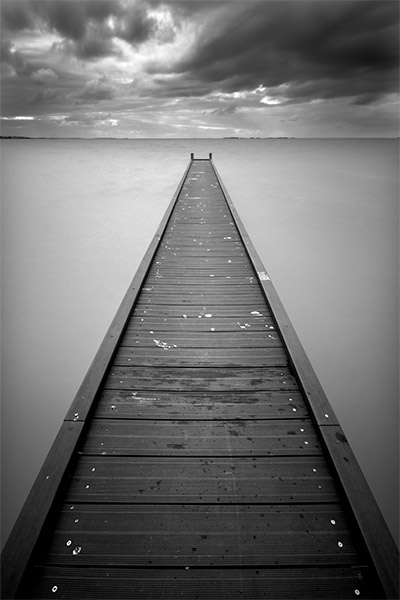
Below – Rise and Fall – Meningie, South Australia, Lake Albert.
I have no idea what those posts are doing out there in the water.
(Update – 31-01-11 Bev at the Lake Albert Motel has informed me that the posts in the water are there to provide a roost for the local pelicans. That makes sense.)
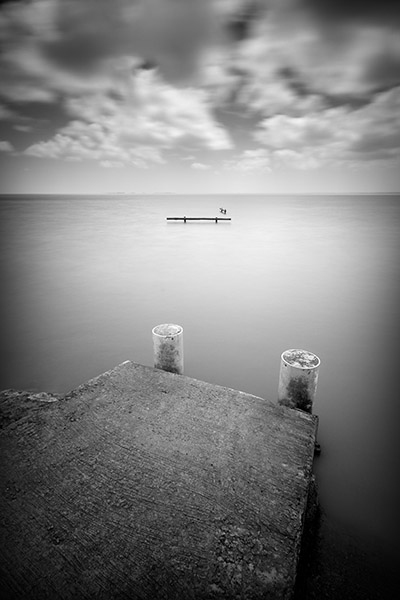
Below – Aspects of Abundance Meningie, South Australia, Lake Albert.
Pelican roosting posts.
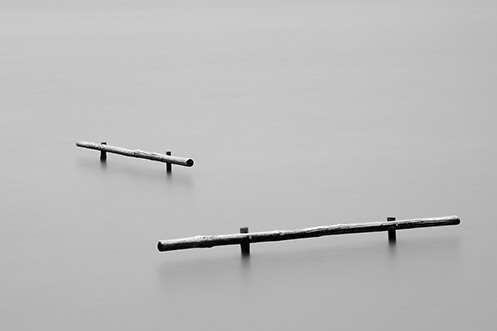
Below – Meningie Some wonderful action going on in the clouds here.
Below – Unbreakable – The second most sturdy piece of outdoor furniture I’ve ever had the pleasure of sitting on.

Hunting the white water – Pinnacles, Phillip Island
Following are some images from The Pinnacles rock formation at Cape Woolamai on Phillip Island. We were hoping for some nice big waves but unfortunately the conditions conspired against us that day.
The images were created using HDR techniques to capture the full dynamic range of this very contrasty environment, i.e. 3 bracketed exposures at 0,-2 and +2 EV. I had an ND400 neutral density filter on the front of the lens to allow longer exposure times and give some sense of movement to the water and clouds.
Below – “Chasing Dinosaurs”
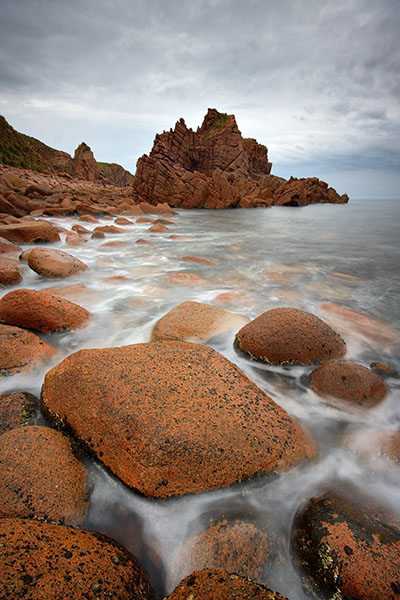
Below – “Waiting for the Swirl of White”
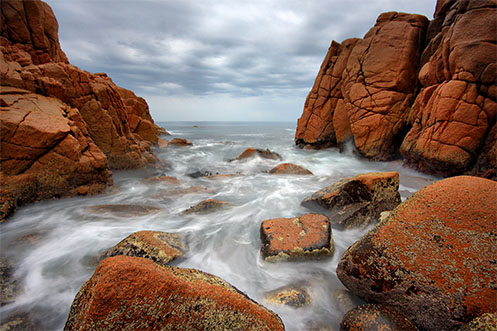
Below – “Sea Level”

Below – “Lost in the Moment”
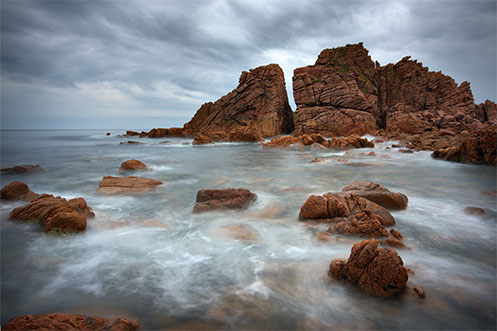
Below – “The Risky Swim”

Like colourful candy – Bathing Boxes, Safety Beach
Here’s a selection of colourful bathing boxes at Safety Beach, a bayside suburb on Port Phillip Bay, Victoria. The bathing boxes are privately owned beach sheds generally owned by Melbourne’s more wealthy people.
If you visit the windows of local real estate agents you can find some of these bathing boxes for sale at ridiculously high prices.
Lolly Boxes 1 – Safety Beach, Port Phillip Bay, Victoria, Australia.

Lolly Boxes 2 – Safety Beach, Port Phillip Bay, Victoria, Australia.

Lolly Boxes 3 – Safety Beach, Port Phillip Bay, Victoria, Australia.

Construction at Powlett River
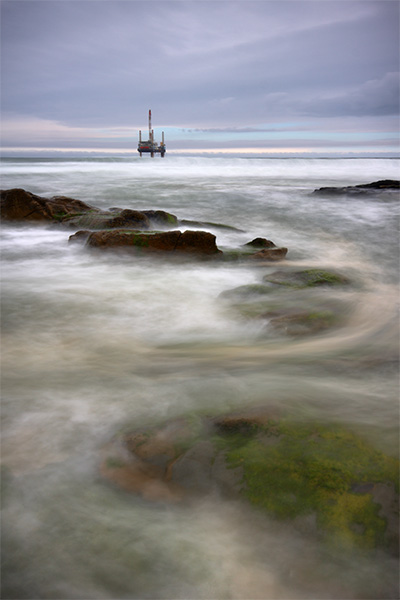
The construction of the controversial desalination plant near the mouth of the Powlett River has yielded a temporary point of interest for photographers.
A large platform has been placed offshore to assist with the construction of the required underwater pipeline.
Although not the most beautiful structure in the world, it acts as a nice point of interest for an otherwise potentially boring background.
I’m in no way a supporter of this project but I decided to take advantage of the platform while it’s there and took a series of images from the spot where the Powlett River meets the ocean.
The idea behind the images was to use the lines created by running water and rock edges to draw the viewer into the scene towards the platform in the background. The images were taken in bright mid afternoon light using strong ND filtering to enable the exposures to be long enough to blur the water.
Below – Platform One

Below – Platform Two

Below – Platform Three
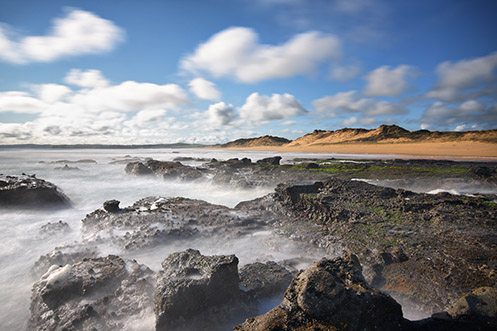
Below – Mouth of the Powlett – Looking north-west across the mouth to the sand dunes, the waves crashing onto the rocks in the foreground just appear as mist due to the long exposure time.
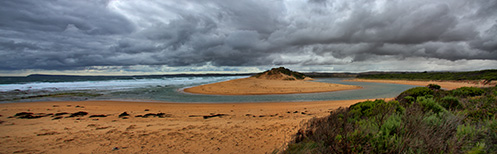
Below – a couple of experimental panoramic shots of the river and dunes.

Exploring Ricketts Point, Beaumaris, Port Phillip Bay
Ricketts Point is a marine sanctuary located south east of Melbourne in Port Phillip Bay. When viewed from the land it’s an unremarkable looking series of sandstone rock platforms. Apparently under the waterline the platforms support a great diversity of flora and fauna.

When viewed from a land-based photographer’s perspective the area looks pretty ordinary during bright daylight hours.
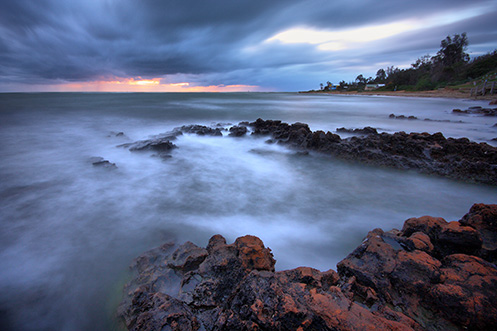
Towards the evening the area becomes more attractive as it provides an unobstructed view of the setting sun and also provides some foreground interest in the form of waves swirling around rocks at the edge of the platforms.
This provides a good opportunity to catch some nice long exposure images.

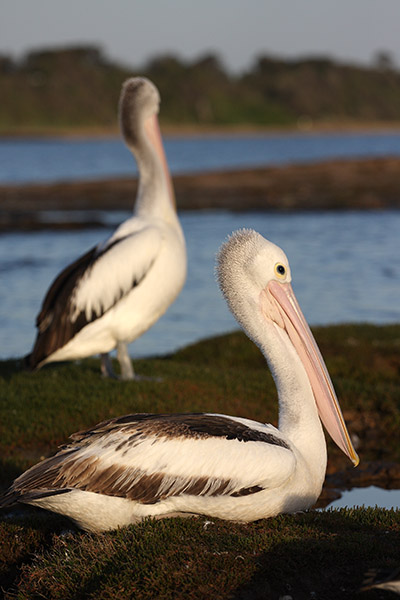
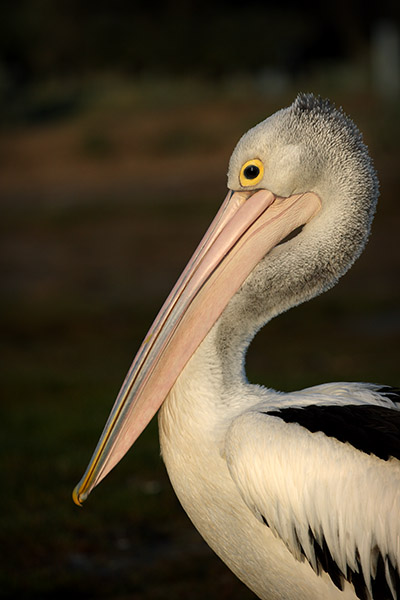
Prior to the sun setting, the rocky platforms serve as a meeting place for several species of birds. Amongst them are a very tolerant group of pelicans. They don’t seem to mind people getting relatively close to them here which provides a nice opportunity for bird watchers and photographers.



To the tip of Cape Liptrap
Cape Liptrap is located on Victoria’s south east coastline overlooking Bass Strait.
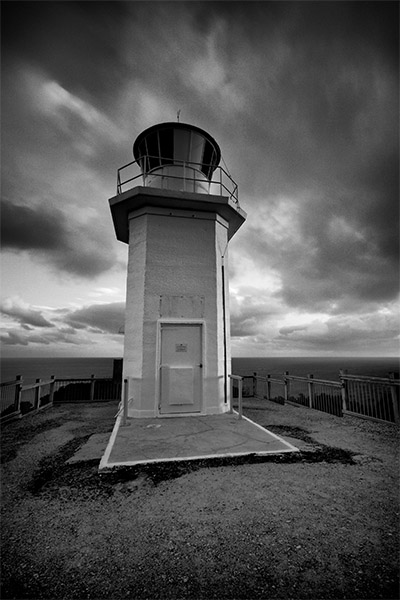
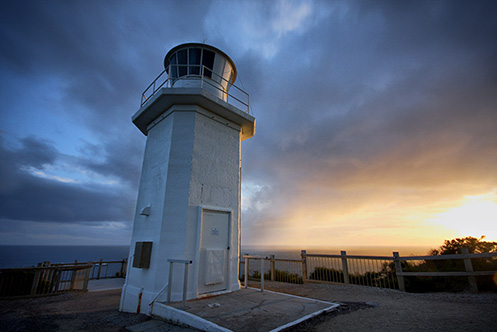
On the high ground just back from the pointy end of the cape sits the Cape Liptrap lighthouse.
Below – “Warrior of the Dark” available as a print here.
Below – “Night’s Witness” is available as a print here.
If you enjoy real excitement, and don’t mind a bit of exercise, it’s worthwhile to jump the fence at the lighthouse and walk/slide your way out to the pointed cliff.
Peering over the edge of the cliff you’re greeted by an amazing rockscape being pounded by the violent waves of Bass Strait. The scene is captivating but I wouldn’t recommend it if you have a real fear of heights.
Below “Vertigo – Over the Edge” available as a print here.
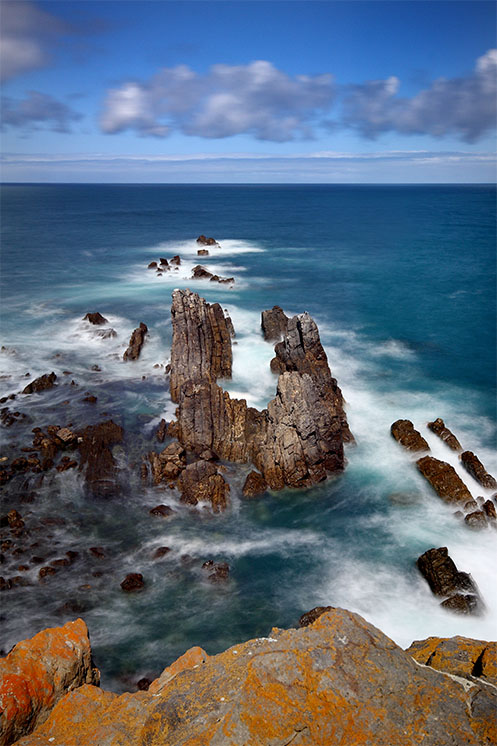
Below – a friend perched on the edge of the cliff enjoying the scenery and of course taking some shots.

Grantville – the pie and pier photography tour.
My excursions are never entirely about the photography. Often they’re about the escape, ….often they’re about self exploration, …….every now and then they might even result in a nice photographic image. Well, nice to me anyhow. 🙂
On previous visits to Grantville I’ve tended to concentrate on trying to capture an inspiring image or two from the mangroves dotted along the coast here. The mangroves are a fairly easy target for photography purposes. At high tide it’s possible to visually isolate them between the water and the sky which works to simplify the image by excluding potentially distracting background elements. On calm days the water can also act as a fantastic mirror for capturing reflections, particularly when doing long exposures.

This particular visit to Grantville was all about capturing the pier though, so here it is.
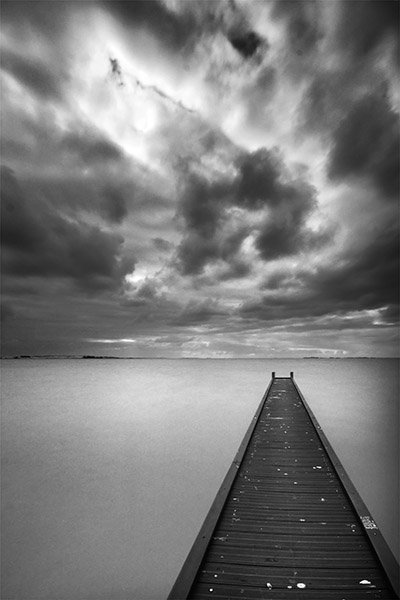
In the black and white image above I’ve deliberately over exposed the image to blow out the sky and increase the contrast between the pier and the background. I personally like the contrasty result here, but I know this style of image is not everyone’s cup of tea.
Pictured below – “The First Days of Sun” which is available to purchase as a print here.
This image from the pier was created from 3 exposures using HDR tone mapping techniques to maintain details in both the bright sky and the dark shadows.

Pictured below – “The Promise of Warm Days” which is available to purchase as a print here.
Another 3 exposure HDR shot converted to black and white and processed with a bit of dodging and burning in Photoshop.

Now for some serious business. I’ve discovered that the cafe on the corner of the Bass Hwy and Grantville Glen Alvie Road in Grantville sells excellent homemade meat pies made with flaky puff pastry. The coffee is pretty good there too.
(Disclaimer – I have no connection with this cafe at all, I just enjoyed the pie so much I felt the need to share it with you.)
The Beauty of Polly McQuinn’s Weir, Strathbogie.
The picturesque Polly McQuinn’s Weir is well sign posted and located a few kilometers south-west of Strathbogie, Victoria, Australia.
The weir features a spillway where water streams over a concrete wall and onto large exposed granite boulders.
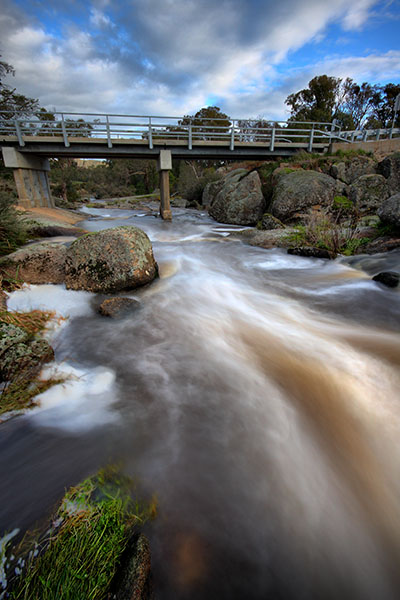
The water then continues snaking around more boulders before flowing under a road bridge then traversing a gently sloped granite plateau before reaching a deep pool surrounded by native vegetation.
There are many opportunities here for the keen photographer.
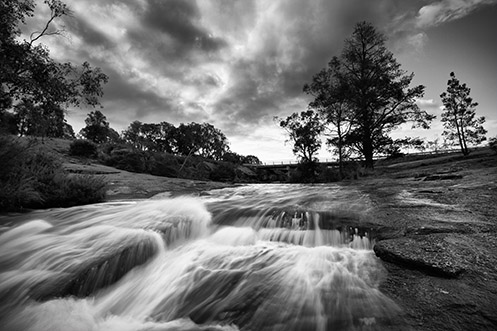
Below – A long exposure of water cascading over the spillway wall and onto granite boulders beneath.
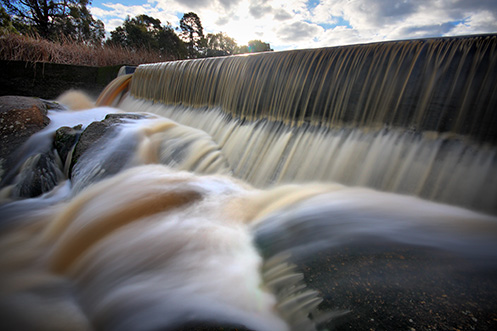
Below – Looking back towards the spillway wall, water flows rapidly over and around granite boulders on it’s way downstream.

Below – In the days preceding my visit to the weir the area had received heavy rainfall.
I suspect this caused lot of the brown silt present in the water. This caused an interesting effect in the water with the deeper sections of the flow taking on a brownish tinge and the shallow sections appearing bluish during long exposure shots.

Below – The view from the bottom of the spillway looking downstream.
The silted water runs rapidly under the road bridge.
Below – “Polly’s Overflow” – Looking upstream from the pool, the water traverses a gentle granite plateau then strikes some foreground boulders whipping the water into a frenzy before it finally enters the tranquility of the pool. This image is available to buy as a print at my Zazzle and RedBubble sites.
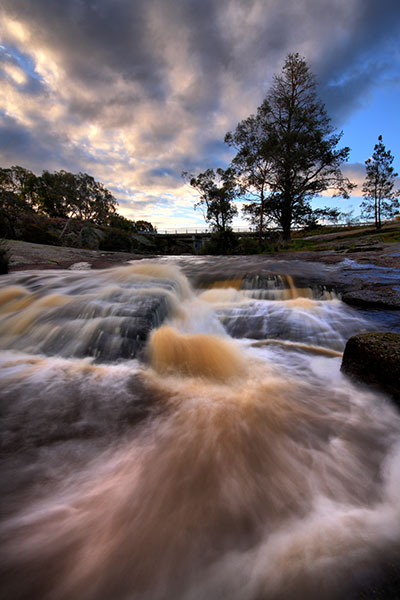
Below – “In Search of Polly”
Apparently the weir was named after a young woman called Polly McQuinn who drowned here more than 100 years ago. Legend has it that the ghost of Polly can sometimes be heard calling for help from passer by.
Unfortunately I didn’t hear Polly on the day I was here.
West – along the coast
Following is a short series of seascape images taken on a recent trip along the Victorian/South Australian coastline.
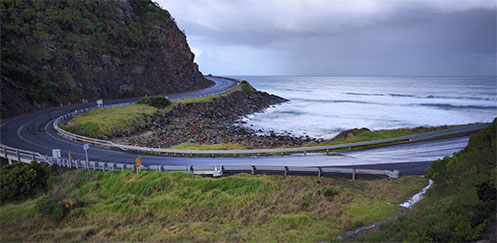
Below – The Great Ocean Road – just south of Lorne, Victoria, Australia.
Notice the skid marks on the road at the bend, …this road is a popular tourist route attracting visitors from all over the world.
Some of these visitors unfortunately forget that we drive on the left side of the road in Australia. This causes all sorts of drama.
Below – Along the Edge – A view of the incoming storm from the lookout at Glenaire, Victoria, Australia.

Below – Bay of Martyrs – A long exposure image from down on the beach at the Bay of Martyrs, on the Great Ocean Road, Victoria, Australia. I was attracted by the unusual shapes that the ocean had managed to create with the foreground rocks here.

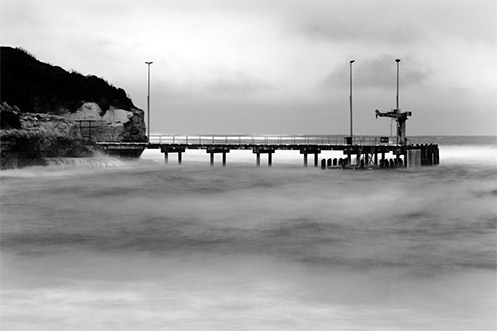
Below – Storm at Port Campbell Pier – a long exposure image made during a stormy morning at Port Campbell pier. This pier really has quite a hard life being continually hammered by waves from the open ocean.
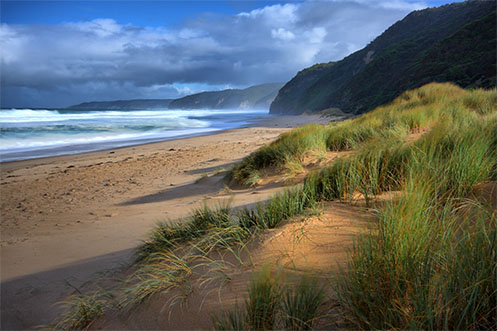
Below – Johanna’s Morn – The morning sun starts to warm the sands of Johanna beach, Victoria, Australia.
Below – Her Deceptive Charm – A long exposure image from Cape Northumberland in South Australia.
The waves were really ripping into the rocks here, …….although the image looks deceptively calm due to the long exposure time.
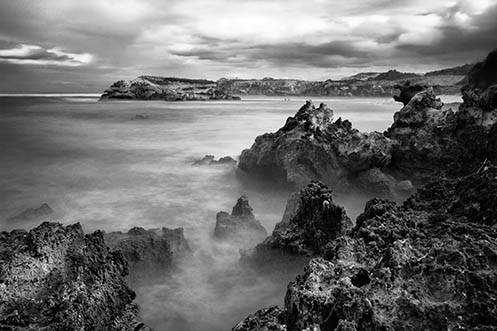
Below – At Ocean’s Edge – On the beach at Cape Northumberland, South Australia.

Abandoned, dilapidated, derelict, decayed and once loved.
Following is a collection of farmhouse images taken on a trip through western Victoria and South Australia.
Initially I intended to take a lot of seascape images on this trip but the rain and sheer cliffs along the Great Ocean Road often conspired against me.
As the journey progressed I found myself becoming more interested in the landscape including the many vacant derelict buildings scattered along the way.
Below – “Shambles” – A deserted farmhouse at Byaduk North, Victoria, Australia.
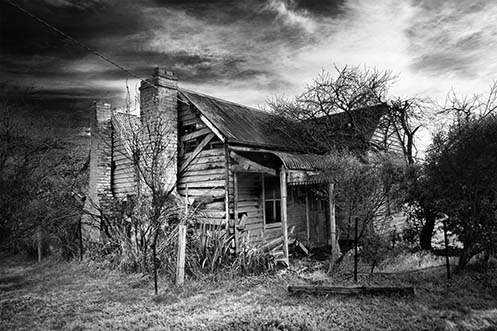
Below – “Out the Back” Byaduk North, Victoria, Australia.

Below – “The Love Shack” – Found along the road north of Port Fairy, Victoria, Australia.
There is also a colour version of the Love Shack here.
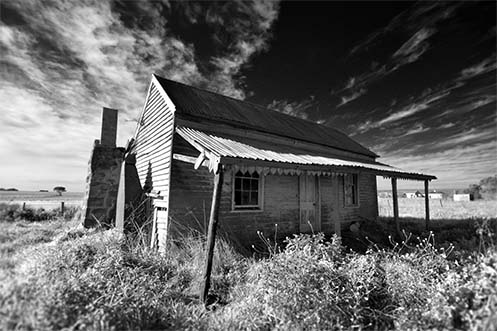
Below – “Spiders n’ Snakes” – an abandoned house along the roadside in Puralka, Victoria, Australia.

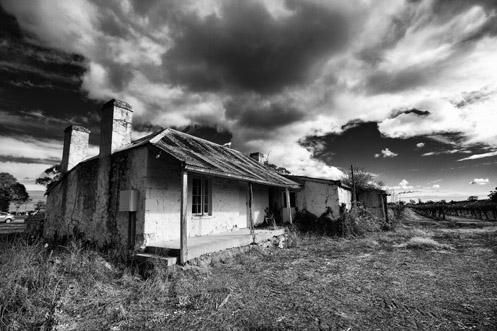
Below – “Cottage in the Vineyard” Padthaway Heritage Cottage (Front) near Bordertown, South Australia.

Below – “Backdoor to the Vineyard” Padthaway Heritage Cottage (Rear) overlooking the vineyard, near Bordertown, South Australia.
Down amongst the Mangroves, Westernport Bay.
You certainly have to admire the hardiness of the Mangrove tree.
It thrives in poor quality soil in tidal areas, and twice a day has it’s roots submerged in salty sea water. Under storm conditions the Mangrove is battered by both wind and waves yet it still manages to hold firmly.
The Mangrove tree is also an interesting subject from a photographer’s perspective. At high tide with the roots submerged it’s fairly easy to photographically isolate the subject from it’s surroundings by using a long exposure time to smooth any waves around it’s base and blur any clouds in the sky.
Below – TimeKeeper
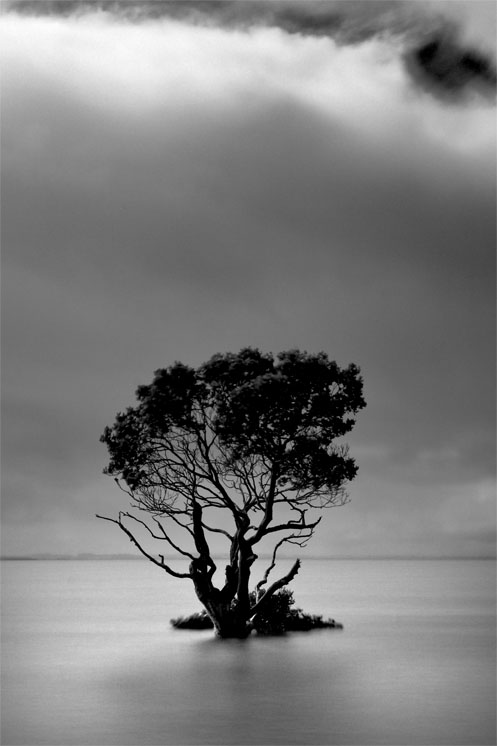
Below – The Risen

Below – Approaching the Forest

At low tide the Mangrove tree has it’s roots exposed creating potentially a new subject of interest for the photographer. The long roots are often intertwined with each other giving the impression of writhing serpents (perhaps that’s just my imagination running wild).
Below – The Serpent Tree
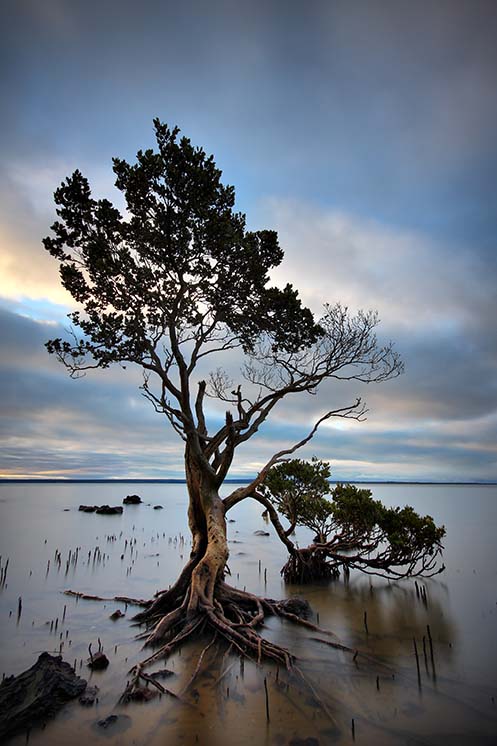
Below – Wild n’ Woolly a long exposure with the roots exposed and the leaves thrashing around in the wind.
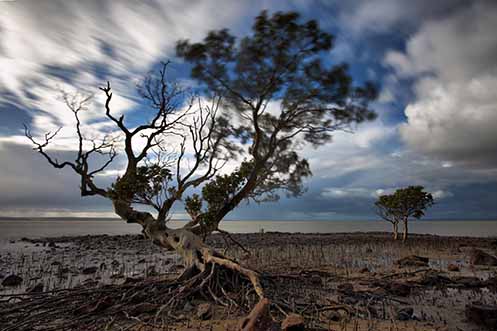
Below – On Borrowed Time the same tree as above but at high tide.

Trestle Bridge Encounters.
Whilst on a recent photography tour of eastern Victoria I encountered a couple of old wooden trestle railway bridges, …….and who can resist a good bridge!

The Stony Creek trestle bridge (pictured above) is located at Nowa Nowa in Victoria’s south east.
Apparently this is the largest standing bridge of it’s kind in Victoria, measuring 247 meters long and standing 20 meters high. The bridge was made in 1916 and remained in service for over 60 years until it was damaged by bushfire in 1980.
– – – – – – – – – – – – – – – – – – – – – – – – – – – –
The two images below were taken at the trestle bridge in Mt Lawson state park, in Victoria’s north east.
The high timber bridge which was built around 1915 spans Boggy Creek and formed part of the now disused Wodonga – Cudgewa railway line.
The view from above –

The view from below –

Incorporating HDR tonemapping techniques with long exposures
The following images were experiments using HDR tone mapping techniques combined with the effects of long exposure times.
Each image was constructed from at least 3 separate exposures using in-camera auto exposure bracketing. In my case, being a Canon shooter, I used 3 exposures of -2,0 and +2 simply for convenience. I believe Nikon shooters have a bit more flexibility in this area.
The images were all taken during daylight hours so it was necessary to use some heavy ND filtering in order to increase the exposure times and achieve a nice misty look to the water. In my case I used an ND400 and an ND8 filter stacked together to achieve this.
With the camera set to aperture priority mode I adjusted the aperture and filter combination (sometimes removing the ND8) to achieve an exposure of 8 seconds. When the shutter button is depressed the camera would then give me 3 exposures at 8 seconds, 2 seconds and 30 seconds (which is close enough to 0,-2 and +2). My particular camera doesn’t let me expose for longer than 30 seconds unless I go to bulb mode and use a remote timer, so out of laziness I tend to limit many of my exposures to 30 seconds. 🙂
The exposures were then combined and tonemapped using HDR software and tweaked in Photoshop to achieve the end result.
Despite all of this sounding a bit technical it’s really quite simple and I encourage you to try it. The results are often very rewarding.
BELOW – Jurassic Afternoon – Sunlight and waves break through a slit in the prehistoric Pinnacles rock formation on Phillip Island.

BELOW – The Mist of St.Pauls – A long exposure at St. Pauls beach, Sorrento, Victoria, Australia.

BELOW – Prehistoria – An image from The Pinnacles, at Phillip Island, Victoria, Australia.

BELOW – Swimming with Dinosaurs – Down amongst the prehistoric Pinnacles rock formations at Phillip Island, Victoria, Australia.

Addicted to the Ocean
A snapshot of a fellow RedBubble photographer catching “last light” at Blairgowrie beach.

Swanning around Westernport Bay
Here are some more images taken at various places around Westernport Bay, Victoria, Australia.
It’s always a lot of fun shooting around here at low tide. The beaches feature a fine grain sticky mud that slowly tries to draw you beneath the surface. With each step that you take you risk losing your footwear. 🙂
Taking long exposures is certainly interesting as the tripod gradually sinks into the silt.
This is just the sort of place where you should take emergency pants in case you unexpectedly sit down in the mud.
The following image was taken at Crib Point beach.
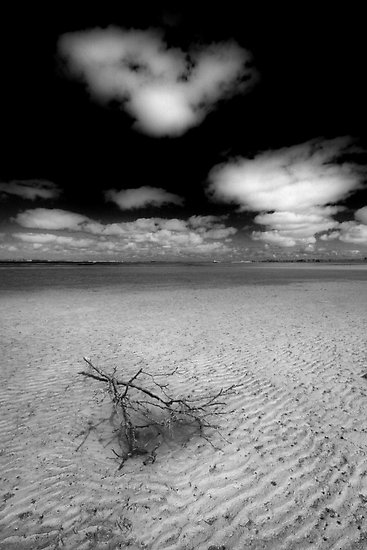
This image Barnacle Build was shot at Balnarring beach.
The following image The Threat of Punishment was taken at Grantville beach. All of the ground in this shot is mud.

A Black and White Journey to Grantville Beach
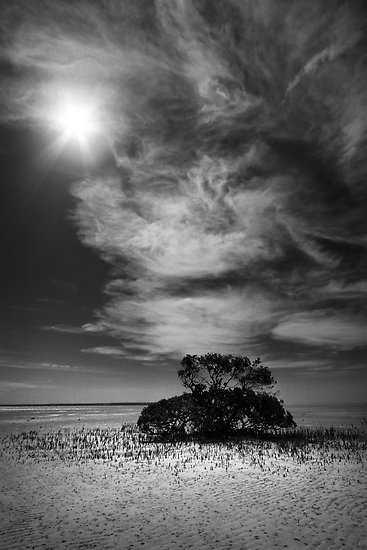
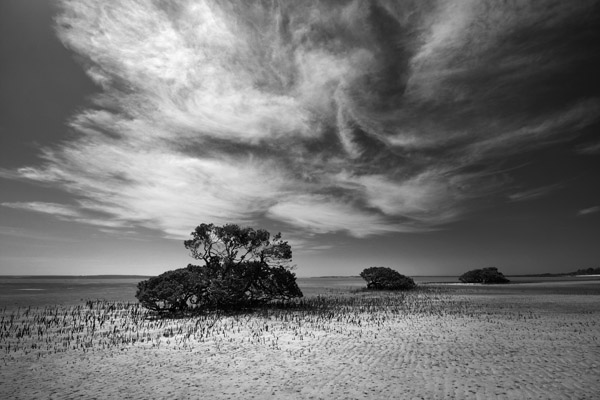
The following two images were taken at Grantville which is located on the eastern side of Westernport Bay, Victoria, Australia.
Low tide at the Grantville beach exposes a huge expanse of fine silty mud dotted with clusters of mangrove trees. On the day I was there the sky was filled with bright swirling clouds so I incorporated them into the photos as an added point of interest. Originally I envisioned capturing the scenes with a featureless blue sky but nature has a way of changing plans. 🙂
I’m been told by several people that the first photo below contains a face in the clouds, and ever since it’s been pointed out to me I see it every time I view the image.
There’s a word for this, ….and the word is pareidolia.
Out on the rock shelves
The following three images were taken on an excursion to the rock shelves of Montforts beach, in Blairgowrie.
It’s an interesting place to be during the transition from high to low tide, as the water on the expansive rocky plateaus cascades over the sides on it’s return to the ocean.
Whilst here it’s important to be aware of which way the tide is going and also keep an eye out for occasional large rogue waves that sweep across the shelves. Prepare to get wetter than you expected here.
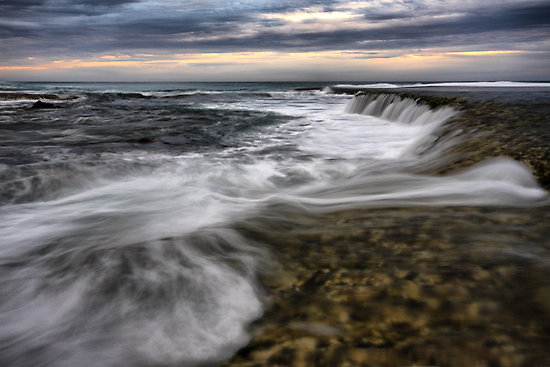
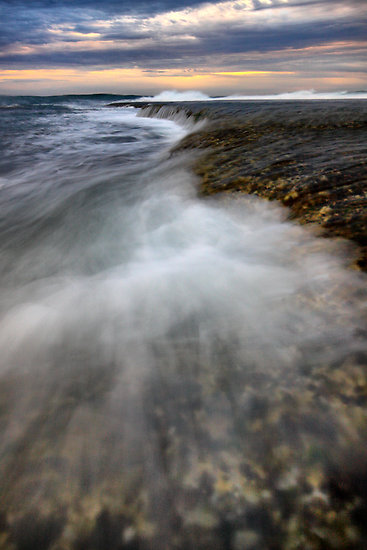

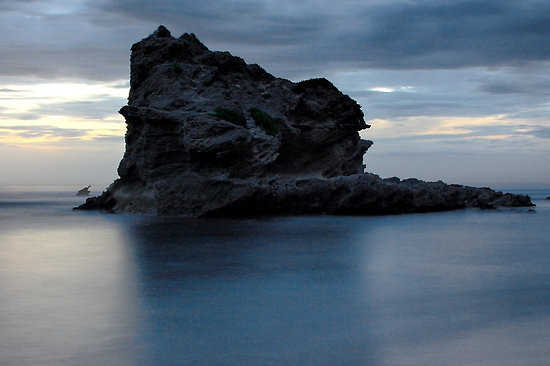
The image below was taken at the neighboring Sorrento beach.
It’s a long exposure taken after sunset giving the oceans surface a deceptively calm and smooth appearance.
Light and Time at my Ocean Beach
A selection of images taken from two excursions to Sorrento beach.
Return to Primal is a long exposure taken after sunset. The true motion of the waves disguised by the slow shutter speed.

High Tide Sphinx is a slow(ish) exposure taken at high tide as the sun was setting behind the Sphinx rock formation at Sorrento beach, Australia.
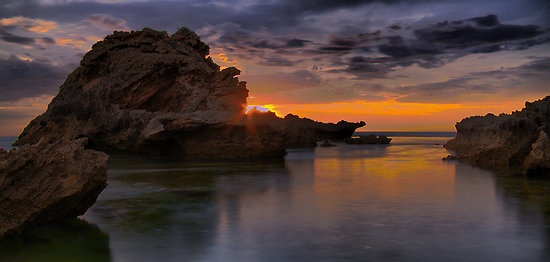
Life in the Good Pond is a slow(ish) exposure taken at sunset. A polarizing filter was used to take the reflection off the surface of the rock pool allowing the scene below the surface to become visible. The blurring on the water was caused by the wind rippling the surface.

I Peek Around the Corner is another image from Sorrento where a polarizing filter was used to remove the unwanted reflection of the sky from the surface of the water enabling us to see the wonder below. In the distance on the horizon the Sphinx rock formation is visible.

Around the Sorrento Sphinx
These images were taken while visiting the Sphinx rock formation at Sorrento beach.
It was quite a windy day causing a lot of ripples on the surface of the rock pools so I used a long exposure (several seconds) to smooth them out and make the ripples disappear.


Dusk at Sorrento ocean beach – some long exposures
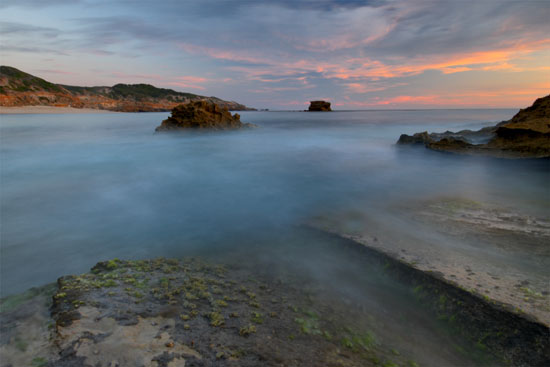
A series of long exposures taken at Sorrento beach, Australia.



A storm rolls over Port Phillip Bay
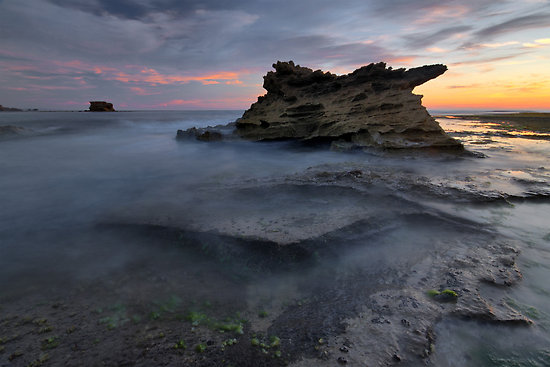
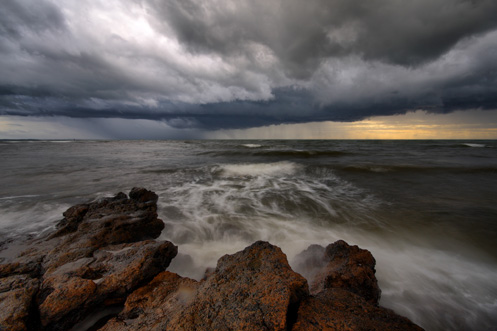
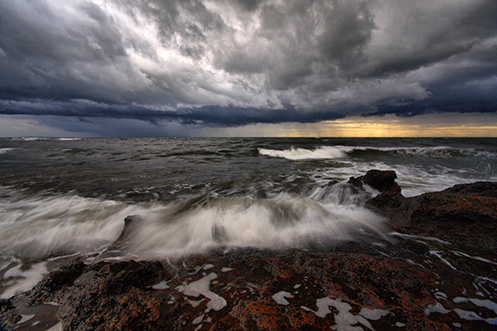
Following are 3 images taken yesterday at Ricketts Point, Beaumaris, as a storm rolled across the bay.
The apparent power and turbulence of the clouds in the sky is mirrored by the motion and ferocity of the water. It was an invigorating place to be.

The Chant of the Pulpit
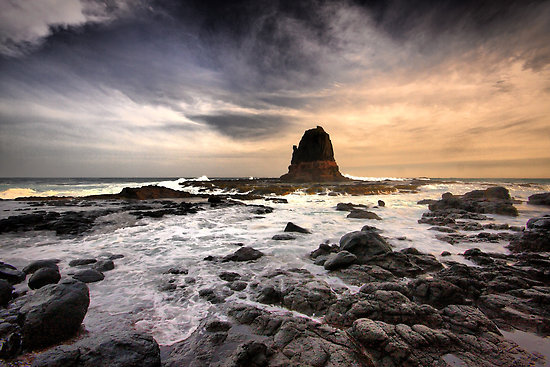
A seascape image from Cape Schanck in Victoria, Australia.
The image features the well known landmark Pulpit Rock as incoming waves rush across the surface of the surrounding rocky platforms.
The Chant of the Pulpit.
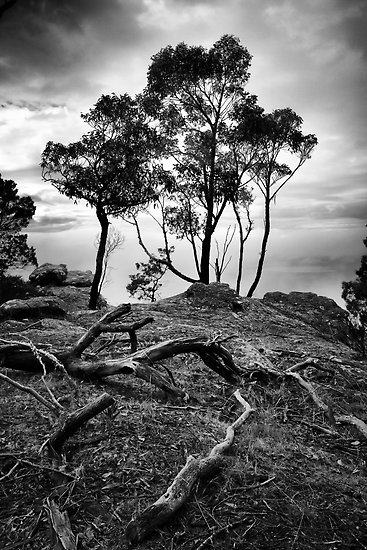
The Edge
Gum trees growing precariously close to a cliff edge in western Victoria, Australia.
I was attracted to this scene by the trees silhouetted against the bright cloudy sky and of course the dead limbs in the foreground.
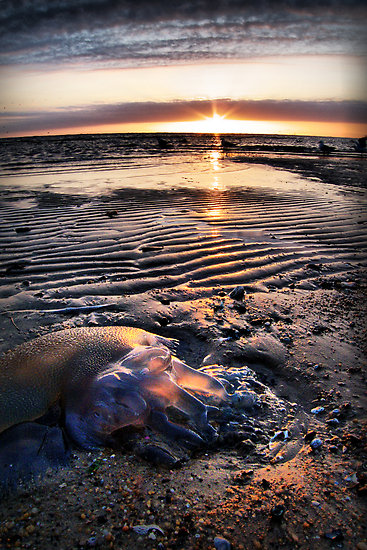
Stranded
This image was taken at Beaumaris beach, Victoria, Australia.
Walking along the beach at sunset was a hazardous proposition as sand was littered with the stranded bodies of hundreds of jellyfish. Poor things!
This shot taken with the Lumix LX3.

 Photography by Jim Worrall