
A Stroll on Shelley beach – Portsea
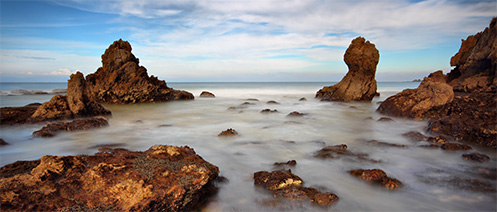
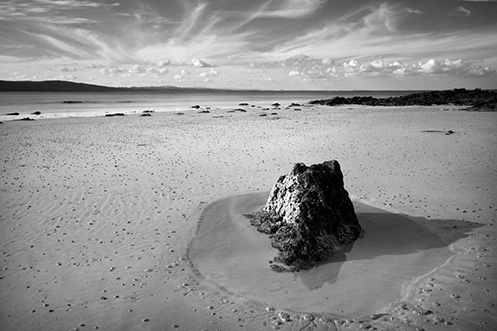
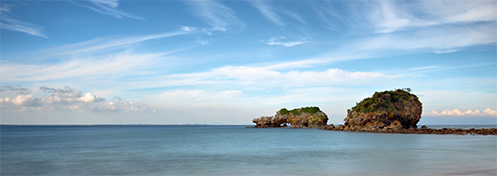
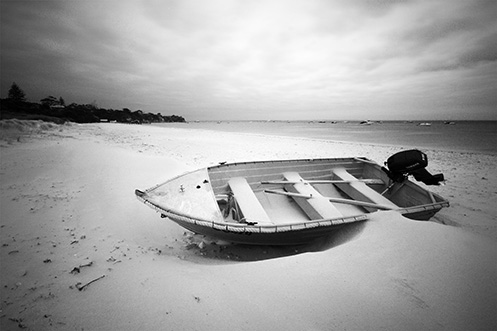
A couple of images from a recent stroll on Shelley beach, Porstsea, Victoria.
It was one of those great days for photography. The clouds were very heavy causing a nice subdued light.
The threat of impending rain also meant I had the beach to myself, ……nice. 🙂
Queensferry – a contrast of tides
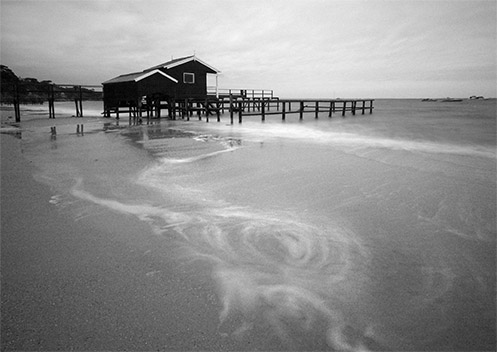
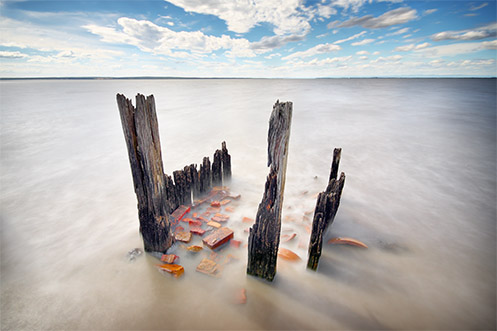
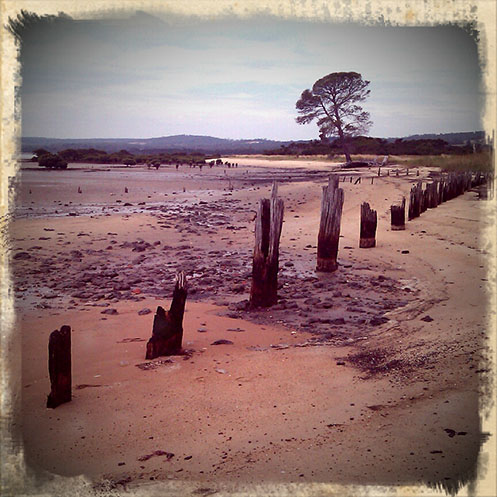
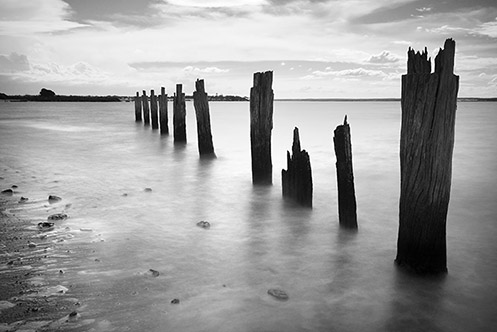
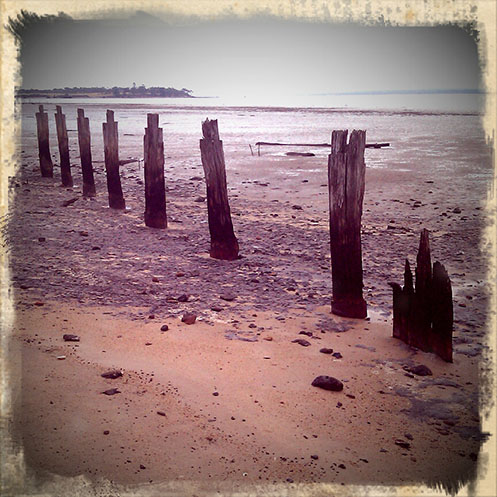
Following are a series of images from Queensferry, on Western Port Bay, demonstrating the area’s vast difference in appearance between high tide and low tide. The high tide images were taken using my 40D with heavy ND filtering.
The low tide images were captured a week earlier (as reference photos) using my phone camera and post processed using an Android app called Retro Camera.
Red Bricks 146



The Docking Station – Corinella
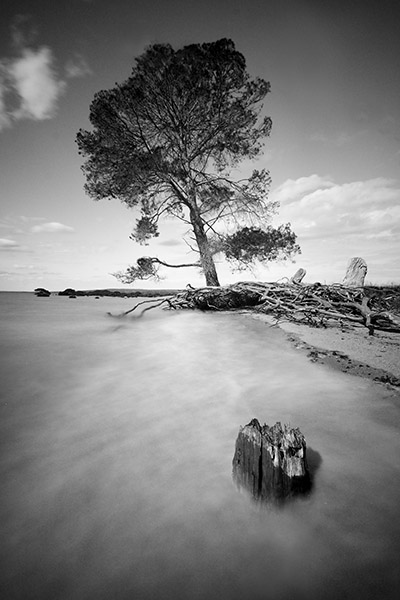
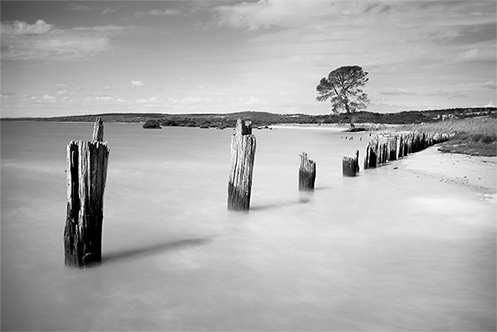
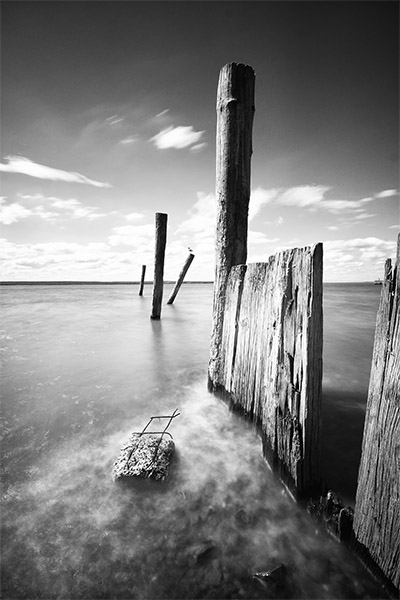
A high tide view of the docking station at Corinella. This is where the French Island barge docks to transfer vehicles and passengers to and from the mainland.
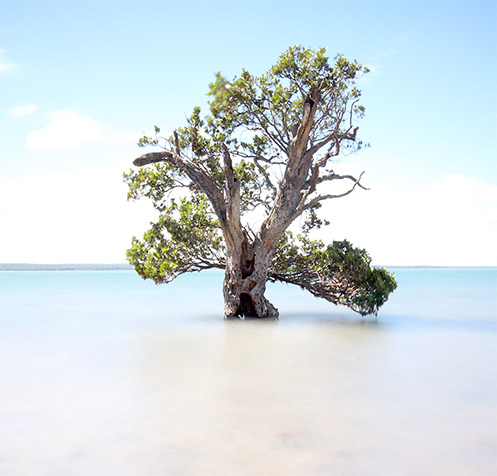
Below – Old Man of the Sea, an old mangrove tree just a stone’s throw away from the docking station.
Exploring the Pointy End of Phillip Island
I’d been to this part of Phillip Island on previous occasions but I loved it so much I thought I’d revisit.
That’s one of the joys of photography, you can visit the same location on several occasions and come away with completely different images each time.
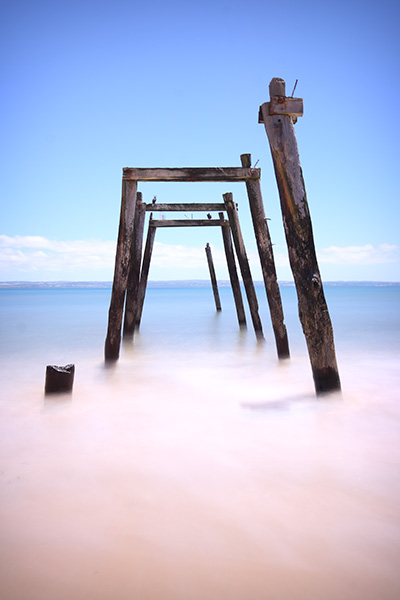
Pictured below – Old wooden remnants at Cat Bay, Phillip Island.


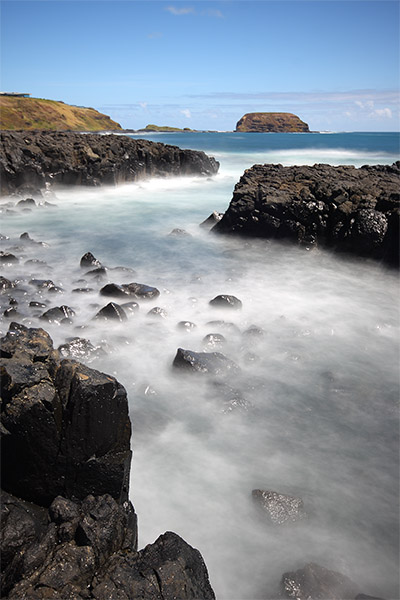
Pictured below – The beach at Right Point, Phillip Island, located between Cat Bay and the Nobbies. The violence of the ocean waves smoothed by the use of long exposure.

Sorrento to Queenscliff
The day started out well with brunch in Sorrento at the Buckley’s Chance restaurant with friends Christine and Caroline.
After being suitably fueled by brunch we strolled to the other end of town and boarded the Sorrento-Queenscliff Ferry for the short trip across the mouth of Port Phillip Bay to Queenscliff.
On arrival we departed the ferry to see what photographic treasures we could find along the beach.
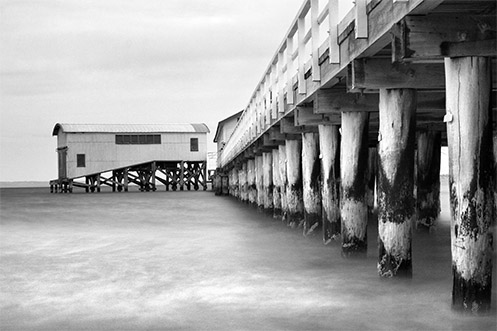
Pictured below – Queenscliff Pier, shot in the early afternoon using an ND400 filter to extend the exposure time and soften the waves.
Pictured below – Evidence of Dredge, a pipeline from the offshore dredger snakes it way past heavy posts buried in the sand at the shoreline. The waves softened to a mist by the use of long exposure time.

Pictured below, an unusual long exposure action shot of the ferry departing the Queenscliff beach on one of it’s many return journeys to Sorrento.

Pictured below – Caroline and Chris explore the beach with a ship load of onlookers viewing from the top deck of the ferry.

Sorrento Back Beach
Shortly before xmas I took the opportunity to snap some images just before the summer “silly season” struck Sorrento.
I’m certain that one day the Sorrento/Portsea area of the Mornington Peninsula will become so heavy with tourists that it’ll snap off and fall into the sea.
Until that day I’ll continue to enjoy it as much as I can.
Pictured below – A couple of long exposure images from south-east of the main beach.
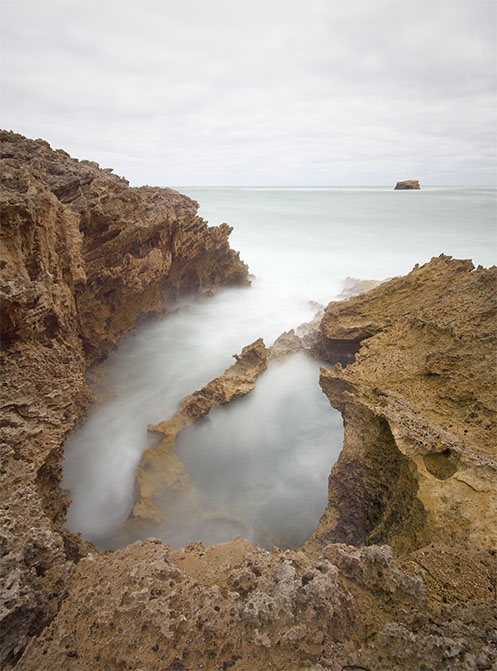
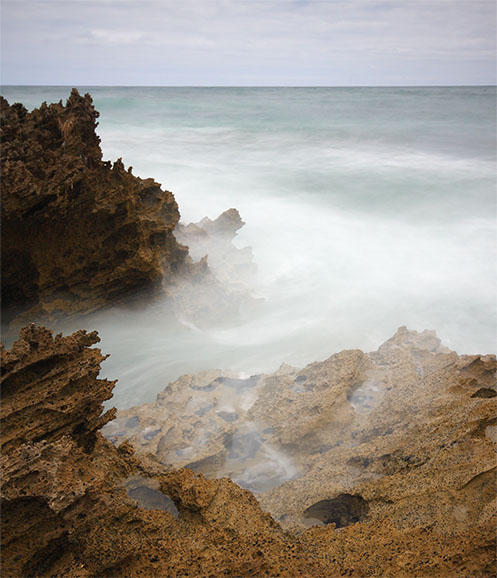
Pictured below – Bay of Islands – Sorrento
Located a short walk from the car park at the end of Diamond Bay Road.
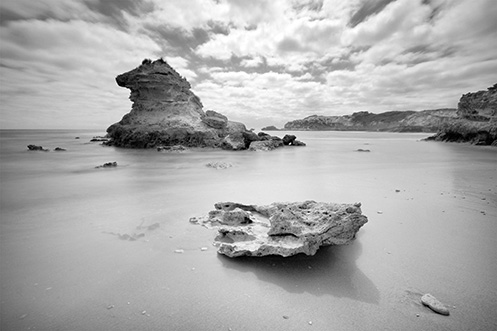
The Dragon’s Head at Number Sixteen
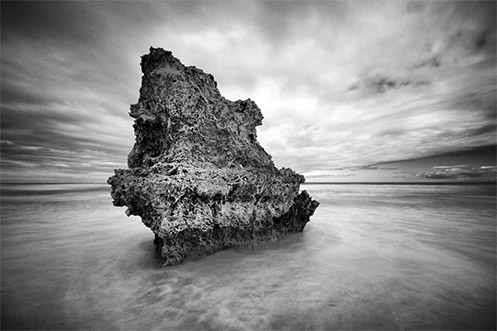
The Dragon’s Head rock at the Number Sixteen beach, Rye, has been a photographic target that I’ve been looking forward to shooting for quite some time. The last time I visited here I’d arrived a bit too late in the tidal cycle to safely explore the rocky plateau that surrounds the Dragon’s Head.
Today’s visit was executed with military precision. I arrived on the beach precisely at low tide, waded out to the Dragon’s Head through ankle deep water and excitedly set up my tripod. The ocean waves were crashing and rolling across the rocky plateau then cascading beautifully over the edge very close to the Dragon’s Head.
Being a big fan of long exposure images you can imagine my disappointment as I fumbled around in my camera bag trying to find my ND filters to fit the wide angle lens. They were no where to be found. I had left the filters behind at home, … they were attached to another lens. It was one of those forehead slapping moments.

In the absence of any suitably sized ND filters I decided to make the unique shape of the rock fill the frame in the image above rather than featuring the flow of water.
The next image below was taken from quite a distance back from the Dragon’s head using a 70-200mm lens. Fortunately I had a suitably sized ND filter for this particular lens so it was possible to soften the look of the flowing water. Unfortunately using the long lens meant that I wasn’t able to get the composition that I was looking for.
Lesson learned – double check the gear before leaving home, never assume!

Tenby Point Revisited
There’s something quite magical about Tenby Point. It’s one of those areas I feel compelled to visit from time to time.
A great surprise this visit was to find the road is now surfaced with asphalt. I’m going to miss all the corrugations and pot holes that once adorned the old dirt track leading to the beach.


The Mists of Kilcunda
On an unseasonally warm winter’s day last weekend, I took advantage of the fine weather to reintroduce myself back to our fine ocean coastline.
Upon arrival at Kilcunda, located on Victoria’s Bass Coast, the sea was remarkably calm and there was a thick haunting mist in the air. A wonderful sight indeed. 🙂

Technical stuff – The image was taken mid afternoon using an ND400 filter to lengthen the exposure time and thus soften the appearance of the sea.
The Noojee – Toorongo Photo Trip
It was one of those spur of the moment decisions.
Chris and I took off for a leisurely drive intending to have lunch at the Noojee pub followed by an afternoon of shooting at the Noojee trestle bridge and the Toorongo River.
As it turned out things were very quiet in Noojee that Friday.
We entered the strangely vacant Noojee hotel dining room and spent a few minutes looking through the menu whilst hoping that they were actually open for business.
After a short time we were discovered by a helpful barmaid who ushered us into the bar area whilst explaining to us that the dining room was closed.
Pictured below – Dappled sunlight across the middle of the Noojee Trestle Bridge.
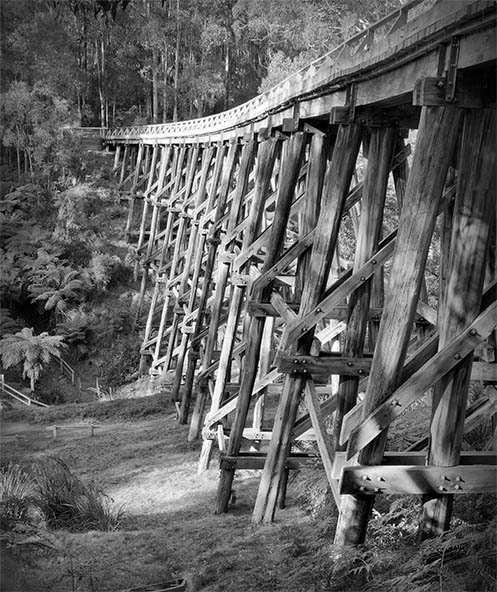
After being seated in the bar area Chris and I both chose the beer battered fish n’chips for lunch. Perhaps it wasn’t the most “heart smart” choice from the menu but it was indeed very tasty and satisfying without being too heavy. 🙂
As we ate our lunch Chris and I would occasionally glance over at the only other occupant of the room. One of the elderly locals was perched at the bar with beer in hand and kept nodding off to sleep. He appeared to be very skilled repeatedly awakening himself just prior to losing balance.
Pictured below – A shot taken from the top of the trestle bridge looking down on the access road. I’ve applied an Orton effect filter to this image to soften it a bit.

After finishing our delicious meals we visited the nearby Noojee trestle bridge. The light wasn’t particularly friendly that day as the morning clouds had dispersed causing a problem with harsh shadows and bright spots but we did our best.
Next stop was the wonderful Toorongo River. I always enjoy the scenic drive along the Toorongo Valley Road that leads to the falls.
It’s great to see the river with such a strong flow and healthy green mosses and small ferns growing on the moist rocks again.
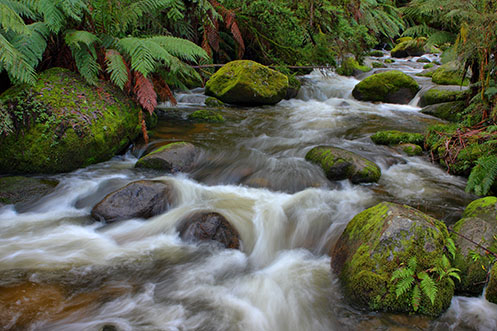
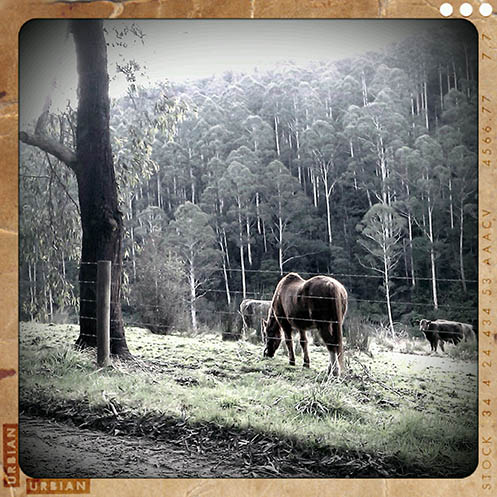
During this trip I decided to try out the camera built into my phone and capture some images using an Android app called Retro Camera. It uses some interesting processing techniques to imitate old school cameras. A fun app!!
Pictured below – The Retro Camera interpretation of the Toorongo River.
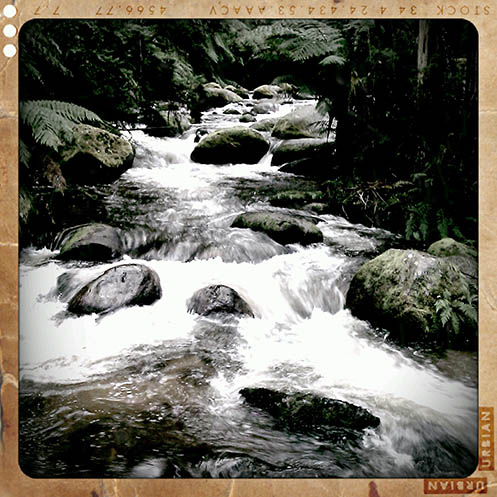
Pictured below – A serene image from along the Toorongo Valley Road processed by the Retro Camera app.
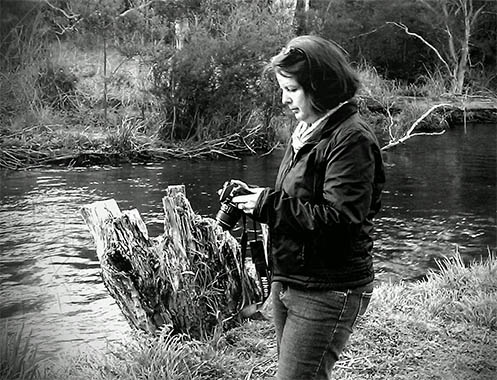
Pictured below – Chris checking her shots on the banks of the river behind the Noojee pub.
Image processed by the Retro Camera app.
Cyclical Rendezvous – water motion at Rye beach
Pictured below, a long exposure image capturing the remnants of spent waves returning to the relentless ocean at Rye beach, Victoria, Australia.

Number Sixteen beach – reprocessed
A couple of images from the previous excursion to Number Sixteen beach, reprocessed in black and white, ……and with a little more drama added.
A long exposure from Rye back beach, Victoria, Australia.
Rye Back beach.

Swimming at the Sixteen – Rye Beach
After a recent photographic excursion to Koonya beach two weeks ago, I swore not to return my feet to the icy waters of the ocean until the warmer weather arrived.
Alas, the lure of the salty seas proved to be too much for me.
This week’s excursion was a low tide expedition to Number Sixteen beach at Rye on the Mornington Peninsula.
Unfortunately I arrived just a little bit too late in the tidal cycle to safely photograph my intended target. Rather than risk my life on the rocky shelves I decided to play around on the beach photographing easier targets, …..and only got wet up to the knees. 😉
A long exposure image from Rye beach.
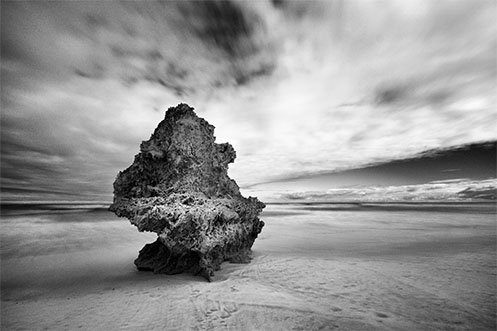
This rock is one of the main features of the Number Sixteen beach. It dramatically changes it’s perceived shape depending on the direction from which you photograph it.
Water rushes back from the beach to join the pounding surf.

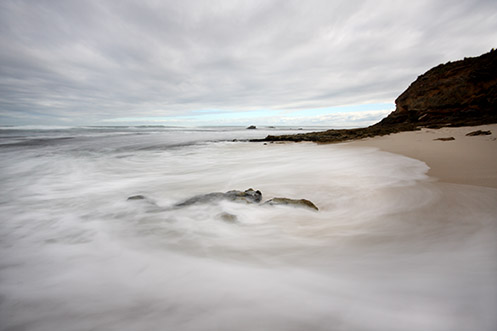
Water swirls around the foreground rocks as it enters the beach.
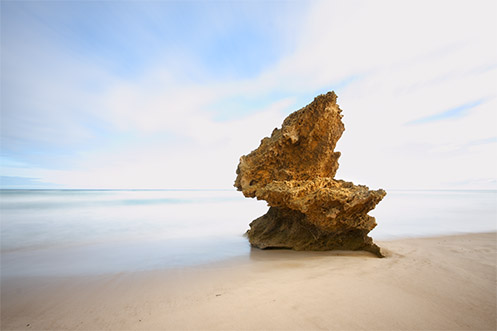
The landmark rock from a different perspective.

American Dreams Exhibition and the Bendigo Sacred Heart Cathedral
We left early Saturday morning for the two hour drive to the regional city of Bendigo in Victoria, Australia.
The Bendigo Art Gallery was hosting a photographic exhibition called American Dreams, a selection of 20th century photography from George Eastman House in the U.S.A.
On arrival in Bendigo my friends and I stopped for brunch at the Cafe El Beso located opposite the art gallery.
After due consideration of the menu we all coincidentally chose the “big breakfast” to kick start our day. The big breakfast consisted of eggs, bacon, mushrooms, fresh spinach and tomatoes all served on thick crusty toast. It was indeed big, satisfying and delicious, ….and highly recommended. The cafe for some strange reason doesn’t serve coffee in mugs, only cups. I don’t know what that’s all about!
With bellies full we waddled across the road and began our exploration of the gallery. We firstly enjoyed viewing the gallery’s impressive collection of large paintings before entering the area hosting the photography exhibition.
To be honest I was initially struck by how small and unimpressive many of the photographic prints were. Gradually as I explored the exhibition further I grew to appreciate the collection as I discovered some of the more moving and impressive images. In summary I would say the exhibition is worthwhile for those interested in the photographic process and journalistic photography.
The American Dreams exhibition ends at the Bendigo Art Gallery on the 10th July 2011.
My image of the inside of Bendigo’s Sacred Heart Cathedral.
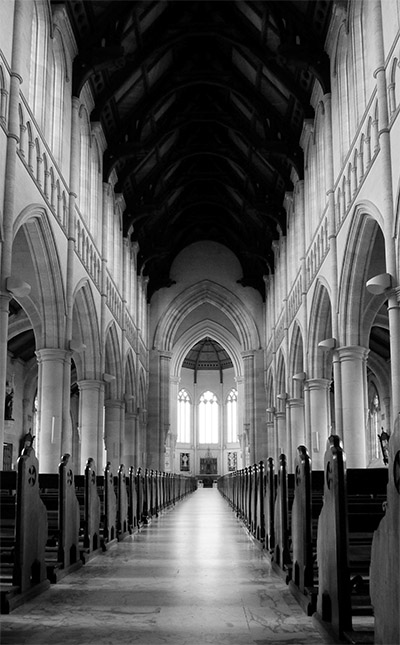
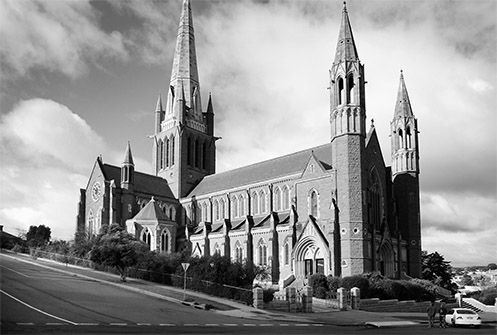
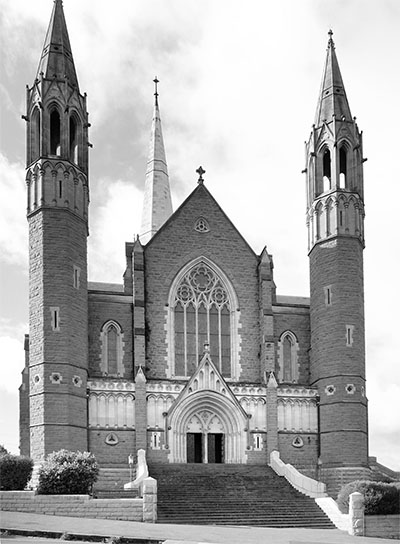
After leaving the gallery we went to explore the Sacred Heart Cathedral.
Hospitals and churches both rank very highly on my list of least favorite places to visit however this cathedral is really quite a photographic gem.
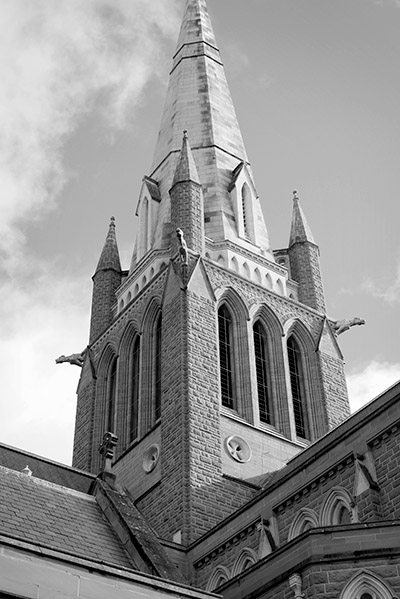
I shot these images on my LX3 using it’s “dynamic black and white mode” and hope to return there soon with my DSLR and a longer lens to catch some more details.
I love the gargoyles jutting out of the corners of the tower here.
The Chill of Winter – Koonya Beach
Winter has suddenly struck with a vengeance in Melbourne and it’s surrounding areas.
The reduced temperature of the Bass Strait water combined with chilling winter winds now makes wide-angle shooting amongst the crashing surf fairly unbearable.
On my most recent trip to Koonya beach, the chill of the winter water running across my lower legs caused my teeth to ache, ….well almost. 😉
Wild winter conditions at Koonya beach, Blairgowrie.
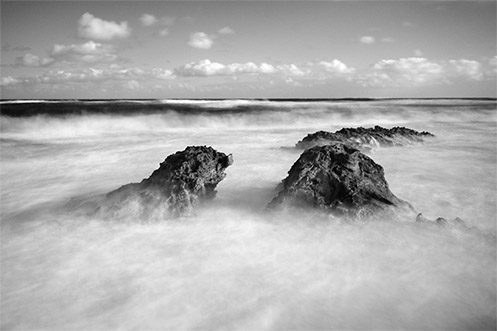
Until the weather warms up a little I’ll be using the mid-range zoom in an effort to keep my feet drier and warmer.
No more long exposures standing in the surf, …..bbrrrrrrr !!

Snapshots from Tooradin
Tooradin is right at the top of my list when it comes to escaping for a little bit of quiet time. Located just a few minutes down the road from my home, Tooradin’s features include a serene creek that runs through the town and winds it’s way down to a great foreshore area where it joins with Westernport Bay.
The foreshore area usually has lots of parking spaces available and serves as a fine place to devour whatever delicacy you’ve chosen from the local bakery, fish and chip, or pizza shop.
Alternatively you can bring along your own boring food and make use of the BBQs.
Pictured below – The view looking down the channel towards Westernport Bay at low tide.

During low tide, large expanses of mud are exposed along both sides of the channel.
You can stroll along the elevated edge of the channel and watch as thousands of tiny crabs, disturbed by your presence, dive for cover into their tiny holes in the mud.
Pictured below – The view looking up the channel towards the main road.
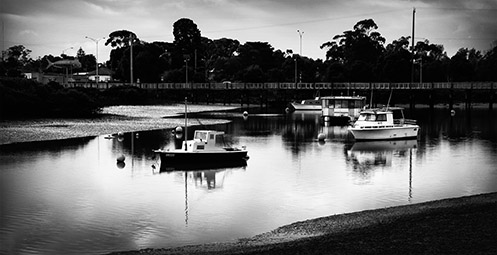
Back to the serious topic of food for a moment, I highly recommend the Tooradin bakery with it’s fine selection of meat pies. They also have more sweet cake/bun/doughnut thingies than you could poke a stick at, …..and the coffee isn’t too bad there either.
The bakery is also conveniently located next to the fine Ice Cream shop, offering heaps of different flavours for those craving even more sugar. 😉
Fish n’chips must be big business in Tooradin because this tiny town has no less than two fish n chip shops.
On one side of the main road is the Tooradin Original Fish & Chip Shop and across the road is the Boardwalk Chippery. The Boardwalk shop boasts the use of “healthy rice bran oil”. The rice bran oil must be an acquired taste, …I’ve tried it but I haven’t yet acquired that particular taste,….but each to their own.
Pictured below – Down the channel a short distance, remnants of the old jetty pictured at high tide, complete with “god rays” shooting through the clouds signaling the end of a beautiful day.

Below – The same jetty remnants pictured at low tide, complete with an amazing number of mud dwelling crabs and their mud holes. 🙂
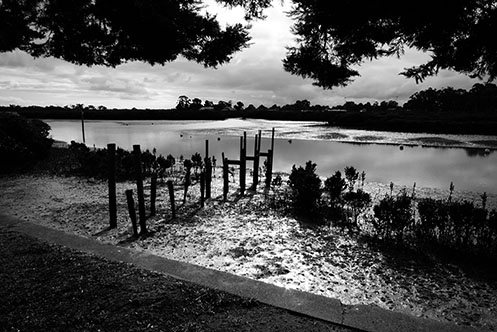
For the curious photographers who might be reading this post, the camera I used was a Panasonic Lumix LX3 in “dynamic B&W” mode with some minor corrections later in Photoshop.
If you’re interested in using any of these images or would like to purchase a high quality print then please contact me at – jim.worrall@gmail.com
What a Difference the Tide Makes.
A couple of images from the Flinders foreshore showing what a huge difference the tide can make.
Both images feature the same structure albeit from slightly different angles.
Below – Flinders Hombres – high tide at the jetty remnants.

Below – liN – the same jetty remnants at low tide.

Magic of the Phillip Island coastline.
Following on from previous posts I thought I’d share with you just a few more images from the Phillip Island coastline. I feel like I’ve just scratched the surface down there, …….there’s just so much beauty to explore and discover.
Pictured below – The Roost – old jetty remnants that serve as a safe roost for the local birds at Cat Bay.

Pictured below – Evidence of Life – a soft misty view of some wonderful wave action off Cowrie beach.

Pictured below – The Long Swim Home – another view from Cowrie beach looking towards the Nobbies in the background.

Pictured below – Pyramid Rock, taken in strong windy and wet conditions from a vantage point ahead of the lookout area.

In Lieu of Rapture
I’m dedicating this image to the recent passing of Rapture Day, May 2011.
Never has such a silly idea generated so much noise in the media and on social networks.
Pictured below – In Lieu of Rapture.

The image was captured at Cat Bay on Phillip Island.
A Trip to the Pointy End – Phillip Island
Over the weekend I did a quick reconnaissance trip down to the pointy end of Phillip Island.
The images below were taken on a stretch of unsealed road named “The Boulevard” which runs along the south coast of Summerlands and ends at the Nobbies. The Boulevard is a grand name indeed for what amounts to a narrow dirt track, however the coastal views can be quite impressive from here.
Pictured below – The view from The Boulevard looking west towards the Nobbies.
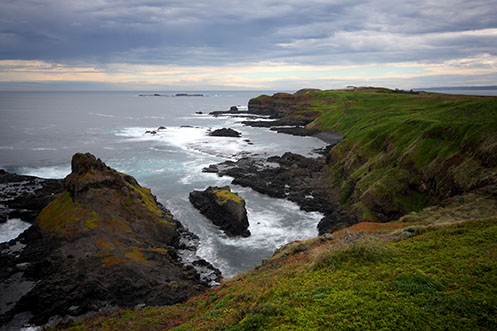
Unfortunately for those of us who like to immerse ourselves in these kinds of coastal environments there is no beach access permitted. We’re reminded of this fact by strategically placed signs warning of penalties for such breaches.
Pictured below – The view from The Boulevard looking east.
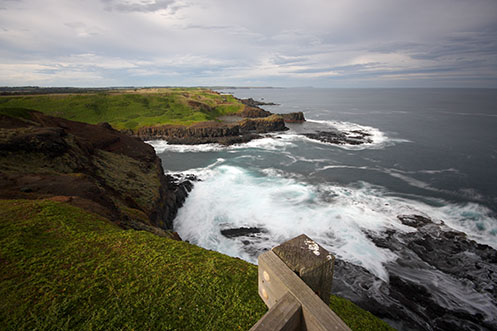
Pictured below – a zoomed in view of the coastline. It looks like a fine place for a photographer to play.
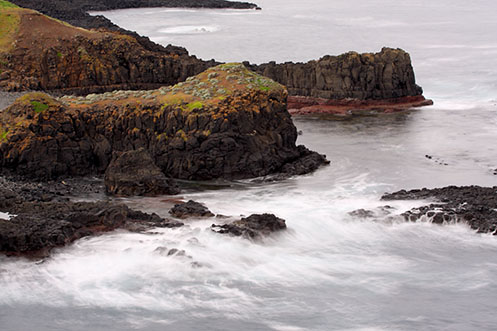
When finished with the south coast I made the short trip over to the north coast to visit Cowrie beach. I’ve been here once before but I had some unresolved images in my head that I wanted to try to capture here. Most of the northern coast is photographer friendly, allowing one to get as close to the water as one dares.
Pictured below – Bull in a China Shop, one of the less sedate Phillip Island waves attacking from left of frame.

Pictured below – A long exposure image using an ND400 filter, The Course of the Penguin, one of the many corridors used by the penguins of Phillip Island.

After finishing at Cowrie beach I left the island and crossed the bridge over to San Remo on the mainland. As I was crossing the bridge I noticed some amusing looking stairs below, surrounded entirely by the water of a high tide. It appeared to be a stairway going from nowhere to nowhere.
Pictured below – From Nowhere to Nowhere, San Remo.

The day concluded with a delicious meal of fish n’ chips from the Fisherman’s Cooperative, …..what bliss!
The bollard, the boat, the buoy and the beginning of a rainbow.
Saturday’s excursion was down towards the pointy end of the Mornington Peninsula.
After a hearty lunch of fish ‘n chips on Dromana beach, it was off to Sorrento for a cappuccino and also check out the surf conditions on the ocean side.
On arrival at the back-beach the surf was violent and unruly, fueled by a ferocious onshore wind.
I’ve tried to capture long exposure images under these conditions a couple of times before and come away from the experience with disappointing results. A howling wind always manages to soften my long exposure images regardless of tripod technique.
With this in mind I resigned myself to exploring the calmer more docile side of Sorrento, the bay side. The view from the beach here was quite nice with small boats bobbing and wobbling around in the water. I took a few shots of the little boats but couldn’t find anything particularly satisfying so I moved my attention to the huge bollards near the pier.
Pictured below – Bollard.
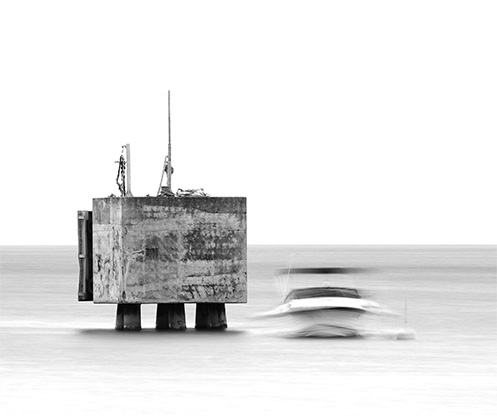
Above – In this image the huge concrete bollard remains motionless whilst surrounded by the blurred movement of waves on the water. It’s nearby neighbors, the boat and the buoy wobble and rock in compliance with the waves. I used a high key effect to eliminate some distracting elements from the background. Both ND400 and ND8 neutral density filters were attached to the lens to achieve the desired long exposure under fairly bright conditions.
Pictured below – The Sorrento Bollards.
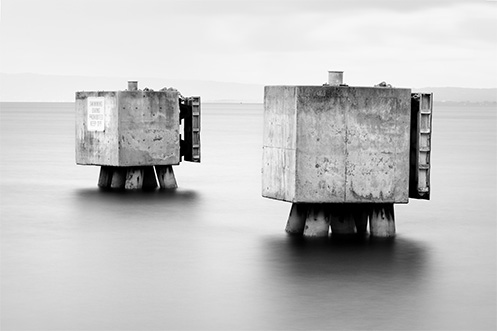
Above – The massive bollards are used to assist with holding the Queenscliff-Sorrento ferry in place at the pier during the exchange of passengers and cars.
After shooting the bollards, mother nature tried to grow me a rainbow. The left and right ends of the rainbow were developing nicely and gradually growing skywards then suddenly fizzled into nothingness.
Pictured below – the left end of the incomplete rainbow.

Pictured below – the right end of the incomplete rainbow.

HMVS Cerberus shipwreck at Half Moon Bay
After a delicious lunch at the Ricketts Point teahouse, Chris from Ambientcapture and I drove to Half Moon Bay where the wreck of the HMVS Cerberus rests semi-submerged some distance offshore.
The HMVS Cerberus was launched in 1868 and is the only remaining breastwork monitor class warship left in the world. You can find more details about the ship’s rich history at it’s Wikipedia page here, or it’s dedicated website here.
My idea from a photographic perspective was to capture the Cerberus using long exposure techniques to blur the motion of the water and clouds, and yet keep the wreck in sharp focus.
I had to wrestle with this one in post processing due to the extreme brightness of the background but I think I finally found a unique vision of the wreck.
Pictured below – HMVS Cerberus is available as a print in various sizes and formats here.
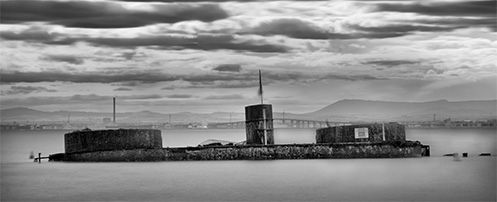
Pictured below – a long exposure view from the Half Moon Bay pier looking north along the coastline. The little blurry bit at the lower center of the image is a buoy bobbing around in the waves.

Pictured below – a more distant long exposure view of the HMVS Cerberus.

Pictured below – the structure behind the Cerberus wreck.
I have no idea what it is, but it’s very popular with the birds.

Downtime – a relaxing afternoon at Warneet
I have mixed feelings about the changes being made to the coastal village of Warneet.
Many of the grand old pine trees along the beachfront have been cut down and it appears that the main dirt roads are being surfaced. Progress, …..I guess.
Pictured below – Downtime – An iconic landmark (watermark) at Warneet coastal reserve.

Pictured below – some of the locals.


The Vagabond Tide – ND400 long exposure
Following is a series of images taken at the Sorrento back beach, Victoria, Australia, using an ND400 filter during bright afternoon light conditions.
Pictured below – Dorsal.
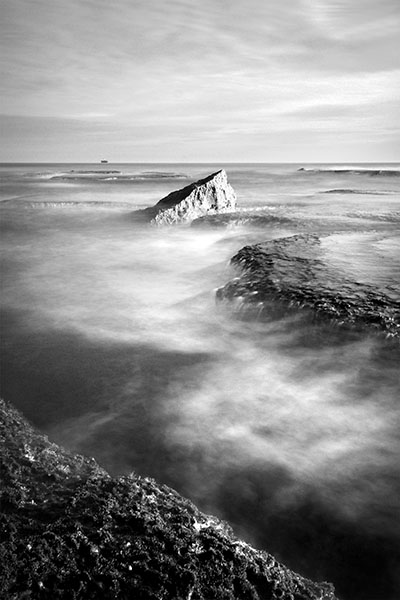
Below – The Vagabond Tide.

Below – The Rinse Cycle.


By the Seaside – Tooradin and Corinella
Following are some images from the shores of Westernport Bay.
Pictured below – The Journey Home, seagulls at the Tooradin foreshore take off en masse as the day gives way to night.

Below – Corinella Sunset, a series of “God beams” appear from behind a cloud as the sun sets at Corinella pier. These “God beams” are also known as crepuscular rays and are explained at Wikipedia here.

Below – The Living Jetty.
At Corinella a jetty platform disappears below the surface during a king tide.
The local sea birds take advantage of the exposed posts by using them as a safe roost.

Below – The best position for overseeing the activities at the Corinella jetty area.
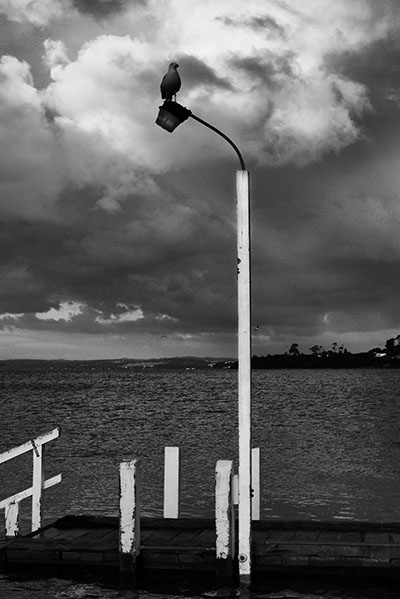
Exploring the Point Nepean immigration quarantine station
Pictured below, the very industrial looking fumigation chambers in the Point Nepean quarantine station were once used to disinfect the belongings of recently arrived immigrants.

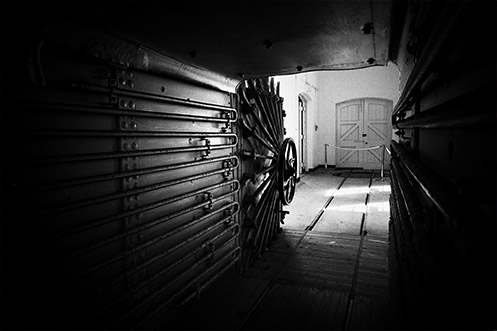


Pictured below, more images from around the historic buildings at the quarantine station.
Parks Victoria has a nice PDF explaining a little about the attractions here.


An Afternoon at Cowrie Beach, Phillip Island.
Cowrie Beach is located just a few hundred meters north-east of the popular tourist destination “The Nobbies” on Phillip Island, Australia. The beach sits just inside the entrance to Westernport Bay and is subjected to rough surf originating from Bass Strait.
The thinly vegetated sandy portions of the beach are home to Fairy penguins and some other more endangered species so there are signs present advising which areas to avoid.
The main attraction here from my perspective is at the water’s edge. The beach is blessed by the presence of dark basalt rock formations continuously pounded by waves.
Below – The Nobbies – an image from Cowrie beach with The Nobbies in the background.

Below – Down the Winding Path – a long exposure looking out to sea from Cowrie Beach.

Below – Awaiting the Devil – a frightening part of the beach where unexpected waves suddenly inundate the dark basalt platforms. There’s a warning sign on the beach reminding fishermen and other visitors how easy it is to be swept off these rocks.
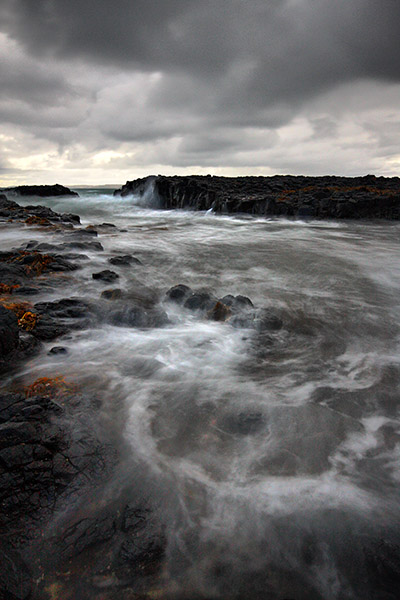
Below – The Ordeal – How the Phillip Island penguins manage to survive the violent Bass Strait surf combined with rocky beaches escapes me.

Below – Through the Vapour
Underground at Point Nepean
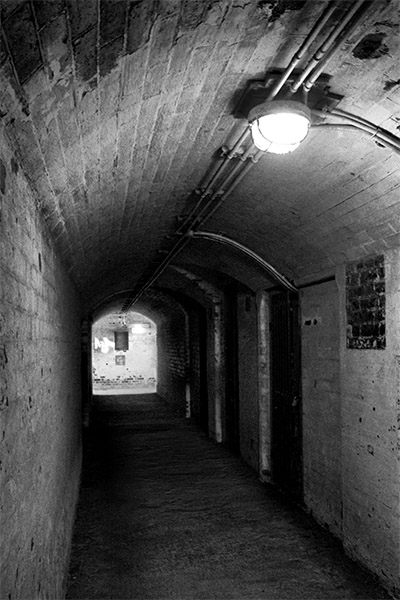
Point Nepean is located at the entrance to Port Phillip Bay and contains old military fortifications dating back to the 1880s.
Amongst the many features at Point Nepean are the old gun emplacements which are serviced by a series of interesting tunnels and purpose built rooms buried into the hill.
The underground atmosphere is enhanced by audio loops continuously playing the eerie sounds of a military yesteryear.

.

.

.
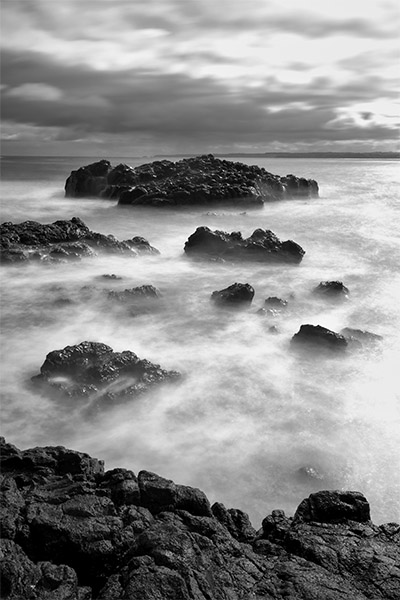
Exploring the light at Right Point, Phillip Island
Saturday’s excursion to Phillip Island turned out to be very rewarding from a photographer’s perspective.
In the late afternoon I stopped at a place called Right Point, which seems to be a very popular destination for surfers. As I peered over the edge of the cliff towards the beach I instantly fell in love with this spot.
Below me were the remains of an old jetty being pounded by the violent surf.
With the sun starting to drop towards the horizon what more could a photographer ask for?
I grabbed my tripod and camera bag and dashed down to the beach like an excited child. The images were already forming in my mind before I had even reached the sand, ……..oh what a feeling !! 🙂
Below – Drawn to the Ocean
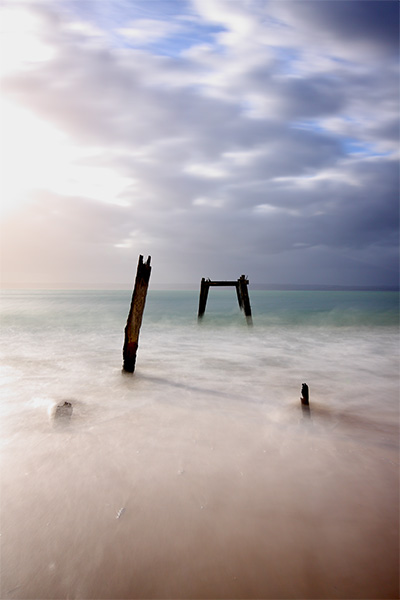
Below – The Penguin Pool
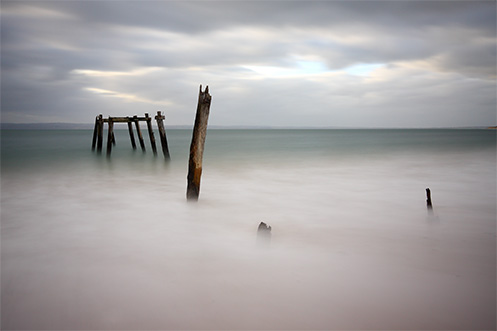
As the sun dropped even closer to the horizon a good situation became even better when suddenly Crepuscular rays broke through a gap in the clouds.
Crepuscular rays, also known as “God rays” or “God beams” are explained here.
Below – Running to the Light
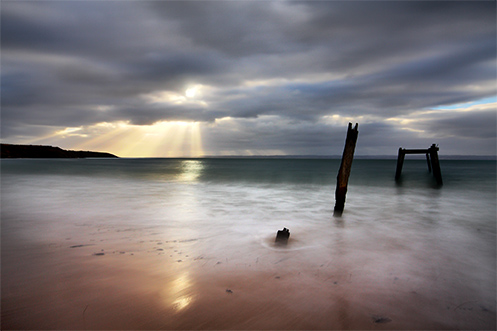
Below – Sky Burst
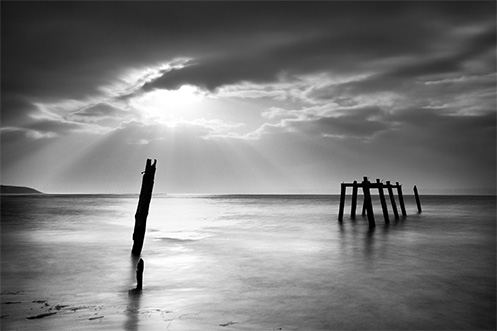
Below – Agaze


 Photography by Jim Worrall