
Exploring Cape Schanck
Cape Schanck is located at the southern tip of Victoria’s Mornington Peninsula.
The beaches here offer a feast of opportunities for photographers. At the tip of the cape sits Pulpit Rock, a huge monolith standing proud amongst tidal rocky platforms.
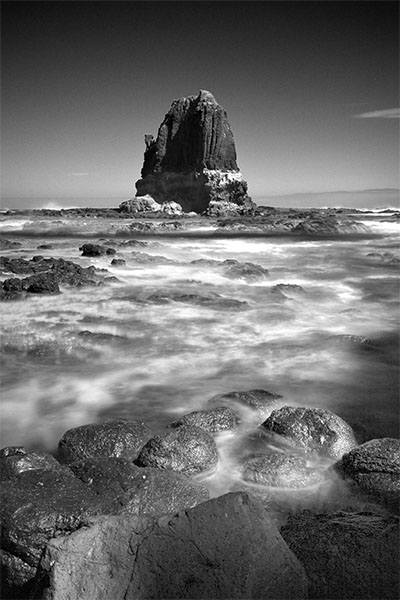
At low tide the rocky platforms are exposed allowing fairly easy access to a large number of rock pools. These pools are home to a variety of sea creatures including small fish, crustaceans and octopuses. Depending on the time of year the pools can contain various forms of brightly coloured seaweed, providing wonderful hiding places for the rock pool residents. This is a great place to dunk your waterproof compact camera if you’re lucky enough to own one. Unfortunately I don’t own one (yet).
Below – Pebbles at the Pulpit

The beach leading out to Pulpit Rock is covered by rounded rocks that roll around and pound into each other with each wave creating an interesting sound that’s quite difficult to describe.
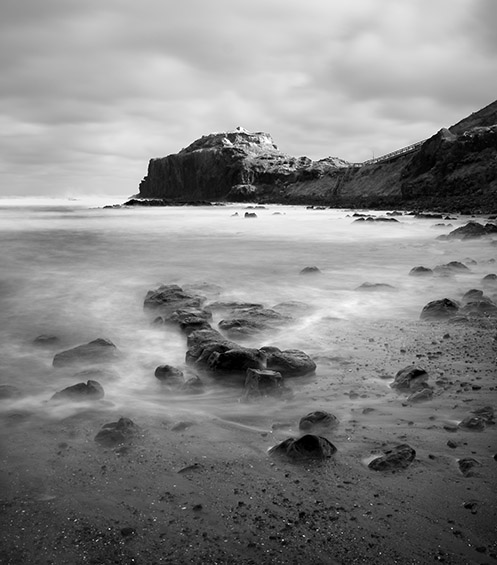
Below – Cape Schanck Lighthouse overlooking the west side of the cape.

Below – Cape Schanck East. The eastern side of the cape provides a rocky beach where there are lots of opportunities for the photographer who enjoys capturing waves crashing over and around rocks. I took quite a few long exposures here.

Below – The Schanck. The white surf and dark rocks contrast each other nicely and provide excellent material for making great black and white images.
Fluid in Motion – Flinders
One of my favorite spots for photogenic wave action along the Mornington Peninsula is Flinders.
West of the township the rugged coastline features extensive cliffs with access to the rocky beaches in only a few places.
The deliciously dark rocks here provide a wonderful contrast to the bright white surf as waves from Bass Strait relentlessly pound the beach.
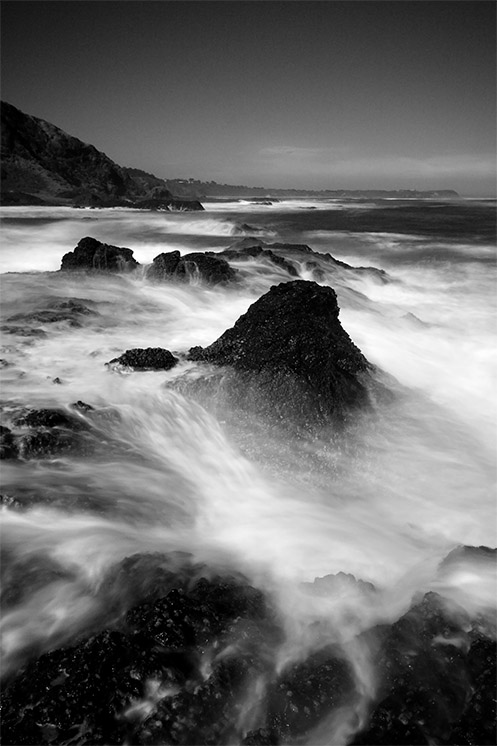
On this occasion I visited the beach during the early afternoon so conditions were extremely bright and contrasty.
I used an ND400 filter, sometimes in combination with an additional ND8 filter, to darken the scene and enable the use of slow shutter speeds to blur the moving water.

It’s always fun and games being close to the edge in places like this. Despite keeping one eye on the camera and the other eye on incoming waves I was caught by surprise on a couple of occasions during the afternoon and drenched by rogue waves exploding on the rocks.
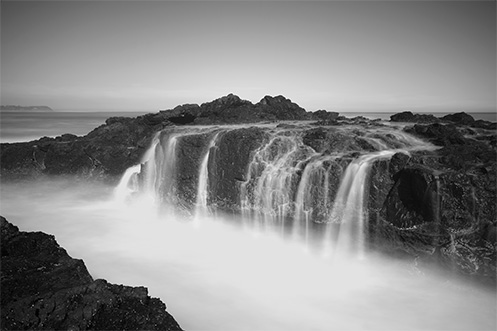
This is really quite an extraordinary spot from a photographer’s perspective. Not so special for the grand seascape but more for the myriad of recesses where the surf dynamically interacts with the rocks.

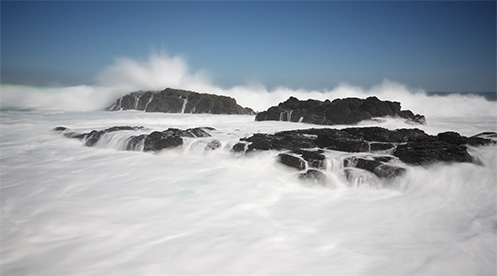
Construction at Powlett River
The construction of the controversial desalination plant near the mouth of the Powlett River has yielded a temporary point of interest for photographers.
A large platform has been placed offshore to assist with the construction of the required underwater pipeline.
Although not the most beautiful structure in the world, it acts as a nice point of interest for an otherwise potentially boring background.
I’m in no way a supporter of this project but I decided to take advantage of the platform while it’s there and took a series of images from the spot where the Powlett River meets the ocean.
The idea behind the images was to use the lines created by running water and rock edges to draw the viewer into the scene towards the platform in the background. The images were taken in bright mid afternoon light using strong ND filtering to enable the exposures to be long enough to blur the water.
Below – Platform One

Below – Platform Two

Below – Platform Three
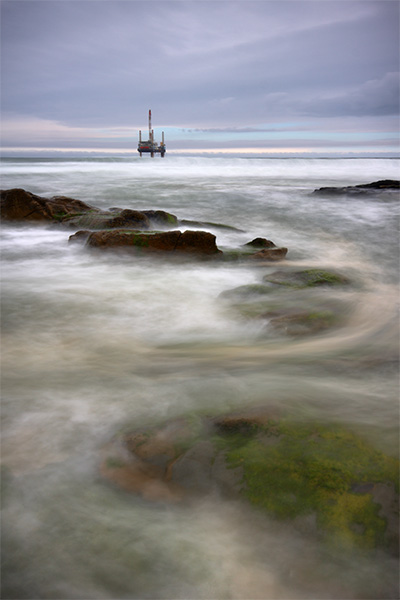
Below – Mouth of the Powlett – Looking north-west across the mouth to the sand dunes, the waves crashing onto the rocks in the foreground just appear as mist due to the long exposure time.
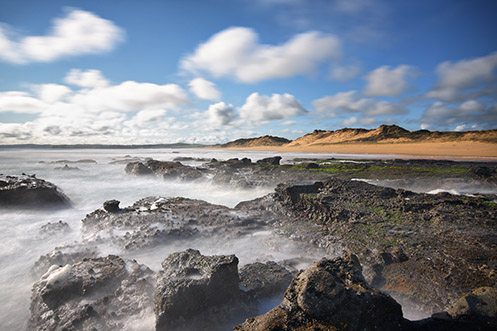
Below – a couple of experimental panoramic shots of the river and dunes.
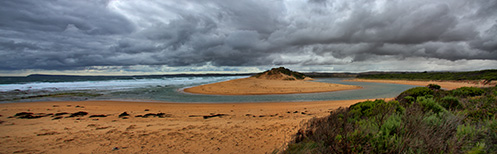

Exploring Ricketts Point, Beaumaris, Port Phillip Bay
Ricketts Point is a marine sanctuary located south east of Melbourne in Port Phillip Bay. When viewed from the land it’s an unremarkable looking series of sandstone rock platforms. Apparently under the waterline the platforms support a great diversity of flora and fauna.

When viewed from a land-based photographer’s perspective the area looks pretty ordinary during bright daylight hours.
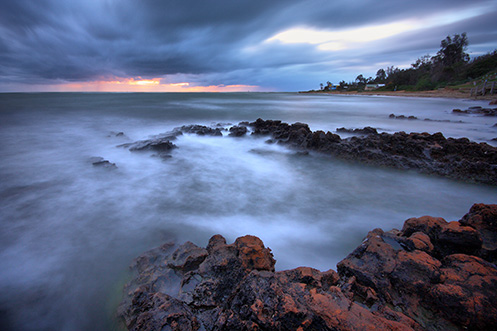
Towards the evening the area becomes more attractive as it provides an unobstructed view of the setting sun and also provides some foreground interest in the form of waves swirling around rocks at the edge of the platforms.
This provides a good opportunity to catch some nice long exposure images.

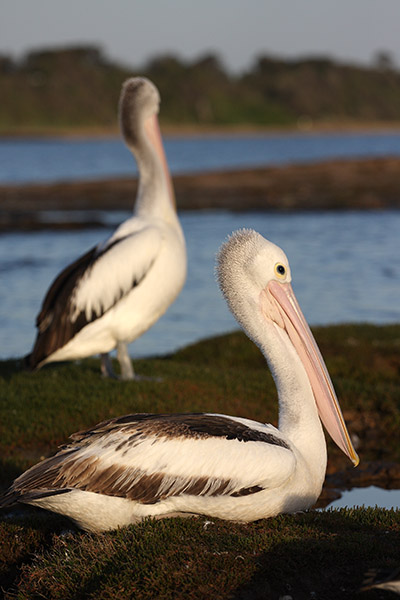
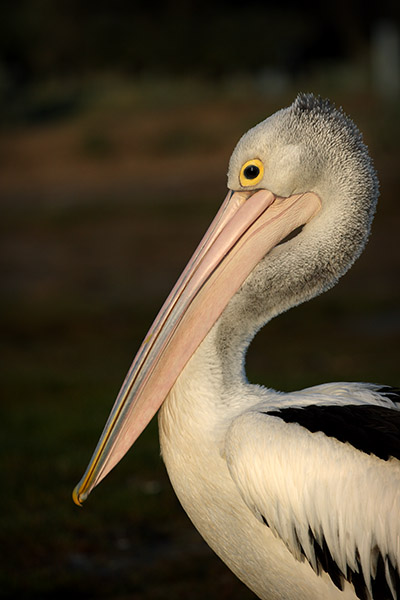
Prior to the sun setting, the rocky platforms serve as a meeting place for several species of birds. Amongst them are a very tolerant group of pelicans. They don’t seem to mind people getting relatively close to them here which provides a nice opportunity for bird watchers and photographers.



The Beauty of Polly McQuinn’s Weir, Strathbogie.
The picturesque Polly McQuinn’s Weir is well sign posted and located a few kilometers south-west of Strathbogie, Victoria, Australia.
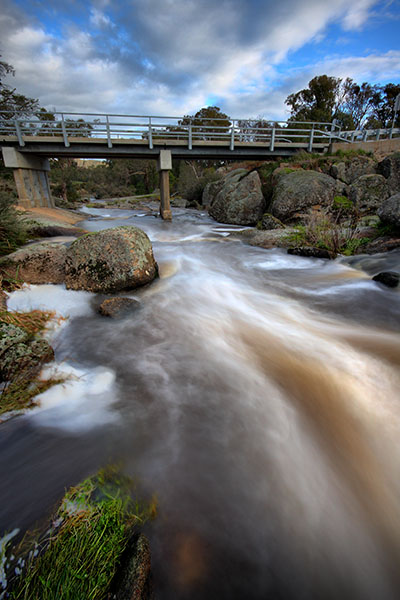
The weir features a spillway where water streams over a concrete wall and onto large exposed granite boulders.
The water then continues snaking around more boulders before flowing under a road bridge then traversing a gently sloped granite plateau before reaching a deep pool surrounded by native vegetation.
There are many opportunities here for the keen photographer.
Below – A long exposure of water cascading over the spillway wall and onto granite boulders beneath.
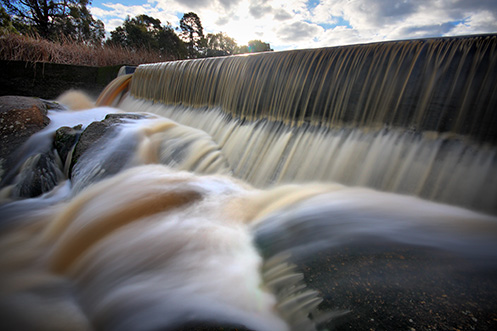
Below – Looking back towards the spillway wall, water flows rapidly over and around granite boulders on it’s way downstream.

Below – In the days preceding my visit to the weir the area had received heavy rainfall.
I suspect this caused lot of the brown silt present in the water. This caused an interesting effect in the water with the deeper sections of the flow taking on a brownish tinge and the shallow sections appearing bluish during long exposure shots.

Below – The view from the bottom of the spillway looking downstream.
The silted water runs rapidly under the road bridge.
Below – “Polly’s Overflow” – Looking upstream from the pool, the water traverses a gentle granite plateau then strikes some foreground boulders whipping the water into a frenzy before it finally enters the tranquility of the pool. This image is available to buy as a print at my Zazzle and RedBubble sites.
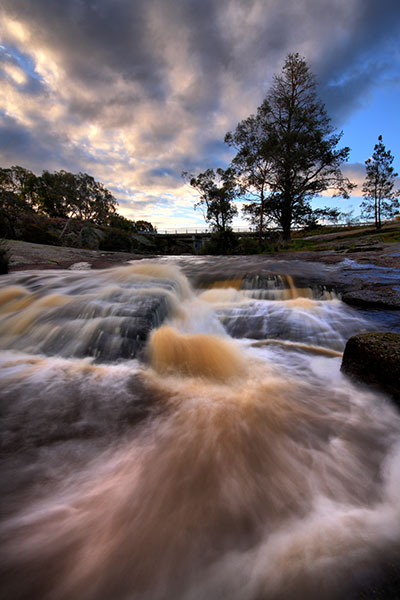
Below – “In Search of Polly”
Apparently the weir was named after a young woman called Polly McQuinn who drowned here more than 100 years ago. Legend has it that the ghost of Polly can sometimes be heard calling for help from passer by.
Unfortunately I didn’t hear Polly on the day I was here.
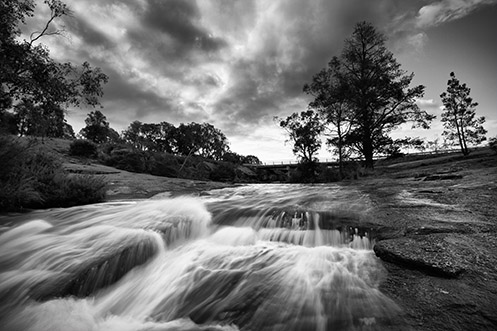
Incorporating HDR tonemapping techniques with long exposures
The following images were experiments using HDR tone mapping techniques combined with the effects of long exposure times.
Each image was constructed from at least 3 separate exposures using in-camera auto exposure bracketing. In my case, being a Canon shooter, I used 3 exposures of -2,0 and +2 simply for convenience. I believe Nikon shooters have a bit more flexibility in this area.
The images were all taken during daylight hours so it was necessary to use some heavy ND filtering in order to increase the exposure times and achieve a nice misty look to the water. In my case I used an ND400 and an ND8 filter stacked together to achieve this.
With the camera set to aperture priority mode I adjusted the aperture and filter combination (sometimes removing the ND8) to achieve an exposure of 8 seconds. When the shutter button is depressed the camera would then give me 3 exposures at 8 seconds, 2 seconds and 30 seconds (which is close enough to 0,-2 and +2). My particular camera doesn’t let me expose for longer than 30 seconds unless I go to bulb mode and use a remote timer, so out of laziness I tend to limit many of my exposures to 30 seconds. 🙂
The exposures were then combined and tonemapped using HDR software and tweaked in Photoshop to achieve the end result.
Despite all of this sounding a bit technical it’s really quite simple and I encourage you to try it. The results are often very rewarding.
BELOW – Jurassic Afternoon – Sunlight and waves break through a slit in the prehistoric Pinnacles rock formation on Phillip Island.

BELOW – The Mist of St.Pauls – A long exposure at St. Pauls beach, Sorrento, Victoria, Australia.

BELOW – Prehistoria – An image from The Pinnacles, at Phillip Island, Victoria, Australia.

BELOW – Swimming with Dinosaurs – Down amongst the prehistoric Pinnacles rock formations at Phillip Island, Victoria, Australia.

Daytime experiments with the ND400 filter.
The following long exposures were taken during daylight hours using an ND400 and ND8 filter stacked together on the front of my Sigma 10-20mm lens. The combination of these two filters attenuates so much light that peering into the viewfinder reveals an inky blackness even during bright daylight conditions.
It’s therefore necessary to compose the image BEFORE screwing the filters onto the lens. It’s also necessary to adjust the focus manually since the auto-focus system has no chance of working under such conditions.
*** (Update October 2012) The introduction of “live view” to many DSLR cameras means that is’s no longer necessary to compose and pre-focus with the dark filters off the lens. I shoot all the time now using live view to peer through the combined darkness of an ND400 and ND8. The filters now stay on the lens which means there is a lot less fiddling around. If you’re looking for a guide to show you how to use an ND400 have a look at my recent blog post here.***
I found that if I set the ISO as low as possible, and set the aperture very small (i.e. a high number), then it was possible to obtain a shutter duration of about 3 minutes. Such long exposures during daytime create some interesting images. I’m looking forward to experimenting more with the ND400.
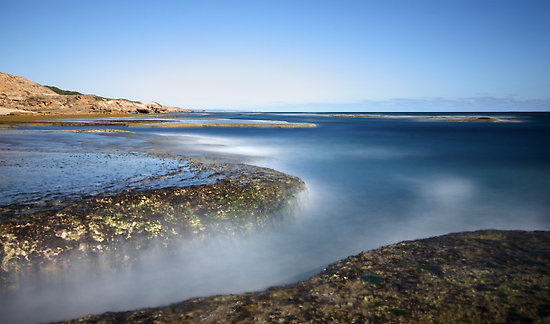


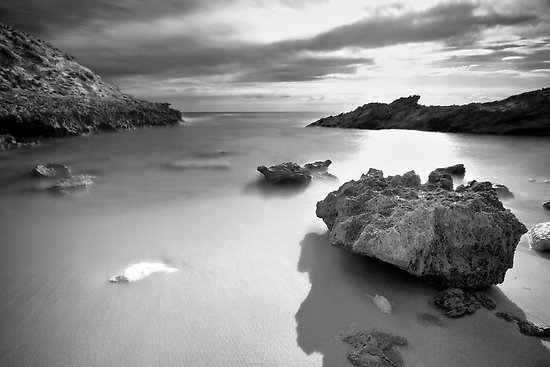
The trip to Point Lonsdale
The following are a series of images taken at Point Lonsdale at high tide.
Initially we went there in the middle of the day to try out some “black glass” ND400 filters. The idea was to shoot some daytime long exposures of the low tide water interacting with the exposed rock shelves. Unfortunately I felt a bit disappointed by the results, not because of the ND400 filter but because I had trouble finding satisfying compositions.
Upon returning to Point Lonsdale at sunset the tide was high and there was a bit more foreground interest and some colour in the sky. I managed to find these images a bit more satisfying.

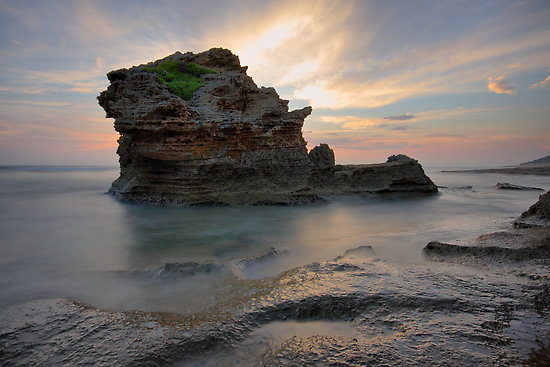
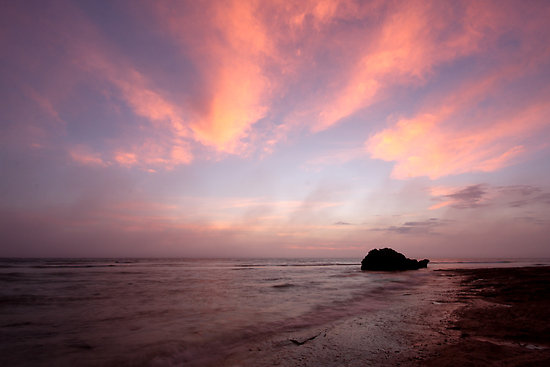
An Evening at Spray Point, Blairgowrie.
The following images were taken on an evening excursion to Spray Point / Montforts beach, Blairgowrie.
I’m never really sure where one beach ends and the other begins. 🙂
Tidal Trickle (below) was taken just prior to the sun dropping below the horizon giving some nice pinks in the sky.

Friends and Fatalities (below) is a long exposure shot taken just after the sun had dropped below the horizon.
The extended exposure time makes the moving water take on a misty appearance and blurs the clouds whilst the foreground rocks remain in focus.

The Unpredicted (below) is a long exposure shot showing water flowing off the rock plateaus after sunset.
Despite the deceptively calm appearance of the image this is really a potentially treacherous area with unexpectedly large waves occasionally sweeping across the plateaus.

Out on the rock shelves
The following three images were taken on an excursion to the rock shelves of Montforts beach, in Blairgowrie.
It’s an interesting place to be during the transition from high to low tide, as the water on the expansive rocky plateaus cascades over the sides on it’s return to the ocean.
Whilst here it’s important to be aware of which way the tide is going and also keep an eye out for occasional large rogue waves that sweep across the shelves. Prepare to get wetter than you expected here.
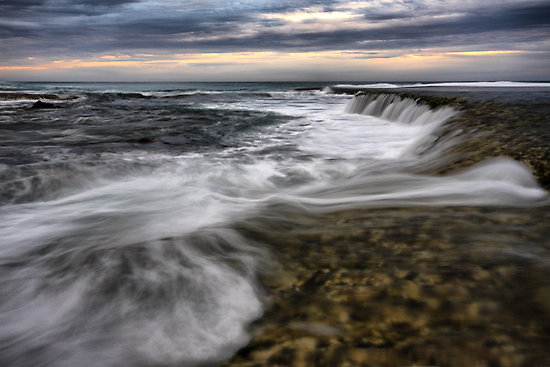
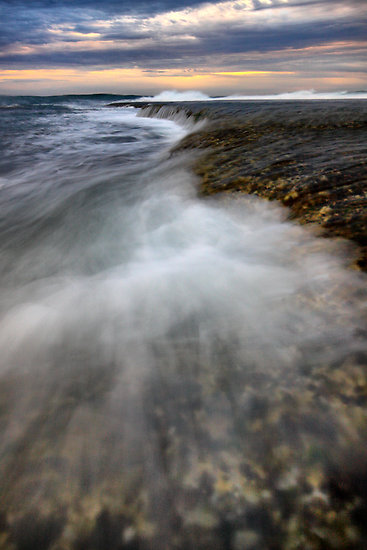

The image below was taken at the neighboring Sorrento beach.
It’s a long exposure taken after sunset giving the oceans surface a deceptively calm and smooth appearance.
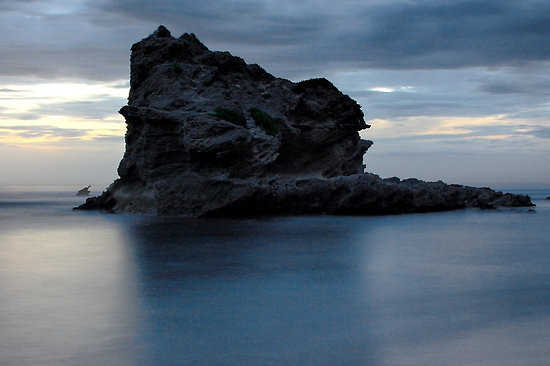
Light and Time at my Ocean Beach
A selection of images taken from two excursions to Sorrento beach.
Return to Primal is a long exposure taken after sunset. The true motion of the waves disguised by the slow shutter speed.

High Tide Sphinx is a slow(ish) exposure taken at high tide as the sun was setting behind the Sphinx rock formation at Sorrento beach, Australia.
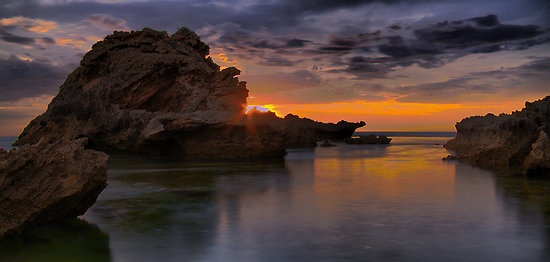
Life in the Good Pond is a slow(ish) exposure taken at sunset. A polarizing filter was used to take the reflection off the surface of the rock pool allowing the scene below the surface to become visible. The blurring on the water was caused by the wind rippling the surface.

I Peek Around the Corner is another image from Sorrento where a polarizing filter was used to remove the unwanted reflection of the sky from the surface of the water enabling us to see the wonder below. In the distance on the horizon the Sphinx rock formation is visible.

Dusk at Sorrento ocean beach – some long exposures
A series of long exposures taken at Sorrento beach, Australia.


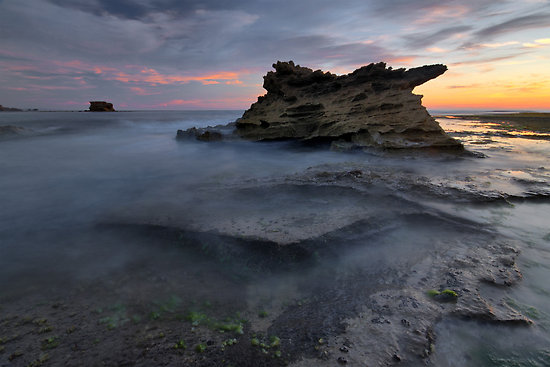

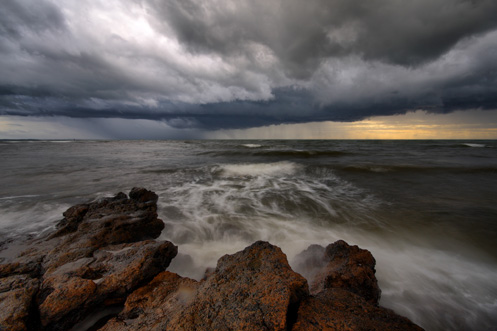
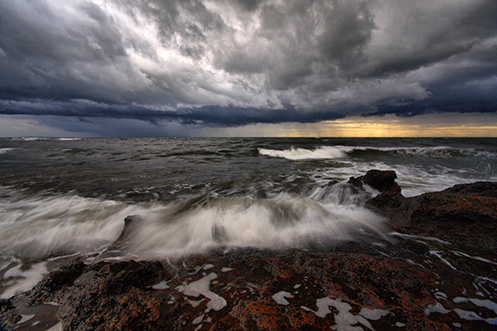
A storm rolls over Port Phillip Bay
Following are 3 images taken yesterday at Ricketts Point, Beaumaris, as a storm rolled across the bay.
The apparent power and turbulence of the clouds in the sky is mirrored by the motion and ferocity of the water. It was an invigorating place to be.

Long exposures on the Mornington Peninsula
A series of long exposures taken at Sorrento and Blairgowrie beaches on the Mornington Peninsula, Australia.
These images were taken using the Sigma 10-20mm and Canon 17-85 mm lenses with ND8 and polarizing filters stacked on the front in order to slow the shutter speed.
Note – when stacking two filters on the 10-20mm lens the rim of the outermost filter becomes visible in the corners of the images necessitating a little cropping in post processing.
All of these images are available to purchase in various forms and sizes by clicking on their titles.
Blaze – taken at Sorrento beach.
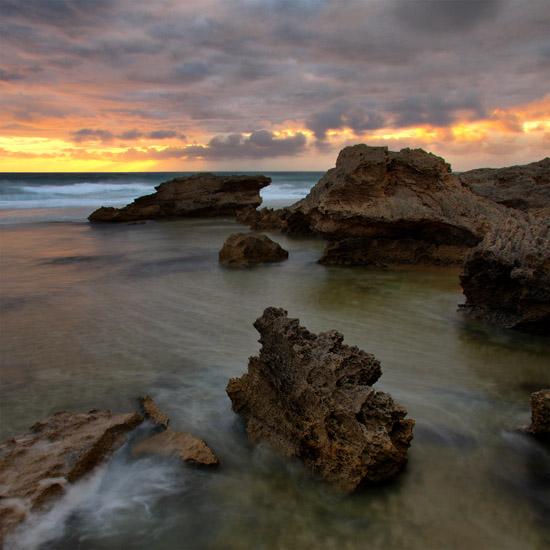
The Glow of Last Light – taken at Sorrento beach.

The Pastel Kiss of Night – taken at Blairgowrie beach.
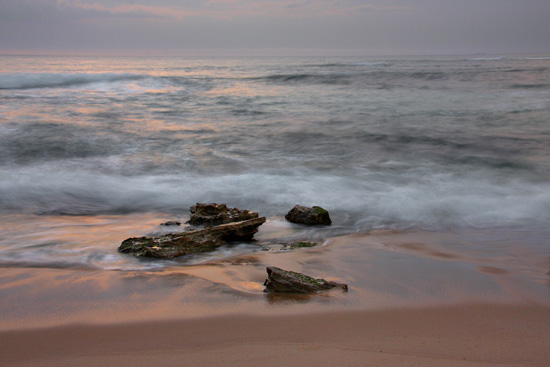
Welcome the Night – taken at Blairgowrie beach.

Koonya Isle – taken at Blairgowrie beach.

Through Angler’s Eyes – taken at Blairgowrie beach.

Burrabong meets the Bushranger
This image shows the Burrabong Creek meeting the ocean at Bushrangers Bay near Cape Schanck, Victoria.
Bushrangers Bay is a secluded beach located about one hours walk from the Cape Schanck car park.
The walking track winds it’s way through beach scrub, up and down hills including many stairs, and along scenic clifftops.
I would advise anyone taking this track to wear sturdy footwear as the path is shared with aggressive bull ants for much of the way, and of course there’s always a chance of encountering a snake sunning itself. Oh, and don’t forget a bottle of drinking water.

The Chant of the Pulpit
A seascape image from Cape Schanck in Victoria, Australia.
The image features the well known landmark Pulpit Rock as incoming waves rush across the surface of the surrounding rocky platforms.
The Chant of the Pulpit.
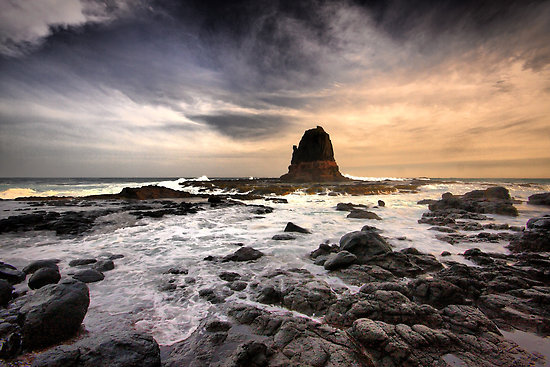
A rockscape at Fingal beach.
After a short hike through the “Fingal forest”, see previous post, I arrived on the beach with the sun high in the sky.
Of course this isn’t the best time of day for photographing this kind of environment.
Landscape and seascape images are best captured around dawn or sunset when the scene is always less contrasty.
In the image below I was attracted by the shimmering, sparkling highlights on the surface of the water as the sun managed to poke its way through a break in the clouds.

A morning at The Pinnacles, Phillip Island.
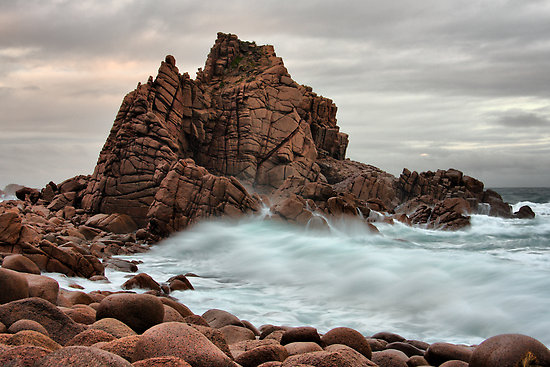
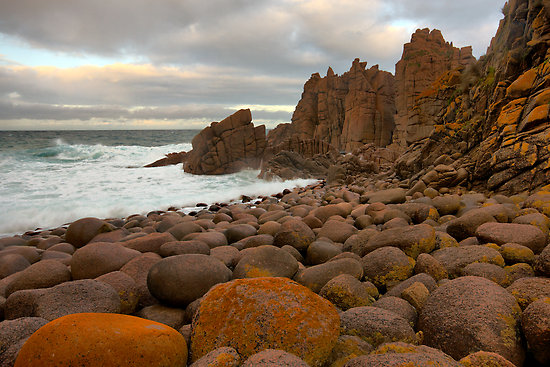
After a long pre-dawn walk along tracks through the tops of the coastal cliffs I arrived at The Pinnacles in time to see the sunrise. Access to the Pinnacles beach area here is via a steep (slippery when wet) track running down the face of the cliff area.
Unfortunately it turned out to be a dud sunrise so there wasn’t much colour in the sky but after getting down to the beach the view of the rock formations was wonderful. An interesting feature of this beach is the large round rocks covering the ground, great for photos but a challenge to navigate at times.

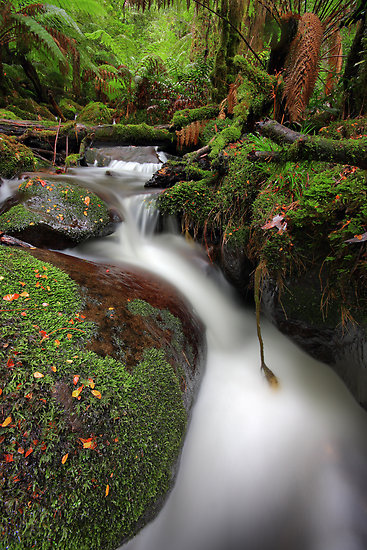
Paradise Gully
Looking upstream at Cement Creek near Warburton, Victoria, Australia.
A beautiful lush green environment well worth visiting for it’s photo opportunities.
This image is available to purchase as a high quality print here.
Flying Solo – exposure after sunset
This image was taken at Sorrento beach shortly after the sun had dropped below the horizon.
The long exposure (30 seconds) smooths out the motion of the waves and gives the ocean a smooth, almost cloud like appearance. The pink hue is a remnant of the sunset.
This image is available to purchase as a high quality print here.

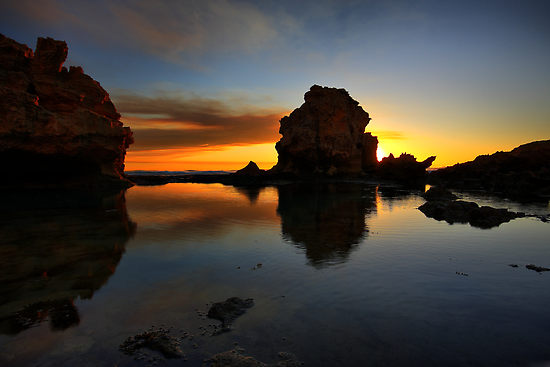
Sirens – magic of sea and sunset
A sunset taken at Blairgowrie beach, Australia.
I never get sick of visiting this ocean coastline along the Mornington Peninsula. The rocky landscape remains as a constant, however the continually changing sky and tide never fail to create a new captivating scene.
Generally the best time to visit this area are when the sunset corresponds with a low tide.
This image is available to purchase as a quality print here.
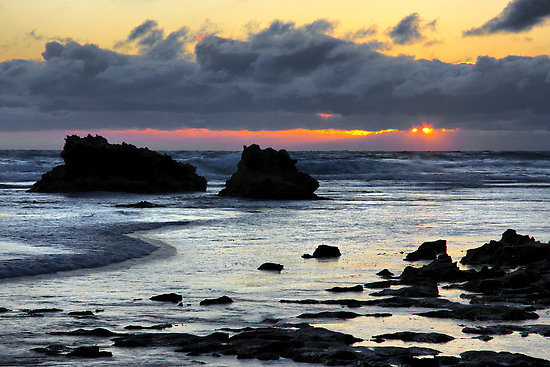
Spellbound – a Blairgowrie sunset

A sunset at Blairgowrie ocean beach, Australia.
This image is available to purchase as a high quality print here.
Neptune’s Playground
A monochrome sunset shot taken at Sorrento ocean beach.
This image is available to purchase as a print here.

Afterglow Sorrento
A sunset shot taken at Sorrento ocean beach, Australia.
This is one of my favorite areas to photograph when the tourist season has finished.
This image is available to purchase as a print here.
West of Mind
A monochrome HDR image taken at Blairgowrie beach, Australia.
The sun struggles through gathering storm clouds.
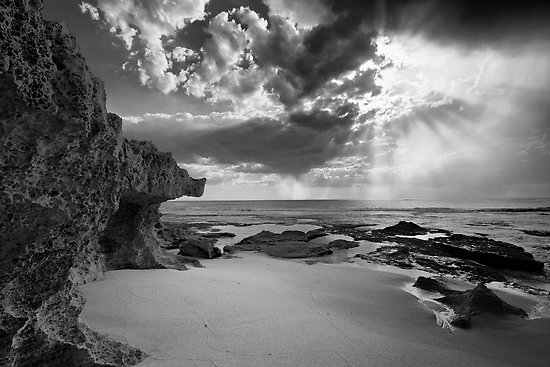
This image is available to purchase as a print here.
January Prime
An afternoon shot, taken at Blairgowrie ocean beach.

This image is available to purchase as a print here.
Exploring the magical Powlett River
A rewarding excursion to the beautiful mouth of the Powlett River.

Image above – The Rush of the Powlett.
Just prior to the Powlett’s water reaching the ocean, the shallow flow speeds up, rippling at the surface and dancing over low obstacles.
The dunes in the background and the river bank on the right glow yellow-orange as the sun sinks low on the horizon.
Image available for purchase here.
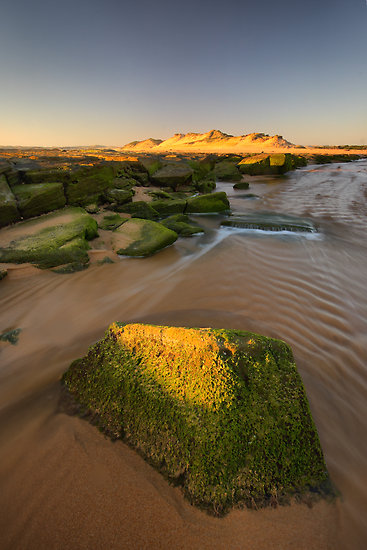
Image above – Ripples.
Evening at the mouth of the Powlett River.
The foreground rock and background dunes lit by the setting sun.
Image available for purchase here.

Image above – The Magic Hour.
The orange glow from the setting sun catches the tops of the foreground rocks and the distant dunes at the mouth of the Powlett River, Australia.
Image available for purchase here.
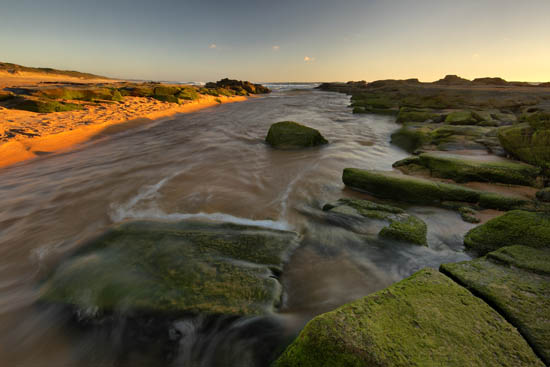
Image above – Looking towards the end of the Powlett River as it meets the ocean.

Image above – Last Rays at the Powlett.
Looking out across the river mouth to the setting sun.
Image available for purchase here.

Image above – Near Journeys End.
The Powlett River nears the end of it’s journey as it winds it’s way through sand dunes towards it’s ultimate destination, the ocean.
Image available for purchase here.
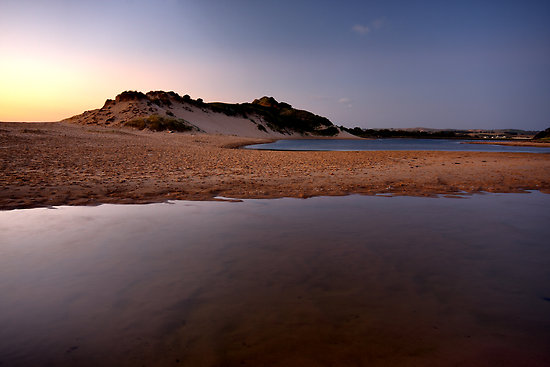
Image above – Powlett Sunset.
The sun sets as the Powlett River winds it’s way through the sand dunes.
Image available for purchase here.
The Archway to Yesterday
The Archway to Yesterday – a seascape shot taken at Blairgowrie ocean beach as the sun drops below the horizon.
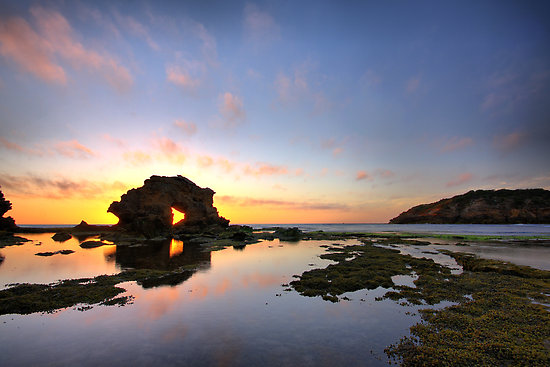
This image is available to purchase as a print here.
Koonya Sunset
Sunset at Koonya beach, Blairgowrie, Australia.
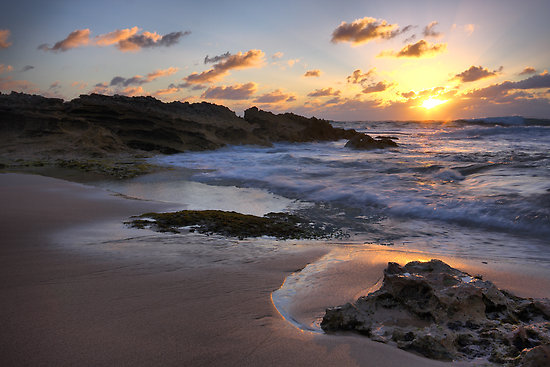
This image is available to purchase as a print here.
Aqua Dynamics – the beauty of force
This black and white image demonstrates the explosion of forces as a Bass Strait wave strikes bedrock along the Victorian coastline.
I was using a 10-20mm lens here so the saying “objects are closer than they appear” applies here.
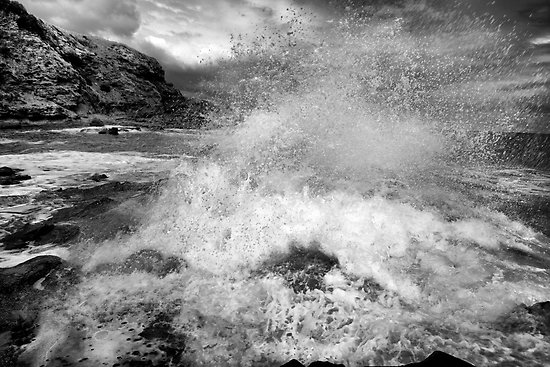
This image is available to purchase as a print here.
A few minutes later I was hit by this sweet thing pictured below. You’ll need to excuse the motion blur as I panicked and tried to move the camera out of harms way as the wave hit us.
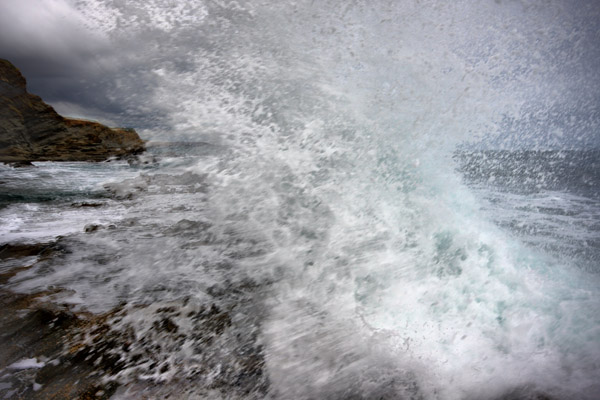
We, (the camera and I), were both soaked by this Bass Strait “back hander”. At this stage, a couple of days later, both the camera (Canon 40D) and the lens (Sigma 10-20mm) are still working. I must be blessed by the camera gods because this isn’t the first time we’ve had a salt water soaking.

 Photography by Jim Worrall