
Exploring Cape Schanck
Cape Schanck is located at the southern tip of Victoria’s Mornington Peninsula.
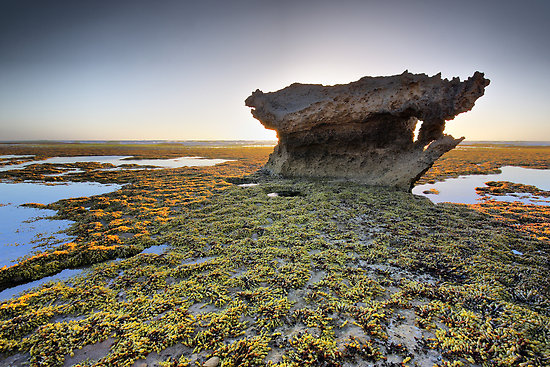
The beaches here offer a feast of opportunities for photographers. At the tip of the cape sits Pulpit Rock, a huge monolith standing proud amongst tidal rocky platforms.
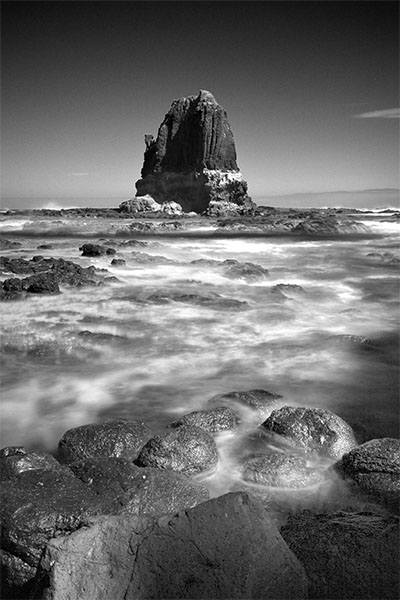
At low tide the rocky platforms are exposed allowing fairly easy access to a large number of rock pools. These pools are home to a variety of sea creatures including small fish, crustaceans and octopuses. Depending on the time of year the pools can contain various forms of brightly coloured seaweed, providing wonderful hiding places for the rock pool residents. This is a great place to dunk your waterproof compact camera if you’re lucky enough to own one. Unfortunately I don’t own one (yet).
Below – Pebbles at the Pulpit

The beach leading out to Pulpit Rock is covered by rounded rocks that roll around and pound into each other with each wave creating an interesting sound that’s quite difficult to describe.
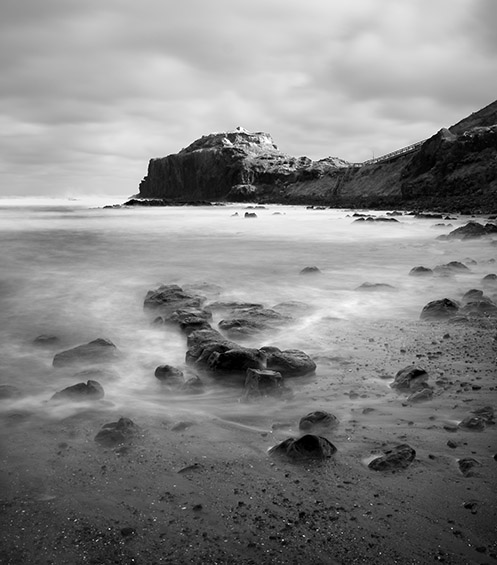
Below – Cape Schanck Lighthouse overlooking the west side of the cape.

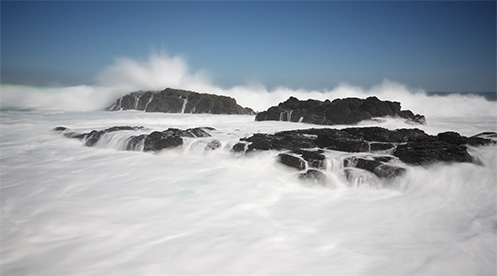
Below – Cape Schanck East. The eastern side of the cape provides a rocky beach where there are lots of opportunities for the photographer who enjoys capturing waves crashing over and around rocks. I took quite a few long exposures here.

Below – The Schanck. The white surf and dark rocks contrast each other nicely and provide excellent material for making great black and white images.
Fluid in Motion – Flinders
One of my favorite spots for photogenic wave action along the Mornington Peninsula is Flinders.
West of the township the rugged coastline features extensive cliffs with access to the rocky beaches in only a few places.
The deliciously dark rocks here provide a wonderful contrast to the bright white surf as waves from Bass Strait relentlessly pound the beach.
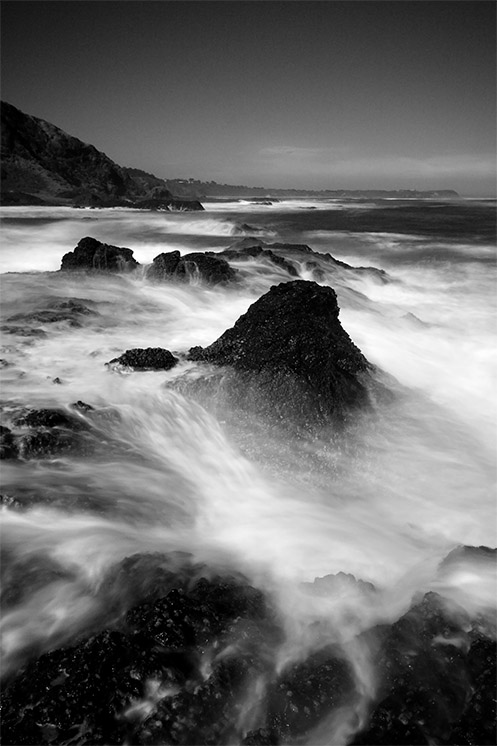
On this occasion I visited the beach during the early afternoon so conditions were extremely bright and contrasty.
I used an ND400 filter, sometimes in combination with an additional ND8 filter, to darken the scene and enable the use of slow shutter speeds to blur the moving water.

It’s always fun and games being close to the edge in places like this. Despite keeping one eye on the camera and the other eye on incoming waves I was caught by surprise on a couple of occasions during the afternoon and drenched by rogue waves exploding on the rocks.
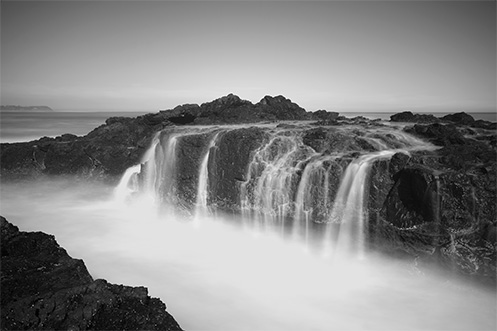
This is really quite an extraordinary spot from a photographer’s perspective. Not so special for the grand seascape but more for the myriad of recesses where the surf dynamically interacts with the rocks.

Construction at Powlett River
The construction of the controversial desalination plant near the mouth of the Powlett River has yielded a temporary point of interest for photographers.
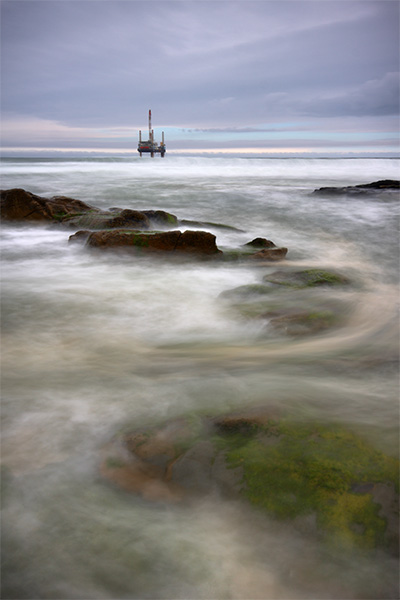
A large platform has been placed offshore to assist with the construction of the required underwater pipeline.
Although not the most beautiful structure in the world, it acts as a nice point of interest for an otherwise potentially boring background.
I’m in no way a supporter of this project but I decided to take advantage of the platform while it’s there and took a series of images from the spot where the Powlett River meets the ocean.
The idea behind the images was to use the lines created by running water and rock edges to draw the viewer into the scene towards the platform in the background. The images were taken in bright mid afternoon light using strong ND filtering to enable the exposures to be long enough to blur the water.
Below – Platform One

Below – Platform Two

Below – Platform Three
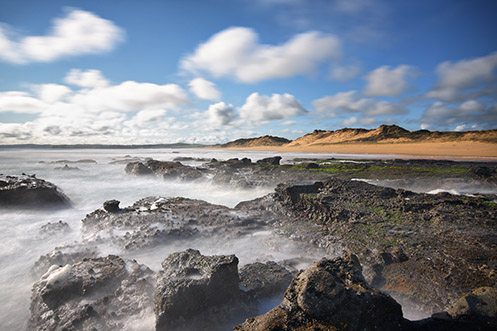
Below – Mouth of the Powlett – Looking north-west across the mouth to the sand dunes, the waves crashing onto the rocks in the foreground just appear as mist due to the long exposure time.
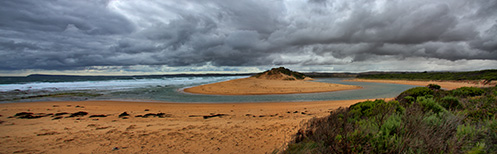
Below – a couple of experimental panoramic shots of the river and dunes.

Exploring Ricketts Point, Beaumaris, Port Phillip Bay
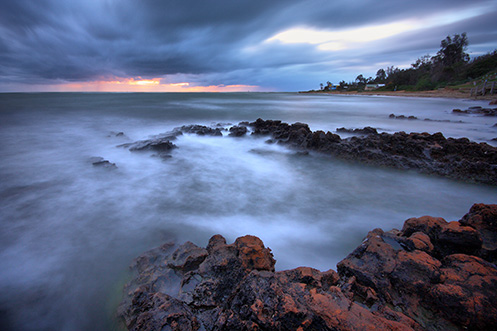
Ricketts Point is a marine sanctuary located south east of Melbourne in Port Phillip Bay. When viewed from the land it’s an unremarkable looking series of sandstone rock platforms. Apparently under the waterline the platforms support a great diversity of flora and fauna.

When viewed from a land-based photographer’s perspective the area looks pretty ordinary during bright daylight hours.
Towards the evening the area becomes more attractive as it provides an unobstructed view of the setting sun and also provides some foreground interest in the form of waves swirling around rocks at the edge of the platforms.
This provides a good opportunity to catch some nice long exposure images.

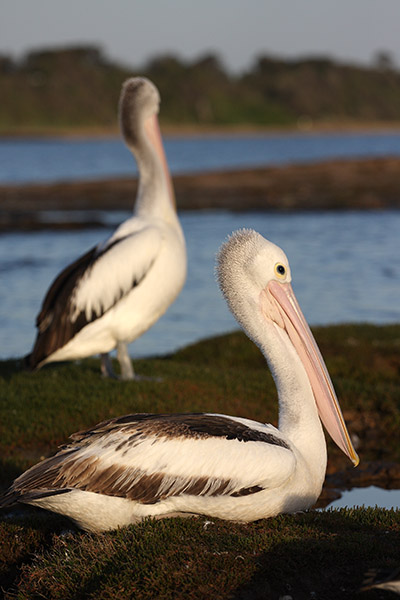
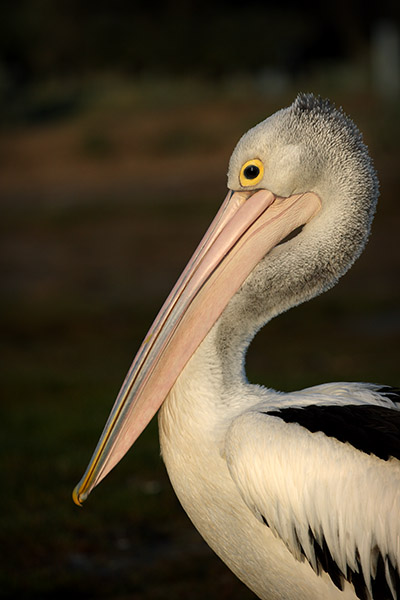
Prior to the sun setting, the rocky platforms serve as a meeting place for several species of birds. Amongst them are a very tolerant group of pelicans. They don’t seem to mind people getting relatively close to them here which provides a nice opportunity for bird watchers and photographers.



Chopsticks at Corinella
An excursion to Corinella revealed “the chopsticks”, large angled posts planted in the muddy sea bed. Remnants of some past structure.
Pictured below – “Chopsticks 1” available as a print here.

Pictured below – “Trio” available as a print here.

Below – To give some sense of scale I planted myself in this shot, …and it certainly wasn’t easy holding myself still in this position for the long exposure. 🙂

Below – A view of the beach on the south-west facing side of Corinella.

At the end of Seaford pier.
This excursion to Seaford pier was a second visit. My goal was to capture an image that I’d had in my mind for some time but wasn’t able to quite capture on the first visit.
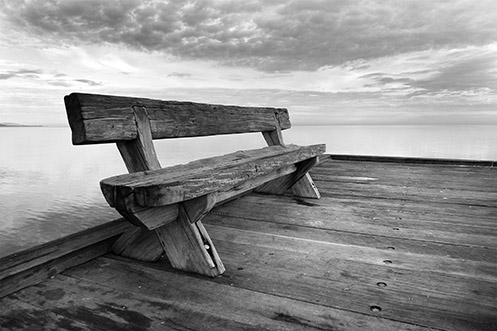
The subject of the image was a wonderful old wooden bench seat located at the end of the Seaford pier.
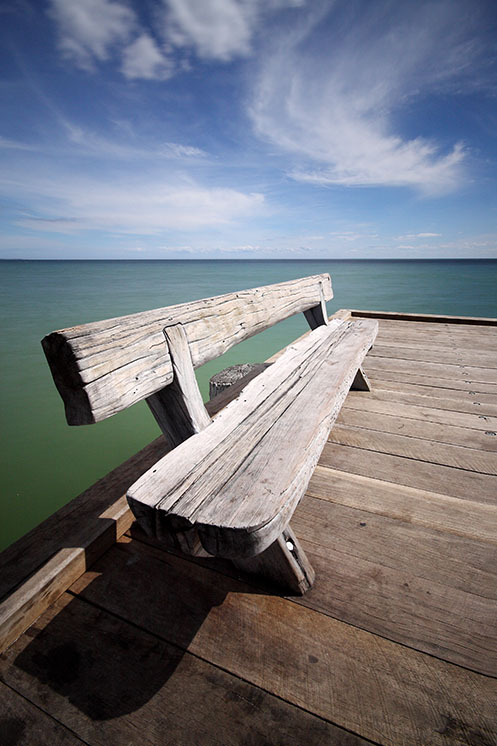
Pictured above – “The Silent Partner” is available as a print here.
I chose to use a long exposure here to smooth out the waves on the water and soften the clouds in the sky. This has the desirable effect of making the image less busy and draws the viewers attention to the wonderful grain and smooth worn texture of the wood.
Conveniently the lines of the bench also draw the viewers eyes into the image and towards a swirling cloud in the background providing a second point of interest.
Pictured below – “Observer” is available as a print here.
This is the image I took on the first visit. I like this image but it wasn’t the vision I initially had in mind. A local resident paid me the ultimate compliment by purchasing a framed print of this one.
To the tip of Cape Liptrap
Cape Liptrap is located on Victoria’s south east coastline overlooking Bass Strait.
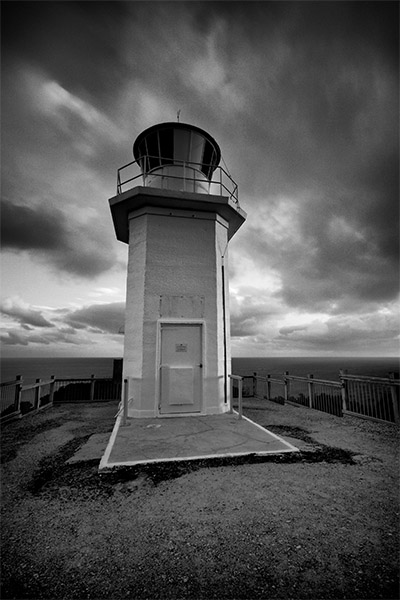
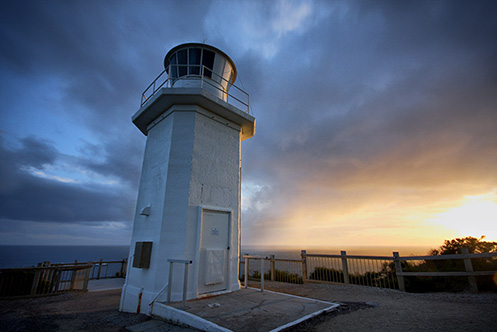
On the high ground just back from the pointy end of the cape sits the Cape Liptrap lighthouse.
Below – “Warrior of the Dark” available as a print here.
Below – “Night’s Witness” is available as a print here.
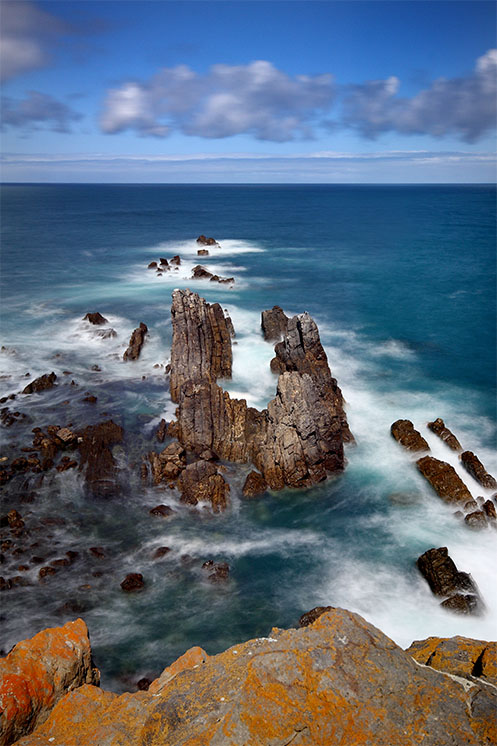
If you enjoy real excitement, and don’t mind a bit of exercise, it’s worthwhile to jump the fence at the lighthouse and walk/slide your way out to the pointed cliff.
Peering over the edge of the cliff you’re greeted by an amazing rockscape being pounded by the violent waves of Bass Strait. The scene is captivating but I wouldn’t recommend it if you have a real fear of heights.
Below “Vertigo – Over the Edge” available as a print here.
Below – a friend perched on the edge of the cliff enjoying the scenery and of course taking some shots.

Exploring the Mordialloc pier.
A series of long exposure images exploring the Modialloc pier and it’s surroundings.
Below – Pier Group Pressure available as a print here.

Below – The Mordi Run available as a print here.

Below – “Troll” available as a print here.

Below – “Markers Three” available as a print here.

Grantville – the pie and pier photography tour.
My excursions are never entirely about the photography. Often they’re about the escape, ….often they’re about self exploration, …….every now and then they might even result in a nice photographic image. Well, nice to me anyhow. 🙂
On previous visits to Grantville I’ve tended to concentrate on trying to capture an inspiring image or two from the mangroves dotted along the coast here. The mangroves are a fairly easy target for photography purposes. At high tide it’s possible to visually isolate them between the water and the sky which works to simplify the image by excluding potentially distracting background elements. On calm days the water can also act as a fantastic mirror for capturing reflections, particularly when doing long exposures.

This particular visit to Grantville was all about capturing the pier though, so here it is.
In the black and white image above I’ve deliberately over exposed the image to blow out the sky and increase the contrast between the pier and the background. I personally like the contrasty result here, but I know this style of image is not everyone’s cup of tea.
Pictured below – “The First Days of Sun” which is available to purchase as a print here.
This image from the pier was created from 3 exposures using HDR tone mapping techniques to maintain details in both the bright sky and the dark shadows.

Pictured below – “The Promise of Warm Days” which is available to purchase as a print here.
Another 3 exposure HDR shot converted to black and white and processed with a bit of dodging and burning in Photoshop.

Now for some serious business. I’ve discovered that the cafe on the corner of the Bass Hwy and Grantville Glen Alvie Road in Grantville sells excellent homemade meat pies made with flaky puff pastry. The coffee is pretty good there too.
(Disclaimer – I have no connection with this cafe at all, I just enjoyed the pie so much I felt the need to share it with you.)
Slowly submerging in Tooradin
The coastal village of Tooradin is located on the shores of Westernport Bay, Victoria, Australia.
Since I live fairly close to Tooradin I often pick up a hot pie and a cappuccino from the wonderful bakery here and drive down to the jetty area for a relaxing break.
Tooradin has two jetties right next to each other. One jetty is of a floating pontoon design which rides on the surface of the water, rising and falling as the tides change. The other jetty is the usual kind consisting of a raised platform fixed to sturdy wooden pillars.
An interesting thing about the fixed platform jetty is that the platform gradually disappears below the surface of the water as the tide rises. This provides the photographer with some interesting possibilities.
Below – the rising tide starts to envelope the platform.

Standing on this jetty makes one feel like a captain going down with his ship.
Below – “Channel” which is available to purchase as a print here.
The platform is just a few centimeters below the surface.

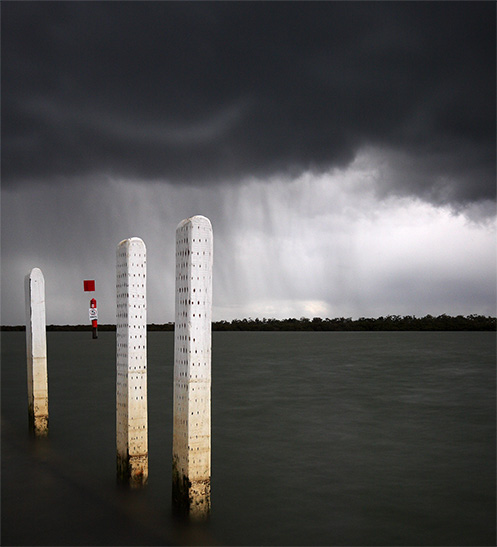
After taking a few long exposures at the jetty mother nature decided to give me a nudge. The thick black storm clouds opened up and sent down a barrage of hail to chase me back to the car.
Below – Run from the Hail
Abandoned, dilapidated, derelict, decayed and once loved.
Following is a collection of farmhouse images taken on a trip through western Victoria and South Australia.
Initially I intended to take a lot of seascape images on this trip but the rain and sheer cliffs along the Great Ocean Road often conspired against me.
As the journey progressed I found myself becoming more interested in the landscape including the many vacant derelict buildings scattered along the way.
Below – “Shambles” – A deserted farmhouse at Byaduk North, Victoria, Australia.
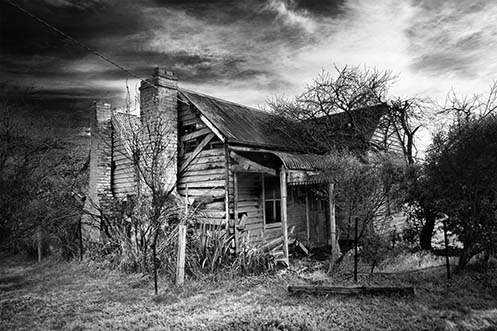
Below – “Out the Back” Byaduk North, Victoria, Australia.

Below – “The Love Shack” – Found along the road north of Port Fairy, Victoria, Australia.
There is also a colour version of the Love Shack here.
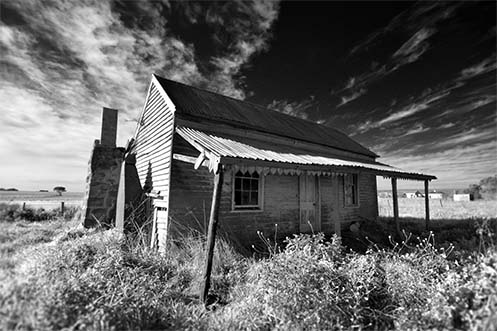
Below – “Spiders n’ Snakes” – an abandoned house along the roadside in Puralka, Victoria, Australia.

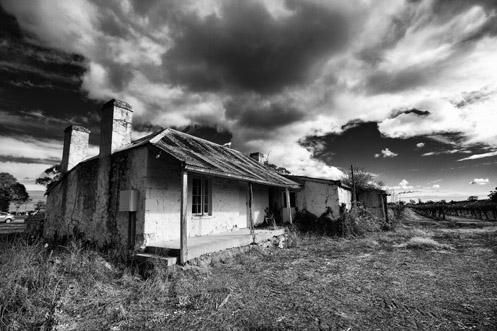
Below – “Cottage in the Vineyard” Padthaway Heritage Cottage (Front) near Bordertown, South Australia.

Below – “Backdoor to the Vineyard” Padthaway Heritage Cottage (Rear) overlooking the vineyard, near Bordertown, South Australia.
Daytime experiments with the ND400 filter.
The following long exposures were taken during daylight hours using an ND400 and ND8 filter stacked together on the front of my Sigma 10-20mm lens. The combination of these two filters attenuates so much light that peering into the viewfinder reveals an inky blackness even during bright daylight conditions.
It’s therefore necessary to compose the image BEFORE screwing the filters onto the lens. It’s also necessary to adjust the focus manually since the auto-focus system has no chance of working under such conditions.
*** (Update October 2012) The introduction of “live view” to many DSLR cameras means that is’s no longer necessary to compose and pre-focus with the dark filters off the lens. I shoot all the time now using live view to peer through the combined darkness of an ND400 and ND8. The filters now stay on the lens which means there is a lot less fiddling around. If you’re looking for a guide to show you how to use an ND400 have a look at my recent blog post here.***
I found that if I set the ISO as low as possible, and set the aperture very small (i.e. a high number), then it was possible to obtain a shutter duration of about 3 minutes. Such long exposures during daytime create some interesting images. I’m looking forward to experimenting more with the ND400.


A visit to Montsalvat, Australia’s oldest artist community.
Following are a collection of images captured at Montsalvat artist community, Victoria, Australia. I’ve finished many of the images in a faded sepia tone to suit the “old” feeling of buildings.
Title – Smoke and Mirrors.
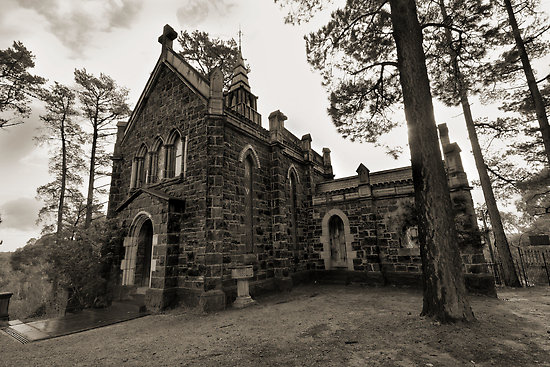
Title – The Flute Makers Call.
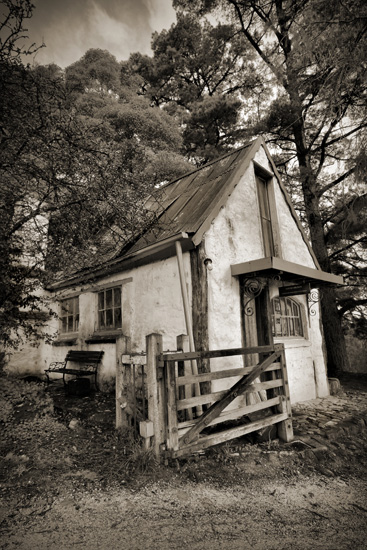
Title – The Fist of the Angels.

The Churl’s Paragon.
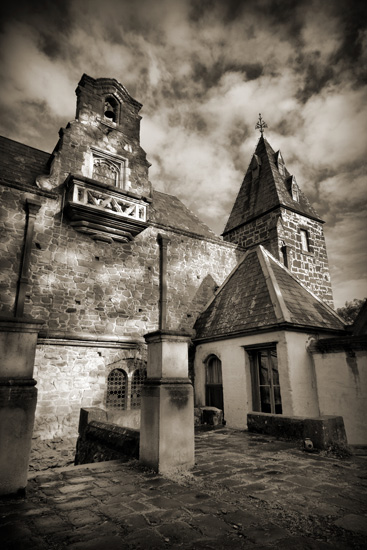
Title – Father’s Hold.
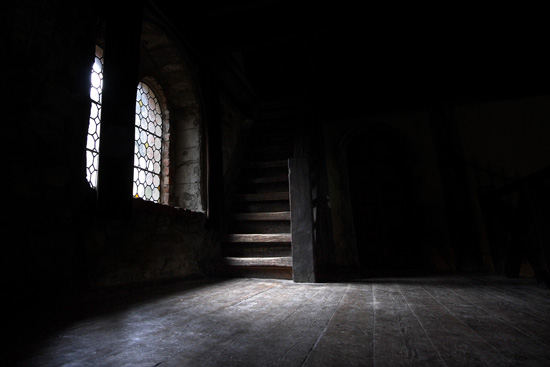
Title – Family Business.

Title – Release the Bats.
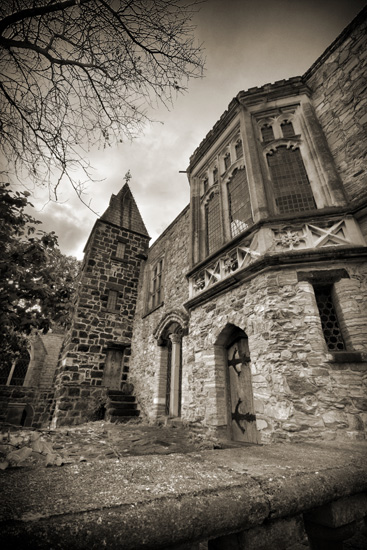
Title – The Fog of the Mind.

Title – Path to Shadowplay.

You can view these images in a larger format or purchase them as a print at –
Thunder and halos at Blairgowrie ocean beach.
The return to Blairgowrie beach was everything I could hope for. I timed the visit to coincide with the low tide late in the afternoon, and as a bonus a thunderstorm happened to roll in off the ocean with a vengeance.
As I stood exposed on the beach to take this photo I was reminded of what a precarious situation this was. There were occasional bursts of lightning coming from the low dark clouds striking the water. Unfortunately I wasn’t able to capture a lightning strike with the camera but the view of the clouds was magnificent.

As the main part of the storm passed over head the rain poured down heavily and I managed to shelter my camera gear and most of my body by huddling against a large rock. As the rain began to ease gaps appeared in the clouds allowing scattered sunlight through creating wonderful light shows including halos and misty streaks.


As always, these photos are available to purchase as prints at –
http://www.redbubble.com/people/pixelmuser/
You can contact me by email at jim.worrall@gmail.com
The optical jewels at Sorrento.
My recent visit to the ocean beach at Portsea sparked a craving for more of the same photographic material.
This time I visited the ocean beach further along the coastline at Sorrento. The first visit to the beach was a spur of the moment decision. When I arrived there the sun was hovering just above the horizon, I had no time to explore the beach and it was a high tide. I took a few shots of the sun fading into the horizon and a few long exposure shots of waves swirling around the rocks.
Here’s a couple of the high tide shots –
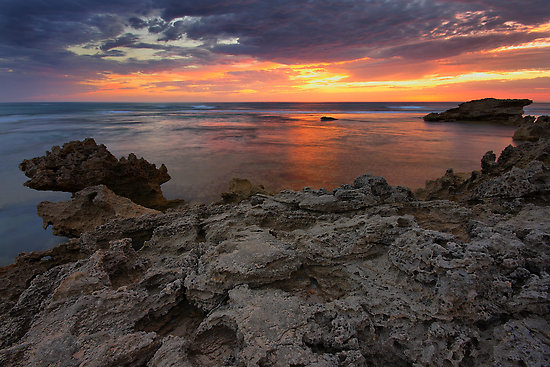
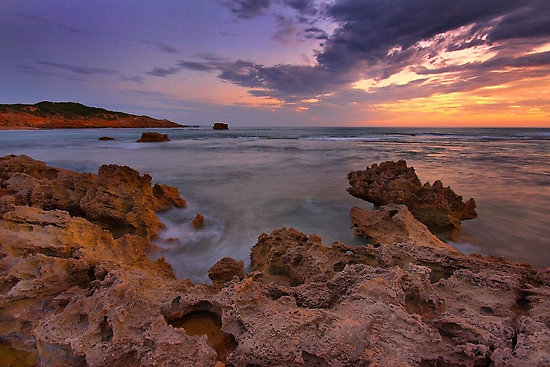
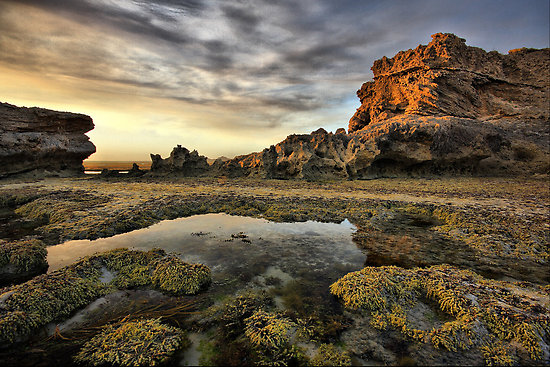
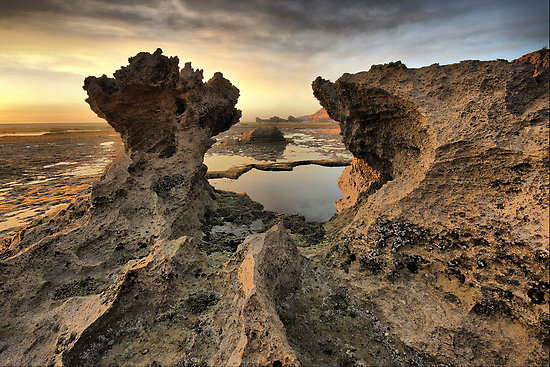
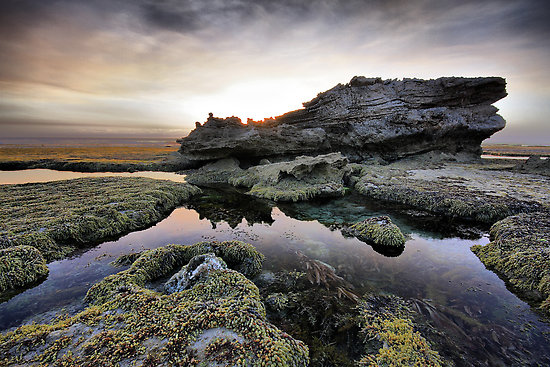
The next visit to Sorrento beach was a bit better planned and I actually remembered to check the tide charts before leaving. On arrival the rock pools were at their low tide best, the sun was high enough in the sky to give me time to explore some of the rocky features yet low enough to give the area a nice warm glow.
Here’s some of the shots from the low tide visit –



Shhhhhh, ….you can hear the forest breathing – Sherbrooke Forest
Sherbrooke forest is a protected area of bushland located in mountains on the outskirts of Melbourne. It’s an area of fairly thick bush with a series of meandering walking tracks for visitors to enjoy.

The best way to explore the forest tracks is ideally alone, …. and as quietly as possible. Many of the forest’s resident animals are nocturnal but there’s still lots to see and hear during the day if you just stay still and quiet for long enough. You can forget about seeing anything much at all if you travel the tracks in a chatty group because the animals will freeze and wait for the noise to pass.
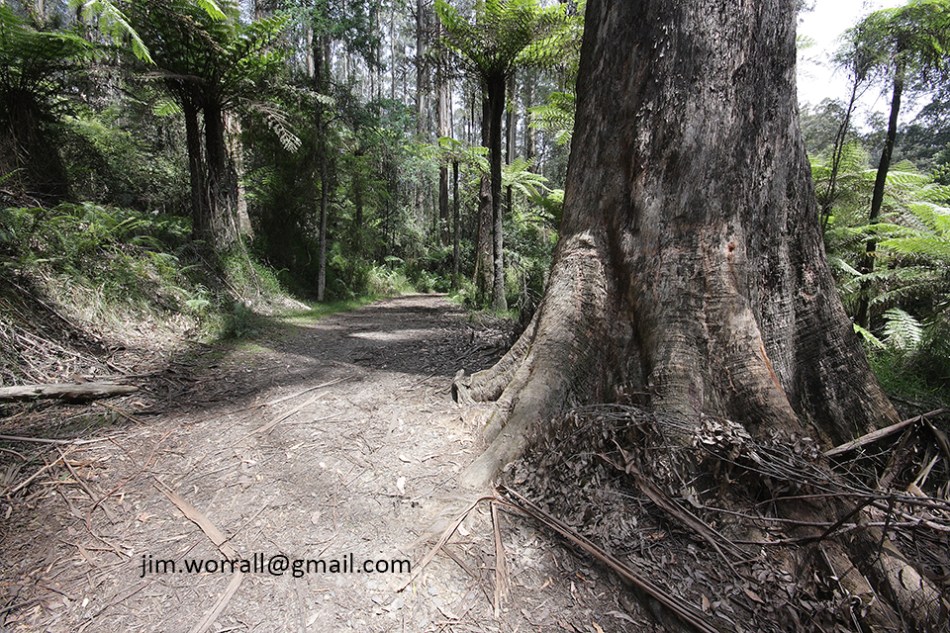
When I visited Sherbrooke forest it was a stinking hot day. . The pedestrian traffic along the track was fairly light, probably due to the heat, and this allowed me to stop several times along the track, undisturbed.
In this forest the animals are not tame but are somewhat conditioned to the presence of human visitors. If you stay still and silent for a couple of minutes, the animals seem to relax and carry on with their usual business. You start to hear the rustle of dried leaves as the animals move around on the forest floor and if you continue to stay quiet you can sometimes catch a glimpse of one of the wild residents.

On the day I visited Sherbrooke forest I was able to catch glimpses of wild kangaroos or wallabies and also a wandering echidna. I must admit though, that when I stepped off the track to photograph something of interest, I was very aware that this is also “snake country” and so I was careful to check where my feet were landing.


