
The Flinders Pier Excursion.
Images from a recent trip to Flinders with friends Christine Wilson and Caroline Gorka.
The objective for the afternoon was to capture some images of the old wooden pier before it’s replaced by the concrete monster that’s currently being constructed right next to it.
As usual I became distracted.
Below – “IiN” some ghostly remains from further along the beach.

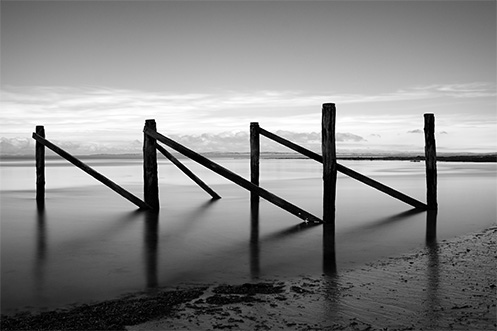
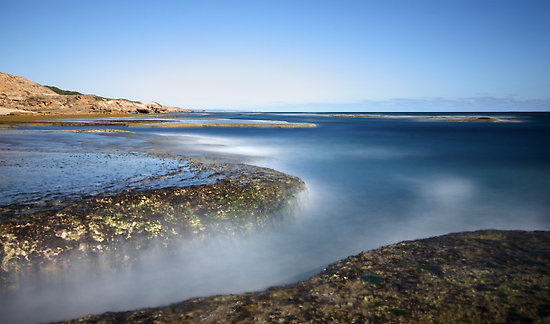
Below – “Flinders Point” just around the corner from the calm harbor area there’s a lot more ocean wave activity.
There were waves crashing all over the place here but the long exposure makes it look deceptively calm.
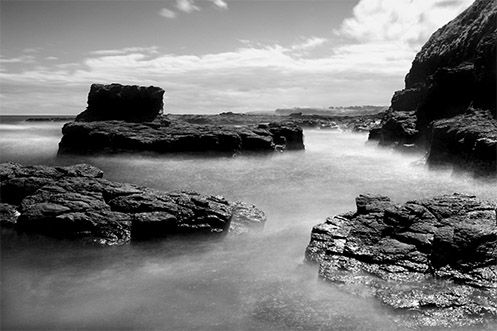
Below – “Flinders Back-Beach” near the blow hole area. Stop giggling, that’s what it’s called !!

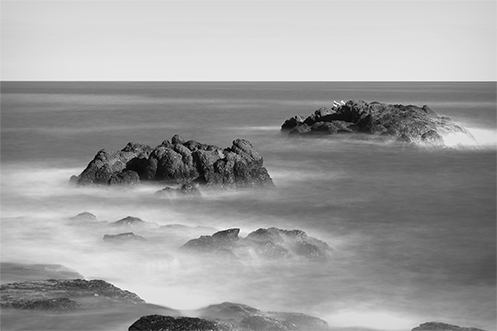
ND400 Long Exposures at Safety Beach (Bracketing and tonemapping long exposures)
Following is a series of bracketed and tone-mapped long exposure images from Safety Beach, Victoria, Australia.
All were shot in the late afternoon using ND400 and ND8 filters combined to achieve the desired long exposure times.
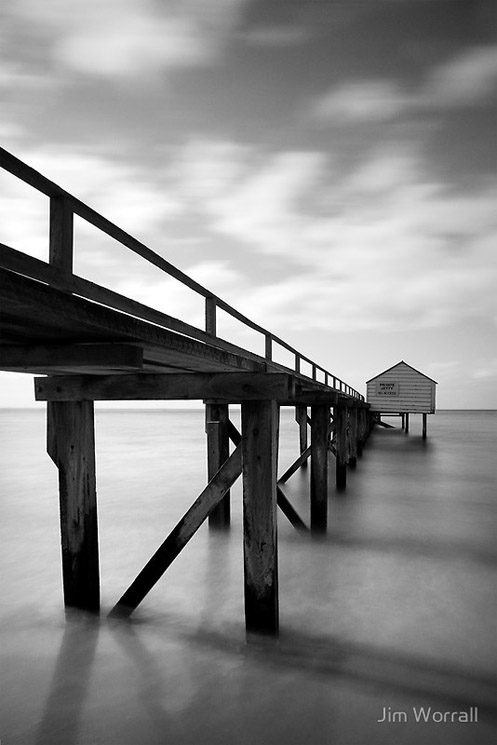
Below – “Safety Beach Jetty”

Here’s how I do my bracketed images – Many of my waterscapes are long exposure tonemapped images generated from 3 exposures at 0,-2 and +2 EV. In order to achieve these 3 exposures I set my camera to aperture priority mode, enable auto bracketing and set the ISO as low as it will go. I then tinker with the aperture value, iso value and either add or remove ND filters in order to force the camera to achieve a shutter speed of 8 seconds for the first exposure (0 EV). Now when the shutter button is activated the camera gives me 3 exposures at 8 seconds, 2 seconds and 30 seconds (which corresponds to approximately 0,-2 and +2 EV)
When these 3 exposures are blended together (tonemapped) in an HDR program the resulting image contains the misty silky effects from the 8 and 30 second exposures and also contains some details from the slower 2 second exposure. When shooting REALLY fast moving water I usually aim for a faster initial exposure time of say 4 seconds. The camera then gives me 3 bracketed exposures at 4 seconds, 1 second and 16 seconds (0,-2 and +2 EV)
The aim is to catch some detail in the fastest exposure but also benefit from the misty effect of the longer exposures.
UPDATE – Oct 2012 – If you’re looking for an introductory guide on how to use the ND400 have a look at my other blog post here.
Below – “Seep” a stormwater drain at Safety Beach.
Yes, a drain can look beautiful. 🙂
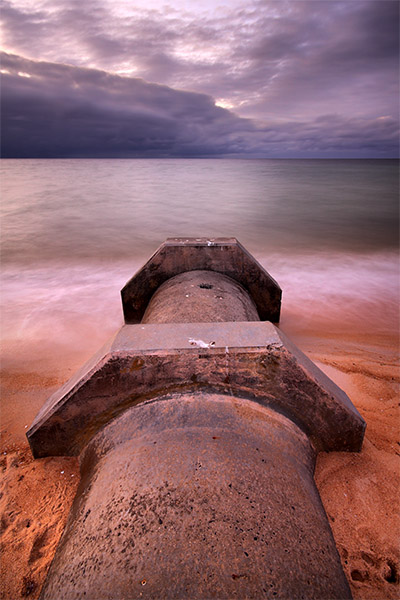
Below – “Jettison” another stormwater drain at Safety Beach.

A Photo Exploration of Grantville beach.
I visited Grantville the day after Victoria had been hammered by unusually high rainfall.
Apparently the extreme rainfall was a side effect of cyclone Yasi’s passage across Queensland and into central Australia.
With the worst of the rain over, the day provided some beautiful photographic conditions with the sun filtered through an interesting arrangement of constantly changing storm clouds.
I love the beach down this way. Each time I visit here I discover something new.
Before I discovered photography I would never have guessed that I would find storm water drains interesting. 🙂
Below – “Purge” a storm water drain running into Westernport Bay.

For those who are interested in the technical details, the drain images are constructed using HDR tone mapping techniques. The long exposures were achieved using a combination of ND400 and ND8 filters on the end of the lens to smooth the waves on the water.
Below – “Running from the Idols” – another drain dumping water into Westernport Bay.
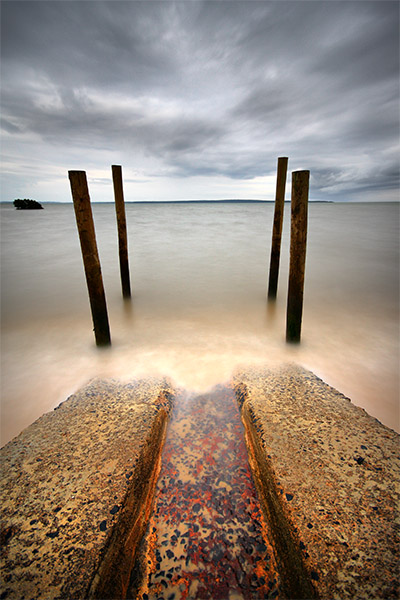
Below – A long exposure self portrait, standing at the end of the Grantville jetty.

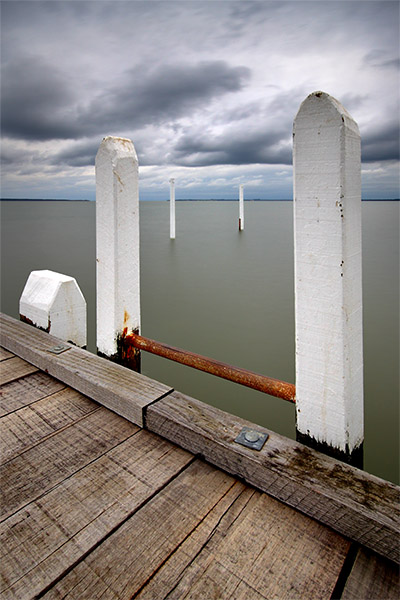
Below – “Grantville Jetty” – a view from the jetty looking out towards the boat ramp marker posts.
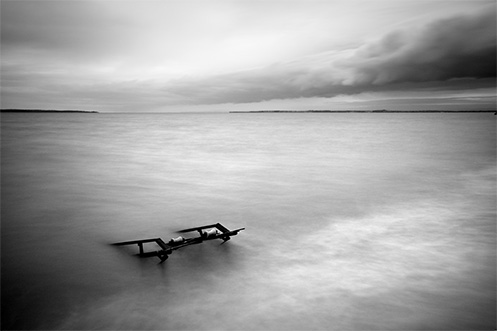
Below – “After the Rains” – a long exposure image from Grantville beach as rain clouds exit. An old boat trailer sits semi-submerged in the foreground.
Fluid in Motion – Flinders
One of my favorite spots for photogenic wave action along the Mornington Peninsula is Flinders.
West of the township the rugged coastline features extensive cliffs with access to the rocky beaches in only a few places.
The deliciously dark rocks here provide a wonderful contrast to the bright white surf as waves from Bass Strait relentlessly pound the beach.
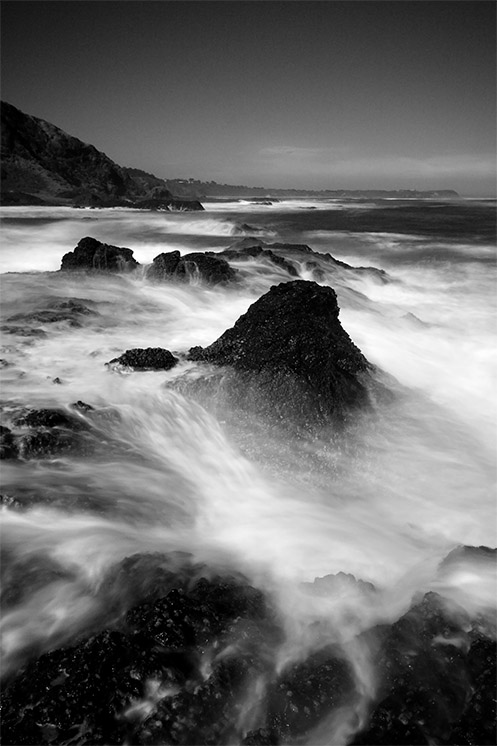
On this occasion I visited the beach during the early afternoon so conditions were extremely bright and contrasty.
I used an ND400 filter, sometimes in combination with an additional ND8 filter, to darken the scene and enable the use of slow shutter speeds to blur the moving water.

It’s always fun and games being close to the edge in places like this. Despite keeping one eye on the camera and the other eye on incoming waves I was caught by surprise on a couple of occasions during the afternoon and drenched by rogue waves exploding on the rocks.
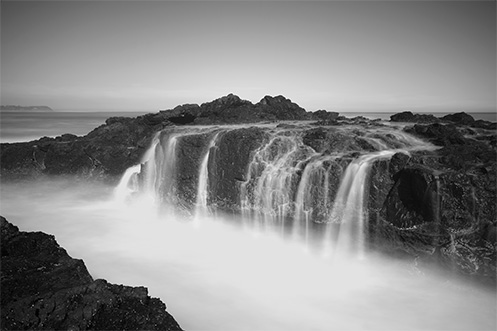
This is really quite an extraordinary spot from a photographer’s perspective. Not so special for the grand seascape but more for the myriad of recesses where the surf dynamically interacts with the rocks.

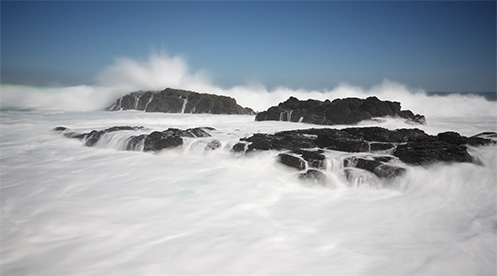
Construction at Powlett River
The construction of the controversial desalination plant near the mouth of the Powlett River has yielded a temporary point of interest for photographers.
A large platform has been placed offshore to assist with the construction of the required underwater pipeline.
Although not the most beautiful structure in the world, it acts as a nice point of interest for an otherwise potentially boring background.
I’m in no way a supporter of this project but I decided to take advantage of the platform while it’s there and took a series of images from the spot where the Powlett River meets the ocean.
The idea behind the images was to use the lines created by running water and rock edges to draw the viewer into the scene towards the platform in the background. The images were taken in bright mid afternoon light using strong ND filtering to enable the exposures to be long enough to blur the water.
Below – Platform One

Below – Platform Two

Below – Platform Three
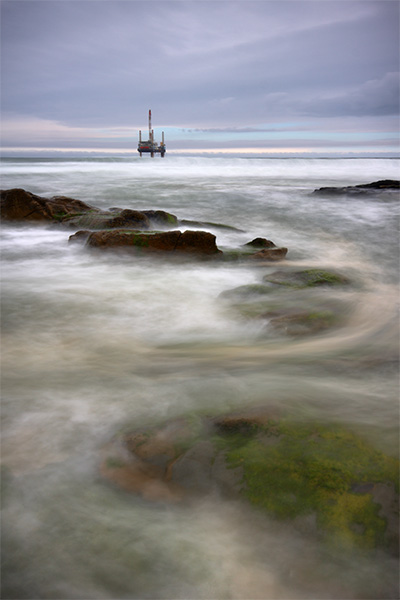
Below – Mouth of the Powlett – Looking north-west across the mouth to the sand dunes, the waves crashing onto the rocks in the foreground just appear as mist due to the long exposure time.
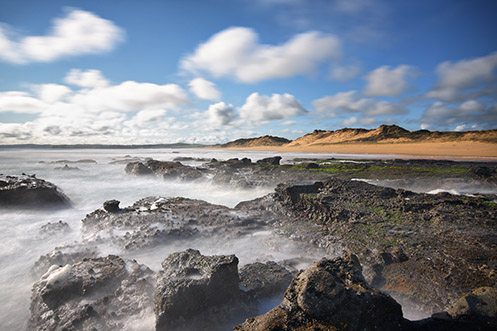
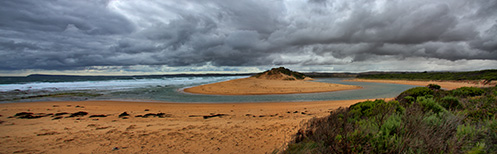
Below – a couple of experimental panoramic shots of the river and dunes.

The Jetties of Portsea and Sorrento
Portsea and Sorrento are coastal villages located at the tip of the Mornington Peninsula, south east of Melbourne. They both share a wild and woolly ocean beach to the south and the much calmer waters of Port Phillip Bay to the north. As a photography enthusiast I enjoy the contrast between the ocean and bay sides of the peninsula.
In winter and early spring you can stand on the ocean beach and not see another soul, a prospect I find very attractive. The only problem is that the wild and woolly conditions that keep the crowds away also make photography difficult. A photographer here has to contend with the difficulties of high winds and sea spray, not impossible I know but very annoying when combined with the low temperatures of winter.
For this reason I’ve found myself gravitating towards the calmer bayside beaches on my last couple of trips down that way.
Below – “34 Steps” which is available to purchase as a print here.

I’ve recently been trying to consciously simplify my images by attempting to exclude as many distracting elements as possible. Whilst shooting on the bayside beaches this has been fairly easy to achieve by using long exposures to reduce the detail in the water and sky. Another benefit of the long exposures is that birds and boats can move through the frame without even appearing in the finished exposure. I used a combination of an ND400 and an ND8 filter giving me about 12 stops of darkness to make the exposures up to 30 seconds long for these images.
Below – “The Danger of Diving”, Portsea beach, which is available to purchase as a print here.

Portsea and Sorrento bayside beaches feature a wonderful collection of public and private jetties.
Below – “Outbound”, Sorrento beach, which is available to purchase as a print here.
Despite being technically over exposed I like the drama this high key image presents.
I like the way the sea and the sky are almost one. A personal favorite.

Below – “Nature versus Nurture”, Portsea beach, which is available to purchase as a print here.

Below – “Boomerang”, Portsea beach, which is available to purchase as a print here.

Below – “Civilization meets the Sea”, Portsea beach, is available to purchase as a print here.

Below – “The Trappings of Wealth”, Sorrento beach, is available to purchase as a print here.
Incorporating HDR tonemapping techniques with long exposures
The following images were experiments using HDR tone mapping techniques combined with the effects of long exposure times.
Each image was constructed from at least 3 separate exposures using in-camera auto exposure bracketing. In my case, being a Canon shooter, I used 3 exposures of -2,0 and +2 simply for convenience. I believe Nikon shooters have a bit more flexibility in this area.
The images were all taken during daylight hours so it was necessary to use some heavy ND filtering in order to increase the exposure times and achieve a nice misty look to the water. In my case I used an ND400 and an ND8 filter stacked together to achieve this.
With the camera set to aperture priority mode I adjusted the aperture and filter combination (sometimes removing the ND8) to achieve an exposure of 8 seconds. When the shutter button is depressed the camera would then give me 3 exposures at 8 seconds, 2 seconds and 30 seconds (which is close enough to 0,-2 and +2). My particular camera doesn’t let me expose for longer than 30 seconds unless I go to bulb mode and use a remote timer, so out of laziness I tend to limit many of my exposures to 30 seconds. 🙂
The exposures were then combined and tonemapped using HDR software and tweaked in Photoshop to achieve the end result.
Despite all of this sounding a bit technical it’s really quite simple and I encourage you to try it. The results are often very rewarding.
BELOW – Jurassic Afternoon – Sunlight and waves break through a slit in the prehistoric Pinnacles rock formation on Phillip Island.

BELOW – The Mist of St.Pauls – A long exposure at St. Pauls beach, Sorrento, Victoria, Australia.

BELOW – Prehistoria – An image from The Pinnacles, at Phillip Island, Victoria, Australia.

BELOW – Swimming with Dinosaurs – Down amongst the prehistoric Pinnacles rock formations at Phillip Island, Victoria, Australia.

Daytime experiments with the ND400 filter.
The following long exposures were taken during daylight hours using an ND400 and ND8 filter stacked together on the front of my Sigma 10-20mm lens. The combination of these two filters attenuates so much light that peering into the viewfinder reveals an inky blackness even during bright daylight conditions.
It’s therefore necessary to compose the image BEFORE screwing the filters onto the lens. It’s also necessary to adjust the focus manually since the auto-focus system has no chance of working under such conditions.
*** (Update October 2012) The introduction of “live view” to many DSLR cameras means that is’s no longer necessary to compose and pre-focus with the dark filters off the lens. I shoot all the time now using live view to peer through the combined darkness of an ND400 and ND8. The filters now stay on the lens which means there is a lot less fiddling around. If you’re looking for a guide to show you how to use an ND400 have a look at my recent blog post here.***
I found that if I set the ISO as low as possible, and set the aperture very small (i.e. a high number), then it was possible to obtain a shutter duration of about 3 minutes. Such long exposures during daytime create some interesting images. I’m looking forward to experimenting more with the ND400.


Long exposures on the Mornington Peninsula
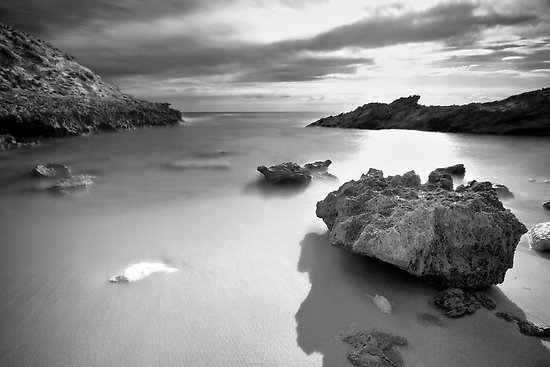
A series of long exposures taken at Sorrento and Blairgowrie beaches on the Mornington Peninsula, Australia.
These images were taken using the Sigma 10-20mm and Canon 17-85 mm lenses with ND8 and polarizing filters stacked on the front in order to slow the shutter speed.
Note – when stacking two filters on the 10-20mm lens the rim of the outermost filter becomes visible in the corners of the images necessitating a little cropping in post processing.
All of these images are available to purchase in various forms and sizes by clicking on their titles.
Blaze – taken at Sorrento beach.
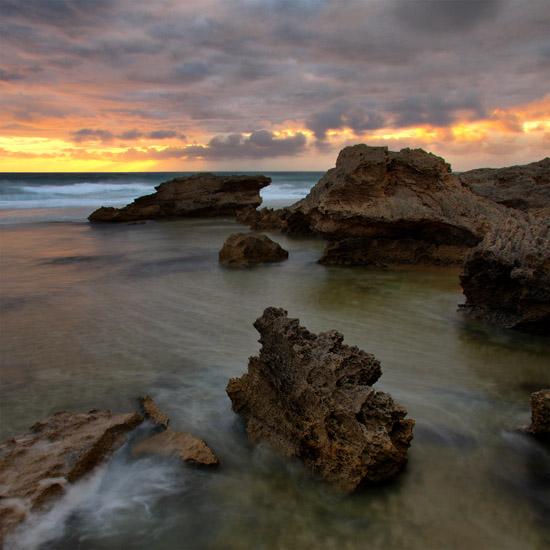
The Glow of Last Light – taken at Sorrento beach.

The Pastel Kiss of Night – taken at Blairgowrie beach.
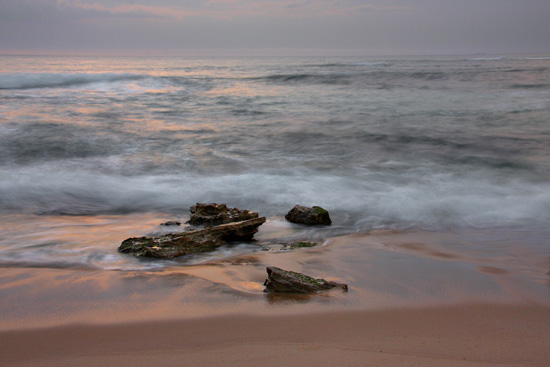
Welcome the Night – taken at Blairgowrie beach.

Koonya Isle – taken at Blairgowrie beach.

Through Angler’s Eyes – taken at Blairgowrie beach.

Glide – the salt spray effect
This sunset image taken at Blairgowrie beach, Australia, turned out to be much softer than I expected but I like the final result. The softness of the image is due to a build up of ocean salt spray on the lens filter.


 Photography by Jim Worrall